



S. Korea finance chief warns against market overreaction following U.S. midterm
Nov 06, 2026, 11:00 am


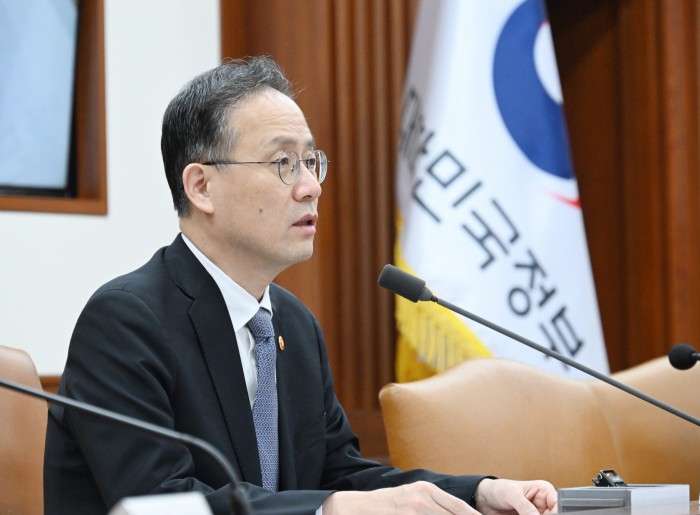 |
| Deputy Prime Minister and Minister of Finance and Economy Lee Hyoung-il delivers opening remarks at a meeting of economy-related ministers on external affairs at Government Complex Seoul on Nov. 6, 2026. /Courtesy of the Ministry of Finance and Economy |
Deputy Prime Minister and Minister of Finance and Economy Lee Hyoung-il said Friday that the government would take proactive measures to prevent South Korea's stock market from overreacting to concerns about tighter U.S. regulations on the artificial intelligence (AI) industry following the midterm elections.
"Relevant agencies will proactively devise necessary measures and implement them at the appropriate time to prevent our stock market from reacting excessively relative to the fundamentals of our economy," Lee said.
Lee made the remarks while chairing a meeting of economy-related ministers on external affairs at Government Complex Seoul, where officials discussed the economic implications of the U.S. midterm elections, possible policy responses and developments in international financial markets.
He described the Nov. 3 U.S. midterm elections as an important turning point that could reshape the global economic and trade environment.
"U.S. stocks fell sharply yesterday amid concerns about tighter regulations on the AI industry, and we cannot rule out the possibility of spillover effects on global stock markets," Lee said.
However, he emphasized that experts expected AI investment to continue and that South Korea's economic fundamentals were stronger than ever. He also pledged to closely monitor developments in global financial markets.
The government expects the United States to maintain its core policy priorities, including strengthening domestic industries and supply chains, even after the midterm elections. However, it plans to proactively assess how changes in the composition of Congress could affect the implementation of industrial and trade policies.
Specifically, the government will review potential changes in trade measures introduced by the U.S. administration, including tariffs and export controls, as well as industrial support policies requiring congressional legislation or budget approval. It will also analyze the potential impact of these changes on South Korean companies.
Lee noted that South Korea's recent strong export performance had been driven by expanding global AI investment and rising semiconductor demand, underscoring the need to closely monitor investment trends and policy changes in major economies.
The government plans to work closely with relevant ministries to ensure the stable implementation of existing South Korea-U.S. trade agreements. It will also strengthen communication with the U.S. administration, Congress and state governments to support favorable export and investment conditions for South Korean businesses.
In addition, the government intends to actively explore opportunities for economic cooperation in strategic industries, including shipbuilding and energy.
Lee Ji-hoon
Most Read
-
1
Ukraine halts strikes on Russian oil refineries un..

-
2
China's fifth plenum to conclude amid expectations..

-
3
ASEAN to discuss Myanmar's return next month

-
4
Southeast Asian auto parts makers hit hard by Chin..

-
5
U.S. links Myanmar peace efforts to rare earth acc..

-
6
Democrats flip U.S. Congress in historic midterm s..

-
7
USFK commander cites interoperability gaps, urges..

PEOPLE







-
Address : In-Young Bldg., 34, Uisadang-daero 1-gil, Yeongdeungpo-gu, Seoul
Copyright by ASIATODAY CO., LTD. All rights resereved