



U.S. Asia policy expected to hold despite Democratic sweep
Nov 06, 2026, 09:25 am


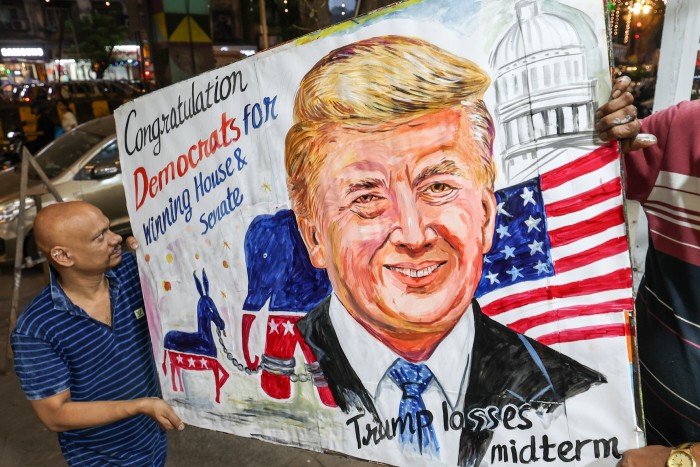 |
| An artist carries a portrait of U.S. President Donald Trump in Mumbai, India, on Nov. 4, 2026. /EPA-Yonhap |
Singaporean experts say the broad direction of U.S. policy toward Asia is unlikely to change fundamentally despite Democrats securing control of both chambers of Congress in the U.S. midterm elections. This is because the president retains considerable discretion over foreign affairs, national security and tariff policies. However, analysts also warn that tougher measures against China pushed by a Democratic-controlled Congress could complicate President Donald Trump's efforts to stabilize U.S.-China relations.
Democrats secured majorities in both the House of Representatives and the Senate in the Nov. 3 midterm elections, according to projections by major U.S. broadcasters, including NBC and CNN. However, experts believe that because midterm elections do not change the occupant of the White House, they are unlikely to fundamentally reverse the administration's foreign policy direction.
Chong Ja Ian, an associate professor of political science at the National University of Singapore (NUS), told Singaporean broadcaster Channel News Asia (CNA) that while the results appeared dramatic from a domestic U.S. perspective, they might moderate Washington's policies on trade, the use of force and diplomacy toward the Association of Southeast Asian Nations (ASEAN) without fundamentally changing them. He explained that congressional intervention would remain limited because Trump retains broad authority over foreign policy, military operations and tariffs, except in rare circumstances such as impeachment or issues commanding overwhelming congressional support.
Adrian Ang, a research fellow at the S. Rajaratnam School of International Studies (RSIS), also noted that the president has considerably greater freedom in foreign and defense policy than in domestic affairs. As an example, he pointed to the Iran war, which began in February, and congressional efforts to invoke the War Powers Act. Both chambers passed resolutions calling for the withdrawal of U.S. forces, but the White House sought to circumvent congressional restrictions in June by arguing that the legislation was unconstitutional and nonbinding. Ang said Democrats would struggle to constrain Trump without the two-thirds majorities in both chambers needed to override a presidential veto.
However, a tougher congressional stance toward China could become a significant factor in U.S.-China policy. Ang predicted that Congress could press for tighter trade and technology restrictions while renewing scrutiny of a delayed $14 billion (approximately 18.8 trillion won) arms sale to Taiwan. Trump has postponed a decision on the sale since his summit with Chinese President Xi Jinping in Beijing in May, calling it a "very good bargaining chip."
Ang warned that these developments, particularly the Taiwan arms sale, could put pressure on the new framework of constructive strategic stability between the United States and China, which the two leaders agreed would be based on respect, fairness and reciprocity.
He said the outcome would depend on how much pressure Congress could exert on the president and the extent to which Trump regarded the stabilization of bilateral relations as part of his political legacy.
Chinese policy researcher Li Yaqi said that although Democrats have limited power to fundamentally change Trump's China policy, they could raise the political cost of his dealings with Beijing through investigations, subpoenas of administration officials, influence over government spending and conditions attached to defense spending legislation.
By contrast, Drew Thompson, a senior fellow at RSIS, said Washington's approach to Taiwan was unlikely to change significantly because support for the island has remained consistently strong across both parties. He emphasized that while Congress controls appropriations, the executive branch takes the lead in foreign policy and diplomatic engagement.
On trade, analysts are divided between warnings that Trump, no longer facing the immediate pressure of midterm elections, could intensify tariff measures and expectations that Congress could exercise greater oversight.
Stephen Olson, a visiting senior fellow at the ISEAS–Yusof Ishak Institute, warned that tariffs targeting manufacturing overcapacity under Section 301 of the Trade Act could be introduced soon, along with new trade measures against major U.S. trading partners.
Such developments would be particularly bad news for the Indo-Pacific region, he said.
The Office of the United States Trade Representative (USTR) launched investigations into manufacturing overcapacity in 16 economies, including China, South Korea, Japan, Vietnam and Thailand, in March. As of early November, no final determinations or proposed tariffs had been announced.
However, Olson also suggested that Congress could demand broader tariff exemptions for products directly affecting American consumers and seek to reclaim some of the trade authority it had previously delegated to the executive branch.
Reuters columnist Clyde Russell wrote Wednesday that U.S. allies such as South Korea and Japan would hope congressional Democrats could soften the most damaging effects of Trump's trade policies.
He nevertheless expected efforts to build critical mineral supply chains outside China, including those involving rare earths, tungsten and lithium, to continue with bipartisan support.
Trump's upcoming diplomatic schedule in Asia is expected to provide an indication of his future approach toward China. The president is scheduled to attend the ASEAN summit in Manila, the Philippines, on Nov. 16, before meeting Xi on the sidelines of the Asia-Pacific Economic Cooperation (APEC) summit in Shenzhen, China. It would be their third face-to-face meeting this year, following summits in Beijing in May and Washington in September.
At a regular briefing Wednesday, Chinese Foreign Ministry spokesperson Mao Ning described the U.S. midterm elections as internal affairs and said Beijing would continue implementing agreements reached by the two leaders, managing differences appropriately and expanding cooperation.
Ang said the current stability in U.S.-China relations was the result of a stalemate and mutual vulnerabilities. The key question, he argued, is whether Trump is willing to adopt a tougher stance toward China despite knowing that Beijing could retaliate. The upcoming meetings could offer an early indication of his intentions.
Jeong Ri-na
Most Read
-
1
Ukraine halts strikes on Russian oil refineries un..

-
2
China's fifth plenum to conclude amid expectations..

-
3
ASEAN to discuss Myanmar's return next month

-
4
Southeast Asian auto parts makers hit hard by Chin..

-
5
U.S. links Myanmar peace efforts to rare earth acc..

-
6
Democrats flip U.S. Congress in historic midterm s..

-
7
USFK commander cites interoperability gaps, urges..

PEOPLE







-
Address : In-Young Bldg., 34, Uisadang-daero 1-gil, Yeongdeungpo-gu, Seoul
Copyright by ASIATODAY CO., LTD. All rights resereved