



[Market Power] Hanjin Group Chairman likely to roll over share-backed loans
Nov 05, 2026, 10:21 am


 |
 |
In response to Hoban Group's additional purchases of Hanjin KAL shares, Hanjin Group Chairman Cho Won-tae has announced plans to invest more than 37 billion won of his personal funds to acquire additional shares. However, with the settlement period for the share purchase overlapping with the maturity of his existing share-backed loans in December, Cho, who faces an urgent need to secure cash, is likely to opt to extend the maturity of those loans. Moreover, more than half of his shareholdings are already pledged as collateral for loans from financial institutions and tax payments, leaving him with limited capacity for additional borrowing.
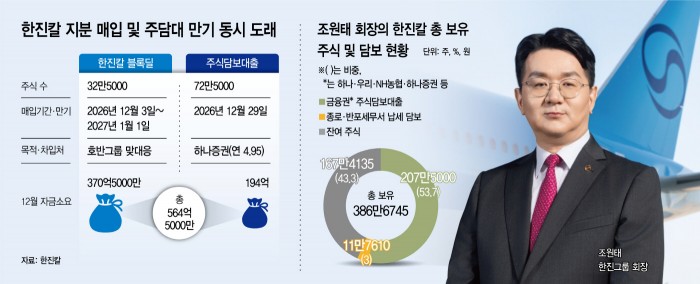
According to the Financial Supervisory Service's (FSS) electronic disclosure system on Wednesday, Cho disclosed on Nov. 2 that he planned to acquire 325,000 common shares of Hanjin KAL, representing a 0.48% stake, through an after-hours block trade. The planned acquisition price is 114,000 won per share, bringing the total settlement amount to 37.05 billion won. The transaction is scheduled to be settled between Dec. 3 and Jan. 1 next year.
Of particular note is the maturity schedule for Cho's existing debt, which is concentrated at the end of next month. According to a substantial shareholding report filed by Cho last month, all five of his share-backed loans from Hana Securities are scheduled to mature on Dec. 29. The loans have a combined principal of 19.4 billion won, an annual interest rate of 4.95% and a collateral maintenance ratio of 160%.
Cho currently has a total of 69.4 billion won in outstanding loans secured by 2.075 million shares pledged to financial institutions. While the maturities of 50 billion won in loans, comprising 40 billion won from banks (Hana Bank, Woori Bank and NH NongHyup Bank) and 10 billion won from Hana Securities, are spread between July and September next year, the remaining 19.4 billion won, or 28% of his total borrowings, is due at the end of this year.
Share-backed loans are typically extended upon maturity. Given that Cho must secure approximately 37 billion won to finance his share purchase, he is considered more likely to extend the maturity of the 19.4 billion won in loans rather than repay them. This is because repaying existing debt at a time when a substantial cash outlay is unavoidable would unnecessarily reduce his available liquidity. If Cho extends the loans at the current annual interest rate of 4.95%, his annual interest expense would amount to approximately 960 million won.
Considering the proportion of shares already pledged as collateral, Cho has limited room to raise additional liquidity using his holdings. He owns a total of 3,866,745 common shares of Hanjin KAL, representing a 5.79% stake. Of these, 2.075 million shares pledged as collateral for loans from financial institutions account for 53.7% of his total holdings. Another 117,610 shares, or 3.04%, have been pledged as tax collateral with the Jongno and Banpo tax offices to secure installment payments of inheritance tax following the death of his father, former Hanjin Group Chairman Cho Yang-ho.
Combining the shares pledged to financial institutions and tax authorities, a total of 2,192,610 shares, or 56.7% of Cho's Hanjin KAL holdings, are subject to collateral arrangements. Although 1,674,135 shares, or 43.30%, remain unencumbered, there are limits to using them to secure additional loans, given the 160% collateral maintenance ratio stipulated in his loan agreements with Hana Securities and the need to guard against forced share sales if the stock price fluctuates.
The low dividend yield relative to financing costs is also considered a burden on Cho's personal cash flow. His planned acquisition price in the block trade is 114,000 won per share, which translates into a dividend yield of 0.32% based on the most recent annual dividend of 360 won per share. If a similar dividend is declared next year, Cho would receive 117 million won in annual dividends from the 325,000 additional shares.
By contrast, if Cho finances the 37.05 billion won block trade at interest rates comparable to those on his existing share-backed loans, ranging from 4.44% to 4.95% annually, the resulting annual interest expense is estimated at approximately 1.645 billion to 1.834 billion won. Interest payments would be roughly 14 to 16 times his dividend income, creating a recurring net financing cash outflow associated with holding the shares.
Asked about Cho's plans to secure funding for the block trade and the repayment of share-backed loans maturing in December, a Korean Air official said, "We cannot confirm that information."
Park I-sak
#Hanjin Group #Share-backed loan
Copyright by Asiatoday
Most Read
-
1
U.S., Israel plan to resume strikes on Iran after..

-
2
Ukraine halts strikes on Russian oil refineries un..

-
3
China's fifth plenum to conclude amid expectations..

-
4
ASEAN to discuss Myanmar's return next month

-
5
Southeast Asian auto parts makers hit hard by Chin..

-
6
U.S.-China-Russia summit increasingly likely to be..

-
7
U.S. links Myanmar peace efforts to rare earth acc..

PEOPLE







-
Address : In-Young Bldg., 34, Uisadang-daero 1-gil, Yeongdeungpo-gu, Seoul
Copyright by ASIATODAY CO., LTD. All rights resereved