



Malaysia diversifies foreign student recruitment to cut reliance on China
Oct 30, 2026, 09:47 am


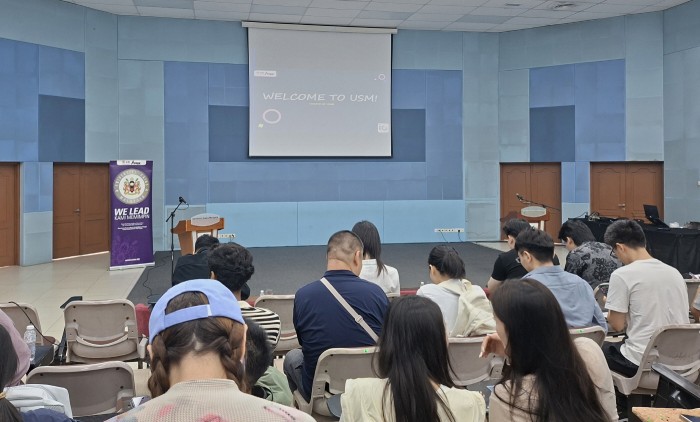 |
| International students attend an orientation event at a public university in Penang, Malaysia. The photo is unrelated to the article. / Photo by Hong Seong-a, Kuala Lumpur Correspondent |
Malaysia is diversifying its international student recruitment beyond its traditional reliance on China as it aims to attract 500,000 international students by 2035. The country is promoting its competitive education costs, English-language academic programs and multicultural environment while strengthening international education cooperation.
Local newspaper Malay Mail reported on Oct. 27 that 159,138 international students were enrolled in Malaysian higher education institutions as of last year. According to Education Malaysia Global Services (EMGS), China remains the largest source of international students, but its share of total international student applications declined from approximately 41% in 2023 to about 27% in the first four months of this year.
EMGS Chairman Ahmad Shalimin Ahmad Shaffie said the share of applications from East Asia as a whole, including China, had fallen below 37% last year. During the same period, applications from South Asia and Central Asia each increased 41%, while those from Southeast Asia rose 28%, Africa 20%, and the Middle East and North Africa 19%. The figures indicate that Malaysia is attracting more students from a wider range of regions as East Asia's share, including China's, declines.
The Malaysian government is expanding its student recruitment efforts beyond its established markets to countries and regions including Sri Lanka, Kenya, Türkiye and Central Asia. The diversification is also extending to cooperation with overseas educational institutions and the international expansion of Malaysian universities.
The Philippines' Commission on Higher Education (CHED) and Education Malaysia Global Services recently signed a letter of intent (LOI) on academic cooperation, agreeing to pursue initiatives including scholarships and student exchanges. Meanwhile, UCSI University established its Dhaka campus in Bangladesh's capital in 2023, becoming the country's first approved foreign university branch campus. The campus is regarded as a notable example of a Malaysian higher education institution expanding overseas.
Expanding student exchanges with Europe is another aspect of Malaysia's efforts to diversify international education cooperation. EMGS participated in an exhibition organized by the European Association for International Education (EAIE) in Glasgow, United Kingdom, to promote Malaysian education. The number of French students participating in Malaysia's short-term student mobility programs increased 13.5%, from 827 last year to 939 this year.
Ahmad Shalimin explained that these changes, alongside growth in overall international student applications, reflected increasing participation from countries other than China.
Gareth Liu Zi Yuan, a senior researcher in the Department of Southeast Asian Studies at Universiti Malaya, advised that the success of international education should be assessed not merely by the number of international students recruited but also from the perspective of long-term people-to-people connections that continue after graduation.
Hong Seong-a
Most Read
-
1
Putin proposes trilateral U.S.-China-Russia summit..

-
2
Attention centers on APEC for possible Trump-Xi-Pu..

-
3
U.S., Israel plan to resume strikes on Iran after..

-
4
Ukraine halts strikes on Russian oil refineries un..

-
5
China tightens grip on boosting domestic demand an..

-
6
China's fifth plenum to conclude amid expectations..

-
7
Amid health rumors, Chinese President Xi Jinping i..

PEOPLE







-
Address : In-Young Bldg., 34, Uisadang-daero 1-gil, Yeongdeungpo-gu, Seoul
Copyright by ASIATODAY CO., LTD. All rights resereved