



China's AI ambitions face hurdles amid translation errors, self-driving accidents
Oct 29, 2026, 03:21 pm


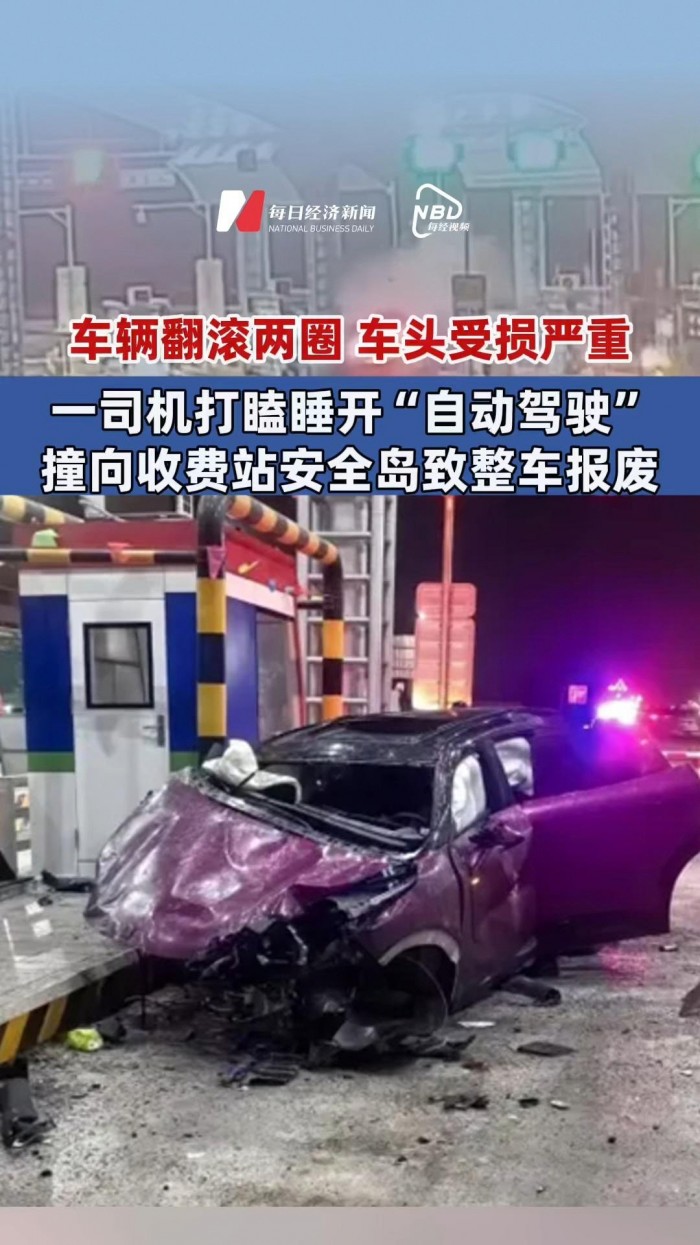 |
| The scene of an accident highlighting the dangers of riding in AI-powered self-driving cars, as recently reported in detail by Chinese newspaper National Business Daily. / National Business Daily |
China is mobilizing its national resources to pursue its ambition of overwhelmingly surpassing the United States in artificial intelligence (AI). However, analysts say the country still has a long way to go, given serious shortcomings such as translation errors. As these problems cannot be resolved immediately, Chinese authorities appear to be facing growing concerns.
According to Beijing-based sources familiar with global information and communications technology (ICT) developments on Oct. 29, China has reportedly surpassed the United States in certain areas of AI or is poised to do so soon, even if it has not overtaken the U.S. industry as a whole. Against this backdrop, it is perhaps unsurprising that the AI evaluation website World AI Ranking recently identified China as a future global leader capable of closely challenging the United States, currently the world's unrivaled AI powerhouse.
However, a series of startling incidents suggests that China still has considerable ground to cover. One example is the serious errors made by AI translation systems used across nearly every industry, particularly journalism and publishing. Some mistakes are far too absurd to dismiss as minor glitches.
A few examples illustrate the problem. Chinese-language media commonly refer to the fifth plenary session of the 20th Central Committee of the Communist Party of China (CPC), a four-day meeting that opened on Oct. 26, simply as the "Fifth Plenum." Translating the expression into English, Korean or Japanese is not necessarily straightforward. Indeed, many Chinese-language news websites reportedly mistranslated the term as "Beijing No. 5 Middle School."
Another equally baffling example involves Japanese Prime Minister Sanae Takaichi (高市早苗), whose name was mistranslated as Kaohsiung (高雄), a major city in southern Taiwan. The mistranslation reportedly remains on many Chinese-language media websites. Japanese readers might find it laughable, but the scale of the error is remarkable.
Frequent traffic accidents involving AI-powered autonomous vehicles are another concern. Multiple fatal accidents were reportedly recorded during the Mid-Autumn Festival holiday late last month and the National Day holiday period earlier this month.
ICT commentator Yang Yingchang (楊英昌) expressed strong reservations about the technology.
"I live in close contact with the AI industry, but I do not fully trust its capabilities," Yang said. "I will never ride in a self-driving car. Even if the day comes when I have to, I will trust my own abilities."
His remarks reflect broader concerns about the reliability of autonomous driving technology.
Security weaknesses across China's AI industry also cannot be overlooked. Examples include the AI tool "ARTEX," reportedly used in recent cyberattacks against South Korean banks, and potentially dangerous AI agents capable of performing actions that users never instructed them to carry out.
Taken together, these problems suggest that China's AI industry still has a considerable way to go before it can achieve its ambitions.
Hong Soon-do
Most Read
-
1
Putin proposes trilateral U.S.-China-Russia summit..

-
2
U.S. weighs dropping MOAB, world's most powerful n..

-
3
Attention centers on APEC for possible Trump-Xi-Pu..

-
4
U.S., Israel plan to resume strikes on Iran after..

-
5
China tightens grip on boosting domestic demand an..

-
6
Amid health rumors, Chinese President Xi Jinping i..

-
7
ASEAN to discuss Myanmar's return next month

PEOPLE







-
Address : In-Young Bldg., 34, Uisadang-daero 1-gil, Yeongdeungpo-gu, Seoul
Copyright by ASIATODAY CO., LTD. All rights resereved