



S. Korea's upward income mobility hits record low of 16.9%
Oct 29, 2026, 01:42 pm


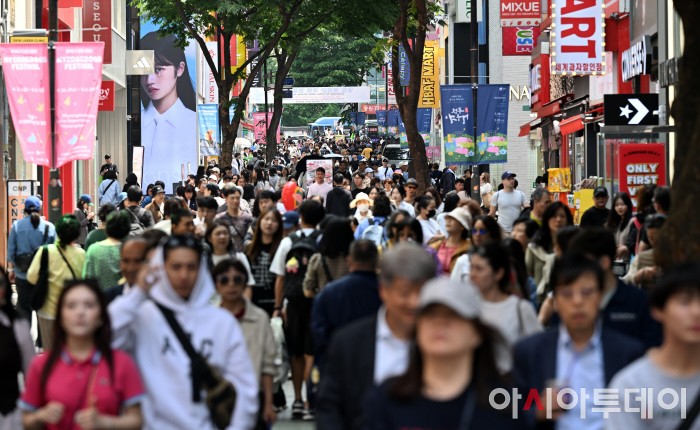 |
| A street in Myeong-dong, Seoul. / Photo by Song Ui-ju |
The proportion of people moving up the income ladder has fallen to its lowest level since records began, highlighting growing barriers to upward mobility. Fewer young people are moving into higher income brackets, while the share of people escaping the bottom 20% of the income distribution has also declined.
According to income mobility statistics released by the Ministry of Data and Statistics on Oct. 29, 16.9% of people moved into a higher income quintile in 2024 compared with the previous year, down 0.5 percentage points. This was the lowest level since data collection began in 2017. The proportion moving into a lower income quintile also fell to a record low of 16.1%, down 0.7 percentage points.
Overall income mobility, combining upward and downward movements, stood at 33.0%, down 1.2 percentage points from the previous year. It marked the fourth consecutive annual decline since 2021, with 67.0% of those surveyed remaining in the same income quintile as the previous year.
By age group, upward income mobility slowed among younger people. The proportion of people aged 15 to 39 moving into a higher income quintile fell 0.6 percentage points to 22.4%. The rate for middle-aged adults aged 40 to 64 also declined to 14.5%. In contrast, the rate for those aged 65 and older rose 0.1 percentage points to 10.0%.
The ministry attributed the slowdown in income mobility among younger people partly to weak youth employment and a sluggish recovery following the COVID-19 pandemic. For older people, it said increased earned income from senior employment programs and other initiatives contributed to improved upward mobility.
The proportion of people moving out of the lowest income bracket also declined. Among those in the bottom income quintile in 2023, 29.3% moved into the second through fifth quintiles in 2024, down 0.6 percentage points from the previous year. The remaining 70.7% stayed in the bottom 20%.
Among younger people, the rate of moving out of the lowest income quintile fell from 38.4% to 37.7%, while the rate for middle-aged adults declined from 31.9% to 31.4%. In contrast, the rate for older people increased from 11.5% to 12.2%.
The statistics analyzed changes across five income quintiles among 28.5 million South Korean nationals aged 15 and older who had employment or business income in both 2023 and 2024. The first quintile represents the bottom 20% of income earners, while the fifth represents the top 20%.
Lee Ji-hoon
Most Read
-
1
Putin proposes trilateral U.S.-China-Russia summit..

-
2
U.S. weighs dropping MOAB, world's most powerful n..

-
3
Attention centers on APEC for possible Trump-Xi-Pu..

-
4
U.S., Israel plan to resume strikes on Iran after..

-
5
China tightens grip on boosting domestic demand an..

-
6
Amid health rumors, Chinese President Xi Jinping i..

-
7
ASEAN to discuss Myanmar's return next month

PEOPLE







-
Address : In-Young Bldg., 34, Uisadang-daero 1-gil, Yeongdeungpo-gu, Seoul
Copyright by ASIATODAY CO., LTD. All rights resereved