



Spain high-speed train collision kills at least 68, injures two Koreans
Oct 29, 2026, 10:41 am


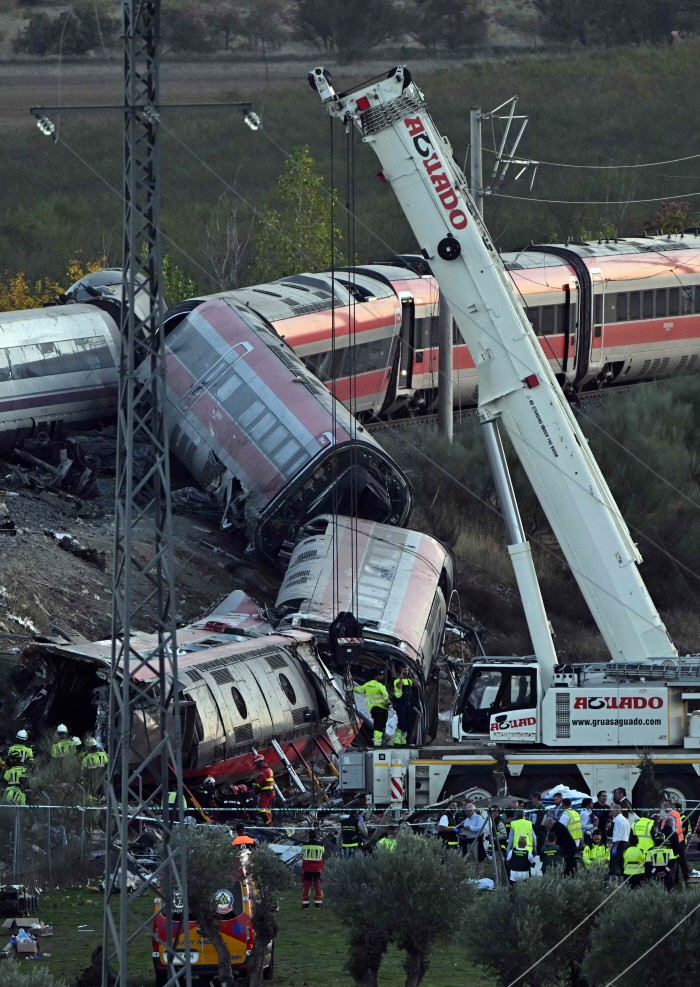 |
| A crane is deployed for recovery operations at the site of a collision between a Renfe AVE train and an Iryo train between Urda and Los Yébenes in Toledo Province, about 150 kilometers south of Madrid, on Oct. 28 (local time). Authorities said 68 people had died in the accident and warned that the death toll could rise further. / AFP-Yonhap |
At least 68 people were killed and more than 100 injured in a collision between two high-speed trains in Toledo Province, central Spain, AFP, AP and Reuters reported on Oct. 28 (local time).
The regional government of Castilla-La Mancha said 58 injured passengers had been taken to hospitals, including 15 in critical condition.
The South Korean Embassy in Spain said 10 Korean nationals were aboard the trains involved in the accident and two were injured.
Rescue helicopters and military personnel have been deployed to the scene for search and rescue operations, while services on the affected high-speed rail line connecting Madrid and Andalusia have been completely suspended.
According to Spain's railway infrastructure manager ADIF, a high-speed train operated by state-owned railway company Renfe, traveling from Madrid toward Seville that morning, struck the rear of an Iryo high-speed train operated by a private company that had stopped on the tracks. The collision derailed the rear two carriages of the Iryo train and the front section of the Renfe train.
At the time of the accident, the Renfe train was carrying 397 passengers, while 147 passengers were aboard the Iryo train.
According to Spanish Transport Minister Óscar Puente, a computer system failure at 8:30 a.m. disabled the safety system along a 63-kilometer section of track, bringing all trains in the area to a halt. However, the central traffic control center instructed the Renfe train to resume service without any speed restrictions. At 8:53 a.m., the train collided with the Iryo train that had previously stopped on the tracks.
Puente said an "incomprehensible" instruction from the central traffic control center had caused the disaster. He stressed that the train drivers were not at fault, adding that the precise speed of the trains at the time of the collision and the circumstances surrounding the accident would be established through a detailed investigation.
Spanish Prime Minister Pedro Sánchez visited the accident site, pledged safety inspections and a thorough investigation into the cause, and declared three days of national mourning.
King Felipe VI of Spain also visited the scene. In a statement, the Spanish royal family said, "We share the grief of the victims' families and those who have lost loved ones, and extend our heartfelt condolences to the injured and everyone affected."
Spain has invested heavily in a high-speed rail network capable of speeds exceeding 250 kilometers per hour over the past several decades, establishing itself as one of the world's leading railway nations. Its high-speed rail network, developed over more than 30 years, extends approximately 3,900 kilometers, making it the world's second-largest after China's 45,000-kilometer network, according to figures from the International Union of Railways cited by AP.
Spain opened its rail network to private operators relatively recently, ending the monopoly of state-owned Renfe. Iryo, backed by Italian capital, began operations in 2022.
However, concerns have emerged that the sharp increase in train services following the opening of the rail market to competition is placing structural pressure on railway infrastructure. In an interview with state broadcaster TVE on Wednesday, Joan Rodríguez, a spokesperson for a Spanish railway union, questioned whether track maintenance had kept pace with the opening of high-speed passenger rail services to private operators.
"We cannot conclude that this was the direct cause of the accident, but the sharp increase in track usage is an issue that must be examined," he said.
Spain also suffered a high-speed train derailment and collision in January that killed 46 people. The latest accident has reignited debate over railway privatization and investment in infrastructure maintenance.
Lee Jeong-eun
Most Read
-
1
Putin proposes trilateral U.S.-China-Russia summit..

-
2
U.S. weighs dropping MOAB, world's most powerful n..

-
3
Attention centers on APEC for possible Trump-Xi-Pu..

-
4
U.S., Israel plan to resume strikes on Iran after..

-
5
China tightens grip on boosting domestic demand an..

-
6
Amid health rumors, Chinese President Xi Jinping i..

-
7
ASEAN to discuss Myanmar's return next month

PEOPLE






-
Address : In-Young Bldg., 34, Uisadang-daero 1-gil, Yeongdeungpo-gu, Seoul
Copyright by ASIATODAY CO., LTD. All rights resereved