



S. Korea to mandate retirement pension funding for all workplaces by 2030
Oct 29, 2026, 10:37 am


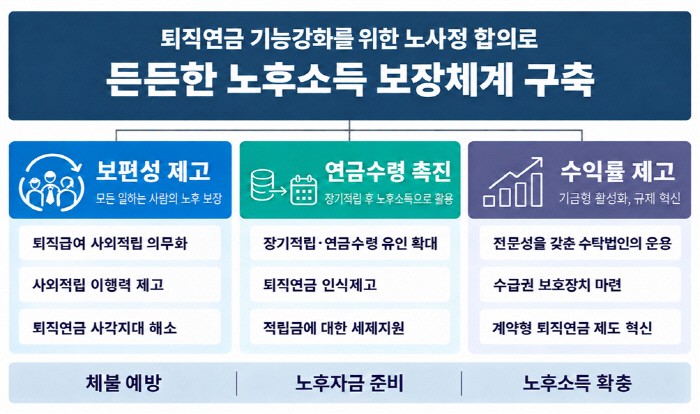 |
| Key measures under the plan to strengthen the retirement pension system. / Courtesy of the Ministry of Employment and Labor |
South Korea will begin gradually requiring companies to set aside retirement benefits in external funds starting in 2028, depending on workplace size. The requirement will expand to workplaces with fewer than 10 employees by 2030, reducing the risk of workers being denied retirement benefits due to financial difficulties or business closures. The government will also expand fund-based retirement pension plans, under which professionals pool and manage retirement savings from multiple participants.
The Ministry of Employment and Labor announced the plan to strengthen the retirement pension system on Oct. 29, jointly with other relevant ministries, following consultations between the government and the ruling party through the National Assembly's Climate, Energy, Environment and Labor Committee. The plan outlines specific measures to implement mandatory external funding and expand fund-based pension plans, as agreed in a joint declaration by labor, management and the government in February.
Phased mandatory funding from 2028, with support for small businesses
External funding of retirement benefits will become mandatory in three stages: workplaces with 100 or more employees from January 2028, those with 10 to 99 employees from January 2029, and those with fewer than 10 employees from January 2030. The timetable assumes that amendments to the Employee Retirement Benefit Security Act will pass this year, allowing a one-year preparation period before implementation. The external funding requirement will apply only to periods of continuous employment beginning after the mandate takes effect at each workplace. Employers will remain responsible for paying retirement benefits accrued during earlier periods of service but will not be required to fund those obligations externally retroactively.
Under the retirement pension system, employers deposit funds for retirement benefits with external financial institutions or other providers. Total retirement pension assets exceeded 500 trillion won at the end of last year, reaching 501.4 trillion won, but the employee participation rate has remained stagnant at around 53% in recent years. In particular, the adoption rate among workplaces with fewer than 30 employees stands at just 23.2%, leaving workers at smaller businesses more vulnerable to unpaid retirement benefits. Last year, unpaid retirement benefits totaled 822.9 billion won, accounting for 41.1% of all unpaid wages and benefits.
The government plans to automatically enroll workplaces that fail to introduce retirement pension plans after the mandate takes effect in the Blue Seed retirement pension fund for small and medium-sized enterprises, operated by the Korea Workers' Compensation and Welfare Service. Employers will be notified of their enrollment and contribution obligations, but labor and management will be allowed to withdraw and transfer to another retirement pension plan within a designated period if they choose one.
"If a workplace has not introduced a retirement pension plan by the time the requirement takes effect, the Korea Workers' Compensation and Welfare Service's Blue Seed fund will send a contribution payment statement," a ministry official explained. "If the workplace still fails to introduce a retirement pension plan, penalties such as administrative fines will follow."
Support measures will also be introduced to ease the financial burden on small businesses. If SMEs with fewer than 30 employees adopt retirement pension plans before the mandate takes effect, the government will cover 10% of employer contributions for workers earning less than 130% of the minimum wage. For SMEs with fewer than 50 employees, the government will subsidize 2 percentage points of the interest rate on business loans taken out at least one month after adopting a retirement pension plan. The government's budget proposal for next year newly allocates 6 billion won and 6.2 billion won, respectively, to the two programs.
The government will also address cases in which employers enroll in pension plans but fail to make the required contributions. It will expand regular inspections of workplaces with insufficient reserves under defined benefit (DB) plans. For defined contribution (DC) plans, employers will be required to provide wage information to establish a system for identifying unpaid contributions.
Expansion of professionally managed pension funds
The government will also expand fund-based retirement pension plans, under which investment professionals manage retirement savings. Unlike conventional contract-based DC plans and individual retirement pension (IRP) accounts, where participants select investment products themselves, fund-based plans allow participants to choose a trustee institution that pools and manages their retirement savings with those of other participants. Investment gains and losses are borne by the participants.
Fund-based plans will be divided into three categories according to their operators: financial institution-operated open funds, jointly established funds and public institution-operated open funds. The system will apply to DC plans and IRP accounts, while DB plans, which provide predetermined retirement benefits, will be excluded. Workplaces will be permitted to operate both conventional contract-based and fund-based plans or establish multiple funds. Eligibility for the Blue Seed fund will expand to workplaces with up to 100 employees in January next year and those with up to 300 employees in January 2028.
Trustee institutions will be required to prioritize participants' interests and will be liable for damages resulting from breaches of their obligations. In major areas, including investment management, conflict-of-interest management and disclosure obligations, trustees will be exempt from liability only if they can demonstrate that there was no causal relationship between a breach and the resulting losses, or that they were not at fault through intent or negligence. Additional safeguards will include requiring trustees to maintain an operational risk reserve equivalent to approximately 0.25% of pension assets. The method and scope of the National Pension Service's participation remain disputed and will be discussed further in the National Assembly.
IRP investment limits to be eased
The government will also revise investment regulations governing existing contract-based retirement pension plans. The current 70% limit on investments in risky assets through IRP accounts will be gradually eased, although the extent of the increase will be determined based on market conditions and participant demand. Investment management accounts (IMAs) and commercial paper issued by financial institutions will also be added to the range of eligible investments for DC plans and IRP accounts. Notifications concerning the application of default investment options will be moved forward from four weeks after a product matures to two weeks before maturity, reducing the period during which funds remain idle at low interest rates.
The government also plans to strengthen incentives for retirees to receive their savings as regular pension payments so that accumulated funds can provide income in retirement. It is considering a system under which benefits would be paid as a pension unless participants explicitly request a lump sum, and plans to require advance disclosure of comparative information on expected returns and payment amounts for pensions and lump sums. It will also support the introduction of pension-backed loan products to meet needs for large sums of money, including housing and medical expenses. However, participants will retain the option of receiving a lump sum, and existing rules on early withdrawals and early termination will remain unchanged.
"We have established an institutional foundation to reliably protect workers' retirement by balancing the stability and profitability of retirement income," Employment and Labor Minister Kim Young-hoon said. "We will make every effort to secure passage of the revised legislation at the National Assembly's plenary session in December and establish comprehensive on-site support systems in line with the mandatory implementation schedule."
Kim Nam-hyung
Most Read
-
1
Putin proposes trilateral U.S.-China-Russia summit..

-
2
U.S. weighs dropping MOAB, world's most powerful n..

-
3
Attention centers on APEC for possible Trump-Xi-Pu..

-
4
U.S., Israel plan to resume strikes on Iran after..

-
5
China tightens grip on boosting domestic demand an..

-
6
Amid health rumors, Chinese President Xi Jinping i..

-
7
ASEAN to discuss Myanmar's return next month

PEOPLE







-
Address : In-Young Bldg., 34, Uisadang-daero 1-gil, Yeongdeungpo-gu, Seoul
Copyright by ASIATODAY CO., LTD. All rights resereved