



Lee, Merz discuss chip, AI, defense cooperation at summit
Oct 29, 2026, 10:31 am


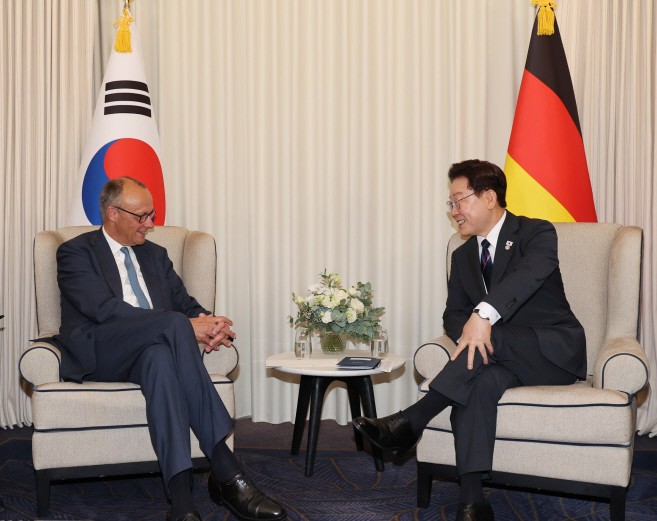 |
| South Korean President Lee Jae Myung and German Chancellor Friedrich Merz greet each other ahead of bilateral talks at the Group of Seven (G7) summit venue in Évian-les-Bains, France, on Aug. 16 (local time). / Yonhap News Agency |
President Lee Jae Myung will hold a summit with German Chancellor Friedrich Merz on Oct. 29 to explore concrete ways to strengthen cooperation in advanced industrial supply chains, economic security, defense and the defense industry. Attention is focused on whether South Korea and Germany, Korea's largest trading partner in Europe, will expand cooperation in future industries such as semiconductors, artificial intelligence (AI) and batteries, while exploring new models of defense cooperation, including joint development and production, beyond competition.
According to Cheong Wa Dae on Oct. 28, Merz will make an official visit to South Korea from Oct. 29 to 30. It will be the first official bilateral visit by a German chancellor in three years and Merz's first since taking office.
The meeting will mark the third summit between the two leaders, following their talks on the sidelines of the Group of 20 (G20) summit last November and the G7 summit this June. Having identified opportunities for cooperation in economic, industrial and defense sectors during their previous meetings, the two leaders are expected to focus on turning those opportunities into more concrete initiatives.
In the economic sector, cooperation on advanced industrial supply chains and economic security, particularly in semiconductors, AI and batteries, is expected to top the agenda. The leaders are also scheduled to discuss ways to expand trade and investment and strengthen cooperation between companies in the two countries.
Germany is South Korea's largest trading partner in Europe. Approximately 850 Korean companies operate in Germany, with major firms maintaining their European headquarters there, reflecting the close industrial ties between the two countries.
Amid the restructuring of global supply chains and the growing importance of economic security, attention is also focused on how far the two manufacturing powerhouses can expand cooperation in advanced industries.
The two leaders are also expected to discuss ways to advance cooperation in defense and the defense industry.
During his meeting with Merz in June, Lee proposed exploring various models of defense cooperation beyond competition, including joint research and development, production and joint entry into third-country markets. Merz also expressed support for expanding defense cooperation with partners, including South Korea.
In particular, attention is focused on whether the two countries, which competed in Canada's submarine procurement program, can identify new areas of cooperation through the summit.
The Canadian Patrol Submarine Project (CPSP) aims to acquire up to 12 submarines to replace four aging vessels. The project is estimated to be worth up to 60 trillion won, including construction, maintenance and repair costs.
In July, the Canadian government selected Germany's thyssenkrupp Marine Systems (TKMS) as its preferred bidder and South Korea's Hanwha Ocean as a backup supplier.
Although the two countries have competed for individual defense contracts, opportunities remain for joint research and development, production and entry into third-country markets in the global defense industry. The summit is therefore drawing attention to what direction the two sides may propose for future cooperation.
The leaders are also expected to exchange views on defense and security, expanding people-to-people exchanges, regional developments and major international issues.
Merz is visiting South Korea to attend the 19th Asia-Pacific Conference of German Business (APK 2026) in Seoul. The conference is a major public-private economic event organized by the German business community to promote economic cooperation between Germany and the Asia-Pacific region.
Following the summit, Lee and Merz are scheduled to hold a joint press conference and attend an official dinner. Around 60 guests, including members of the German business delegation and executives from major Korean companies, are expected to attend the dinner.
Park Young-hoon
Most Read
-
1
Putin proposes trilateral U.S.-China-Russia summit..

-
2
U.S. weighs dropping MOAB, world's most powerful n..

-
3
Attention centers on APEC for possible Trump-Xi-Pu..

-
4
U.S., Israel plan to resume strikes on Iran after..

-
5
China tightens grip on boosting domestic demand an..

-
6
Amid health rumors, Chinese President Xi Jinping i..

-
7
ASEAN to discuss Myanmar's return next month

PEOPLE






-
Address : In-Young Bldg., 34, Uisadang-daero 1-gil, Yeongdeungpo-gu, Seoul
Copyright by ASIATODAY CO., LTD. All rights resereved