



S. Korea's business sentiment hits 4-year high on chip, auto boom
Oct 29, 2026, 10:18 am


 |
| /Yonhap |
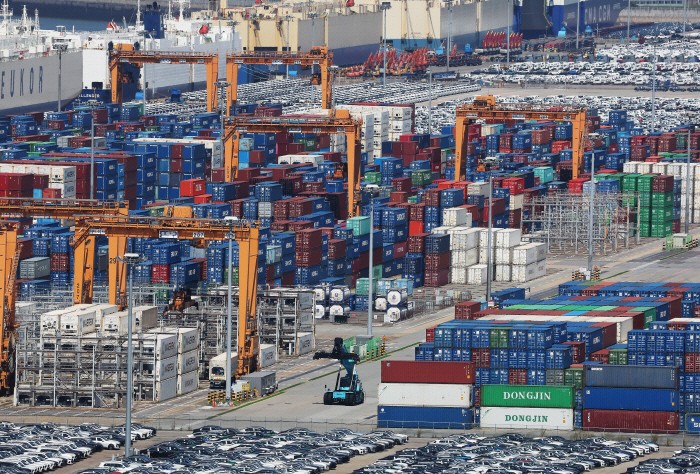
Business sentiment in South Korea improved significantly this month as the benefits of strong performance in key industries, including semiconductors and automobiles, began to spread across the broader economy. The improvement was driven by the easing of temporary disruptions, including strikes at automakers and the Chuseok holiday last month, as well as increased investment in semiconductor plants and data centers and a rise in foreign tourists. In particular, the business sentiment index for small and medium-sized enterprises (SMEs) rose by more than 10 points, suggesting that the economic recovery is spreading to smaller businesses.
According to the Bank of Korea's October Business Survey and Economic Sentiment Index (ESI), released on Oct. 29, the Composite Business Sentiment Index (CBSI) for all industries rose 5.1 points to 104.2 this month from 99.1 in September. This marked its highest level in four years and two months, since August 2022, when it stood at 105.5. The monthly increase was also the largest in five years and six months, since April 2021, when the index rose 7.5 points.
The CBSI is a composite indicator based on key components of the Business Survey Index (BSI), including business conditions, production, new orders and financial conditions. With its long-term average set at 100, a reading above that level indicates business sentiment is more optimistic than the historical average, while a reading below 100 indicates more pessimistic sentiment.
The manufacturing CBSI rose 6.1 points from the previous month to 105.6. The increase was largely attributed to the normalization of automobile production following the end of last month's strikes and Chuseok holiday disruptions, as well as the spread of higher production and investment in major industries such as semiconductors and shipbuilding to upstream industries, including machinery, equipment and chemicals.
The improvement was particularly pronounced among SMEs. Their CBSI surged 11.2 points from 94.4 to 105.6, while the index for large companies rose 3.9 points from 101.2 to 105.1. The index for companies focused on the domestic market also climbed 8.1 points from 95.7 to 103.8, far exceeding the 1.8-point increase recorded by export-oriented companies.
By industry, the automobile production index rose 30 points from the previous month, while the new orders index increased 20 points. In the chemicals and chemical products industry, both production and new orders rose 19 points. As demand for supplies from downstream industries such as semiconductors, shipbuilding and automobiles increased, the finished goods inventory index for other machinery and equipment fell 12 points. Since the inventory index generally moves in the opposite direction to economic conditions, declining inventories contributed positively to business sentiment.
Sentiment also improved in the nonmanufacturing sector. The nonmanufacturing CBSI rose 4.3 points from the previous month to 103.2. Along with an increase in construction orders for semiconductor plants and data centers, a rise in foreign tourists during China's National Day holiday and greater demand for pharmaceuticals during the seasonal transition helped boost performance in the wholesale and retail sectors.
The outlook for next month was also optimistic. The CBSI outlook for all industries in November stood at 101.8, up 2.2 points from the October outlook recorded in the previous month's survey. The manufacturing outlook rose 1.9 points to 103.0, while the nonmanufacturing outlook increased 2.4 points to 101.0.
However, businesses continued to face management challenges. Manufacturers cited weak domestic demand (21.6%) as their biggest difficulty, followed by rising raw material prices (19.9%) and economic uncertainty (13.7%). Weak domestic demand (18.5%) was also identified as the biggest challenge in the nonmanufacturing sector.
The ESI, which combines business and consumer sentiment, rose 0.9 points from the previous month to 100.8. A reading above its long-term average of 100 indicates that overall economic sentiment among businesses and households has improved relative to historical levels. The ESI's cyclical component, which excludes seasonal and irregular factors, also rose 1.0 point to 100.1.
Han Sang-wook
Most Read
-
1
Putin proposes trilateral U.S.-China-Russia summit..

-
2
U.S. weighs dropping MOAB, world's most powerful n..

-
3
Attention centers on APEC for possible Trump-Xi-Pu..

-
4
U.S., Israel plan to resume strikes on Iran after..

-
5
China tightens grip on boosting domestic demand an..

-
6
Amid health rumors, Chinese President Xi Jinping i..

-
7
ASEAN to discuss Myanmar's return next month

PEOPLE






-
Address : In-Young Bldg., 34, Uisadang-daero 1-gil, Yeongdeungpo-gu, Seoul
Copyright by ASIATODAY CO., LTD. All rights resereved