



Kakao open-sources two AI embedding models
Oct 29, 2026, 09:41 am


 |
| /Kakao |
Kakao has released two open-source embedding models designed for personalized artificial intelligence (AI) agents and semantic search. Built on the company's proprietary small language models, the new models offer improved Korean-language search performance and operational efficiency.
According to Kakao on Oct. 29, the newly released models are "Kanana-2-3b-embedding," with 3 billion parameters, and "Kanana-2-1.3b-embedding," with 1.3 billion parameters. Both models were made available through the global AI platform Hugging Face.
Embedding models convert the meaning of text into numerical representations to retrieve information relevant to users' queries. While conventional language models understand questions and generate responses, embedding models analyze semantic similarities between queries and information to retrieve relevant content.
This allows users to find information with similar meanings even when they cannot remember exact words or names. The technology can also help personalized AI agents retrieve past conversations or user information and connect them to current queries.
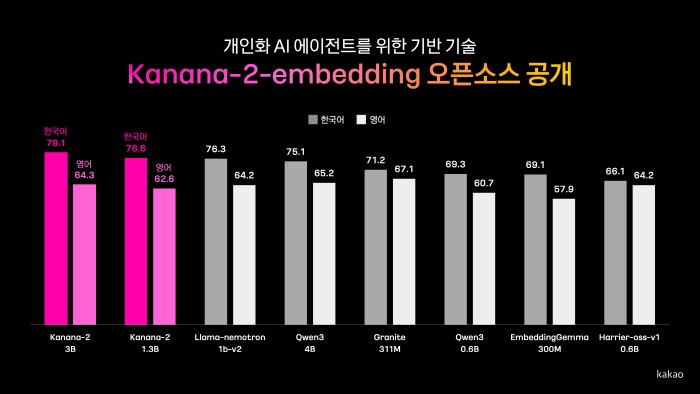
Kakao said the two models achieved the highest Korean-language performance and comparable English-language performance in its internal evaluations against similarly sized open-source embedding models, including "llama-nemotron-embed-1b-v2" and "Qwen3-Embedding-4B." The company also said its models demonstrated higher inference efficiency than Qwen3-Embedding.
Compared with its previous Kanana embedding model series, Kakao said the new models showed improved search performance and efficiency gains of several dozen times or more in memory usage and inference speed.
Kakao developed the 3B model by training its proprietary small language model, "Kanana-2-SLM," to apply its language understanding capabilities to information retrieval. It then developed the 1.3B model using knowledge distillation, a technique that transfers knowledge learned by a larger model to a smaller one.
The company also applied Matryoshka Representation Learning (MRL), a technique that allows search performance, storage requirements and processing speed to be adjusted according to the service environment. Developers can adjust the size of embedding vectors to select the level of efficiency best suited to their services.
Both models are released under the Kanana Open License, which permits use for research and development as well as commercial purposes, subject to its licensing terms. Kakao expects researchers and companies in Korea and abroad to use the models to develop personalized AI agents and semantic search services.
"For AI agents to provide users with the assistance they need, it is important not only to answer questions but also to accurately retrieve relevant information from scattered sources," said Roh Byung-seok, performance leader of Kakao's Unified Foundation Model team. "We will support the use of embedding technologies with strengths in Korean across various services and continue related research."
Son Kang-hoon
Most Read
-
1
Putin proposes trilateral U.S.-China-Russia summit..

-
2
U.S. weighs dropping MOAB, world's most powerful n..

-
3
Attention centers on APEC for possible Trump-Xi-Pu..

-
4
U.S., Israel plan to resume strikes on Iran after..

-
5
China tightens grip on boosting domestic demand an..

-
6
Amid health rumors, Chinese President Xi Jinping i..

-
7
ASEAN to discuss Myanmar's return next month

PEOPLE







-
Address : In-Young Bldg., 34, Uisadang-daero 1-gil, Yeongdeungpo-gu, Seoul
Copyright by ASIATODAY CO., LTD. All rights resereved