



Takaichi leads Japan PM preference poll at 27%, but 38% undecided
Oct 26, 2026, 11:01 am


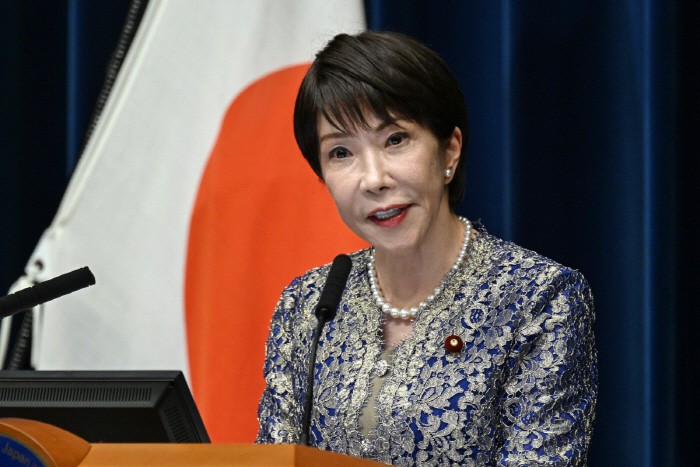 |
| Japanese Prime Minister Sanae Takaichi speaks at a press conference at the Prime Minister's Office in Tokyo on Oct. 17. / AP, Yonhap |
Japanese Prime Minister Sanae Takaichi, who has marked one year in office, leads a survey asking respondents who would be most suitable to serve as the country's next prime minister. However, more respondents said they did not know whom to choose than those who selected Takaichi. Her Cabinet's approval rating also remained unchanged from last month at 45%. While Takaichi enjoys strong support among voters backing the ruling Liberal Democratic Party (LDP), that support has yet to spread sufficiently among unaffiliated voters.
In a nationwide opinion poll conducted by the Mainichi Shimbun on Oct. 24–25, 27% of respondents chose Takaichi as the most suitable person to serve as Japan's next prime minister. Defense Minister Shinjiro Koizumi received 12%, followed by former Internal Affairs and Communications Minister Yoshimasa Hayashi at 10%. However, the largest group, 38%, answered "Don't know." The results suggest that although Takaichi leads other political figures, she has not emerged as an overwhelming choice among voters.
The differences were even more pronounced when respondents were grouped by party affiliation. Among LDP supporters, 55% selected Takaichi, compared with 15% for Koizumi and 7% for Hayashi. By contrast, 53% of unaffiliated voters said they did not know whom to choose. Takaichi received 17% among these voters, ahead of Koizumi at 10% and Hayashi at 9%, but her support was substantially lower than among LDP supporters.
Opinions were also divided over how long Takaichi should remain in office. The largest share of respondents, 32%, said they wanted her to serve as prime minister for as long as possible. Another 23% wanted her to step down soon, while 17% preferred that she remain until her term as LDP president expires in September 2027. Seven percent wanted her to serve until the House of Representatives' term expires in February 2030, while 21% said they did not know. Among those who approved of her Cabinet, 66% wanted her to remain in office for as long as possible. However, 55% of those who disapproved of her Cabinet wanted her to resign early. The findings highlight a clear divide between supporters and opponents over the prospect of Takaichi remaining in power for an extended period.
In the same Mainichi survey, Takaichi's Cabinet approval rating stood at 45%, unchanged from September, while the disapproval rating rose 1 percentage point to 41%. After remaining at 41% for two consecutive months in July and August, the approval rating climbed to 45% in September but failed to rise further in the latest survey. The 27% figure represents respondents' preference for the next prime minister, while the 45% Cabinet approval rating measures their assessment of the current administration's performance. The two figures therefore should not be interpreted as measuring the same thing.
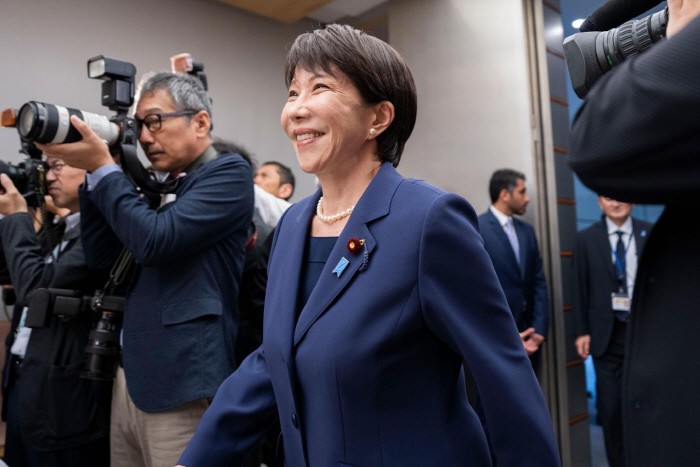 |
| Japanese Prime Minister Sanae Takaichi arrives at the Prime Minister's Office in Tokyo on Oct. 2 for a meeting with Qatari Prime Minister Sheikh Mohammed bin Abdulrahman Al Thani. / AP-Yonhap |
Other polls conducted earlier, on Oct. 17–18, showed different levels of support. In a joint survey by the Sankei Shimbun and Fuji News Network (FNN), the Takaichi Cabinet's approval rating stood at 62.6%, up 1.0 percentage point from September. Meanwhile, a survey by TV Asahi-affiliated All-Nippon News Network (ANN) put the rating at 47.1%, its lowest level since the administration took office. Because polling organizations use different questions and survey populations, the figures cannot be directly compared. Nevertheless, the recent surveys do not show a consistent trend of a significant increase in Cabinet approval.
Public opinion surrounding the dismissal of former Agriculture, Forestry and Fisheries Minister Kazuo Yana has also posed a challenge for the prime minister. In the Mainichi survey, 41% of respondents said the dismissal came "too late," while 40% considered its timing "appropriate." Yana resigned amid controversy over remarks suggesting that he had cut road budgets for local governments that had not supported him. The Cabinet's approval rating remained unchanged from the previous month in the latest survey, conducted after his dismissal.
In the FNN survey, 85.0% of respondents said Yana's resignation was appropriate. However, 51.2% said the timing of Takaichi's decision to accept his resignation was "inappropriate," exceeding the 41.3% who considered it "appropriate." This suggests that many respondents evaluated the resignation itself separately from the prime minister's handling of the matter.
Public opinion on the Takaichi administration's policies also showed a mixture of support and concern. In the FNN survey, 62.6% of respondents supported reducing the consumption tax on food. However, 80.9% said the government should clearly explain how it would finance the tax cut. While Takaichi is pushing ahead with her policies on the strength of support from LDP voters, she also faces the challenge of convincing undecided voters without party affiliations that her government can secure the necessary funding.
Choi Young-jae
Most Read
-
1
Ukraine halts strikes on Russian oil refineries un..

-
2
China's fifth plenum to conclude amid expectations..

-
3
ASEAN to discuss Myanmar's return next month

-
4
Southeast Asian auto parts makers hit hard by Chin..

-
5
U.S. links Myanmar peace efforts to rare earth acc..

-
6
Democrats flip U.S. Congress in historic midterm s..

-
7
USFK commander cites interoperability gaps, urges..

PEOPLE







-
Address : In-Young Bldg., 34, Uisadang-daero 1-gil, Yeongdeungpo-gu, Seoul
Copyright by ASIATODAY CO., LTD. All rights resereved