



China opens closely watched fifth plenum
Oct 26, 2026, 10:26 am


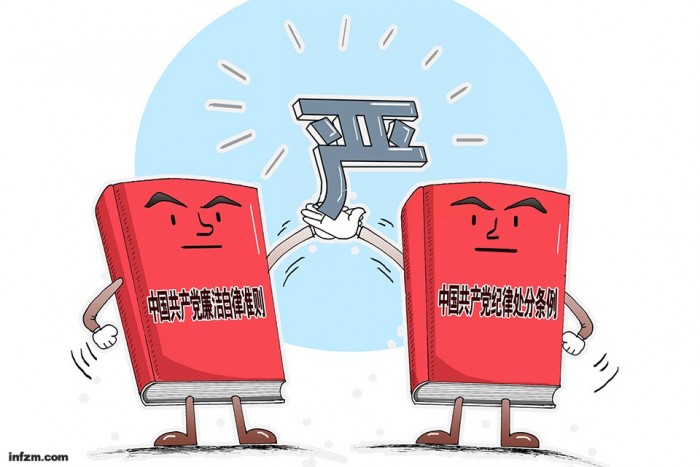 |
| A cartoon published by a Chinese newspaper suggests that the fifth plenary session of the 20th Communist Party of China (CPC) Central Committee, scheduled to take place over four days starting Oct. 26, will be held under the banner of rigorous Party governance. The illustration can be seen as an indication that the meeting could serve as a platform for formalizing President Xi Jinping's extended rule. / Beijing Youth Daily |
The fifth plenary session of the 20th Central Committee of the Communist Party of China (CPC), the Party's highest decision-making body, opens in Beijing on Oct. 26 for four days of closed-door meetings. Judging from previous reports and recent developments involving senior Party and government officials, the gathering, sometimes described as a Chinese-style conclave — a reference to the secret meeting held by the Roman Catholic Church to elect a new pope — is expected to actively address key issues, including measures to stimulate domestic consumption and a major intensification of anti-corruption efforts.
Looking back at the CPC's history over the past eight decades, the fifth plenary session of each Central Committee, which is formed every five years, has traditionally focused on fundamental macroeconomic policies and other major Party and government priorities. This year's fifth plenum is unlikely to be much different. According to Beijing-based sources familiar with China's leadership circles on Oct. 25, the meeting is expected to prioritize measures to achieve the objectives of the 15th Five-Year Plan (2026–2030), whose basic framework was finalized last year.
Measures to stimulate domestic consumption, which remains seriously depressed, are naturally expected to be among the main issues. This is particularly likely given that consumer spending during the Mid-Autumn Festival holiday late last month and the National Day holiday earlier this month failed to pick up as much as expected. Against this backdrop, it would hardly be surprising if China's consumer goods trade-in subsidy program, known as yijiu huanxin (以旧换新), becomes a major topic throughout the meeting. The program, which provides subsidies to consumers who replace old products with new ones, has proved effective in stimulating domestic demand over several years of implementation.
Various new measures featuring innovative ideas are also expected to be considered. Considerable preparations appear to have been made. Sources say Xi Jinping, general secretary of the CPC Central Committee and president of China, was unable to meet North Korean leader Kim Jong-un during Kim's one-day visit to Dandong in Liaoning Province on Oct. 24 because Xi was unusually occupied with reviewing these measures. If that account is accurate, it would underscore the extent of the preparations.
Another major issue likely to receive considerable attention is a sweeping crackdown on corruption, which has not traditionally been a central focus of previous fifth plenums. The need to strengthen discipline within the Party and government and overhaul personnel arrangements has become increasingly urgent as Xi seeks to consolidate what can already be regarded as his extended rule. Against this backdrop, it is understandable that full and rigorous Party self-governance and the institutionalization of anti-corruption efforts are being discussed as central agenda items.
The sudden downfall of Xia Linmao, a member of the Standing Committee of the CPC Beijing Municipal Committee and executive vice mayor of Beijing, on Oct. 22 over alleged corruption further suggests that a sweeping anti-corruption drive could become one of the meeting's most important issues. The fact that numerous senior officials have been removed from their posts since the beginning of the year also appears far from coincidental.
Other possible agenda items include a major personnel reshuffle aimed at promoting a younger generation of potential successors who could ultimately help underpin Xi's authority, as well as measures to ensure the successful hosting of the Asia-Pacific Economic Cooperation (APEC) summit in Shenzhen, Guangdong Province, on Nov. 18–19. In other words, the meeting could feature extensive discussions on issues that would each contribute to Xi's extended rule. It is therefore hardly surprising that sources have already suggested that this fifth plenum could mark a historic turning point in the formal consolidation of Xi's long-term leadership.
Hong Soon-do
Most Read
-
1
Ukraine halts strikes on Russian oil refineries un..

-
2
China's fifth plenum to conclude amid expectations..

-
3
ASEAN to discuss Myanmar's return next month

-
4
Southeast Asian auto parts makers hit hard by Chin..

-
5
U.S. links Myanmar peace efforts to rare earth acc..

-
6
Democrats flip U.S. Congress in historic midterm s..

-
7
USFK commander cites interoperability gaps, urges..

PEOPLE






-
Address : In-Young Bldg., 34, Uisadang-daero 1-gil, Yeongdeungpo-gu, Seoul
Copyright by ASIATODAY CO., LTD. All rights resereved