



Indonesia cuts gas supplies to Singapore
Oct 26, 2026, 09:56 am


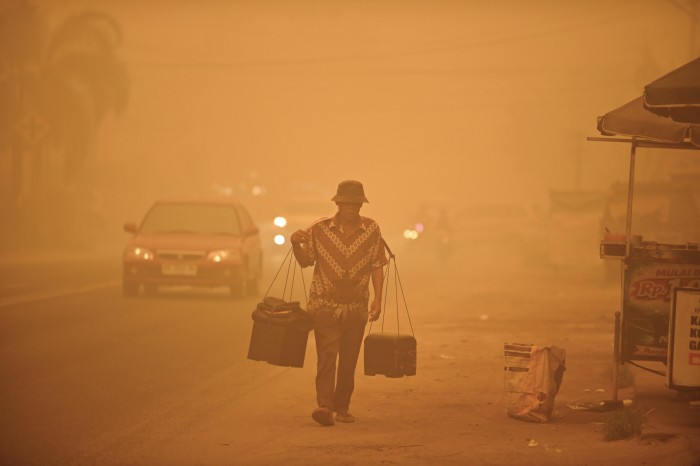 |
| A street vendor walks through thick haze caused by wildfires in Palangka Raya, Central Kalimantan, Indonesia, on Oct. 24 (local time). / AP, Yonhap |
Indonesia has abruptly reduced natural gas exports to Singapore, saying it will prioritize domestic demand. The move comes amid a dispute between the two countries over haze caused by wildfires in Indonesia, prompting differing interpretations of the political motivations behind the decision.
According to AFP on Oct. 24 (local time), Indonesia cut natural gas supplies to Singapore by 31 million standard cubic feet (approximately 880,000 cubic meters) per day starting that day. Djoko Siswanto, head of SKK Migas, Indonesia's upstream oil and gas regulatory agency, announced in a statement that supplies would be reduced by 15 million cubic feet from Natuna in the Riau Islands Province and 16 million cubic feet from Sumatra.
"The measure is intended to maintain the reliability of domestic gas supplies for electricity generation," he said, adding, "We will continue to monitor developments on a daily basis."
Singapore is the only country affected by the cuts so far. Singaporean daily The Straits Times, citing local reports, said the gas pipelines from the two regions are directly connected to Singapore, making it the only country affected by the measure. According to data from the U.S. Energy Information Administration (EIA), Indonesia is one of Singapore's major natural gas suppliers, having exported 145.3 billion cubic feet (approximately 4.1 billion cubic meters) in 2024. AFP estimated that the daily reduction amounts to approximately 8% of annual supply volumes.
However, the impact is expected to be relatively limited compared with Singapore's overall demand. Singapore's Energy Market Authority (EMA) said the reduction accounts for less than 2% of the country's total daily gas demand.
"EMA understands that our importers will pursue all relevant recourse in their contracts for the gas supply disruption," the agency said in a statement to AFP. It emphasized that contingency plans were already in place to deal with such reductions.
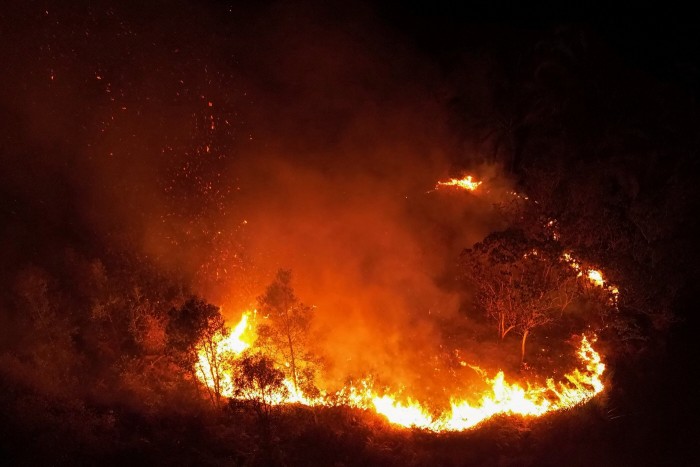 |
| Thick smoke and flames rise from a wildfire in Penyang village, East Kotawaringin Regency, Central Kalimantan Province, Indonesia, on Oct. 23 (local time). / Reuters, Yonhap |
Although the Indonesian government has officially cited the need to meet domestic demand as the reason for the gas supply cuts, questions have arisen over the decision because senior Indonesian officials made a series of sharply critical remarks directed at neighboring countries shortly before the reductions were announced. On Oct. 21, Indonesian President Prabowo Subianto strongly criticized "countries that like to insult Indonesia" in connection with the haze crisis, without naming any particular country. The following day, Energy and Mineral Resources Minister Bahlil Lahadalia said Indonesia was considering restricting gas exports under its policy of prioritizing domestic consumption and warned that the country would take corresponding measures against nations that did not "respect" Indonesia. The gas supply cuts were implemented two days after that warning.
The dispute between the two countries was triggered by wildfires that have remained uncontrolled for months. According to forest monitoring organization Nusantara Atlas, more than 1.9 million hectares of land were affected by fires in Indonesia from January through September this year. Thick haze from the islands of Borneo and Sumatra has pushed air pollution to dangerous levels not only in Indonesia but also in neighboring Malaysia, Singapore and East Timor, prompting the Association of Southeast Asian Nations (ASEAN) to convene an emergency meeting to discuss countermeasures. Singapore, in particular, has signaled a tough response by pledging legal action against companies responsible for the fires.
Nevertheless, it remains difficult to conclude that the gas supply cuts were retaliatory measures linked to the haze dispute. According to The Straits Times, Indonesia has been seeking to reduce gas exports to Singapore for several years because of rapidly growing domestic demand. In 2022, the two countries agreed to extend their gas supply contract until 2028 while reducing supply volumes. Energy economist David Broadstock said, "Questions remain over whether political factors played a role in this decision and whether it was a response to the haze dispute. While political considerations cannot be definitively identified as the decisive factor, their possible influence cannot be entirely ruled out."
Jeong Ri-na
Most Read
-
1
Ukraine halts strikes on Russian oil refineries un..

-
2
China's fifth plenum to conclude amid expectations..

-
3
ASEAN to discuss Myanmar's return next month

-
4
Southeast Asian auto parts makers hit hard by Chin..

-
5
U.S. links Myanmar peace efforts to rare earth acc..

-
6
Democrats flip U.S. Congress in historic midterm s..

-
7
USFK commander cites interoperability gaps, urges..

PEOPLE







-
Address : In-Young Bldg., 34, Uisadang-daero 1-gil, Yeongdeungpo-gu, Seoul
Copyright by ASIATODAY CO., LTD. All rights resereved