



Vietnam targets over 10% growth again next year despite warnings of weak foundation
Oct 19, 2026, 10:05 am


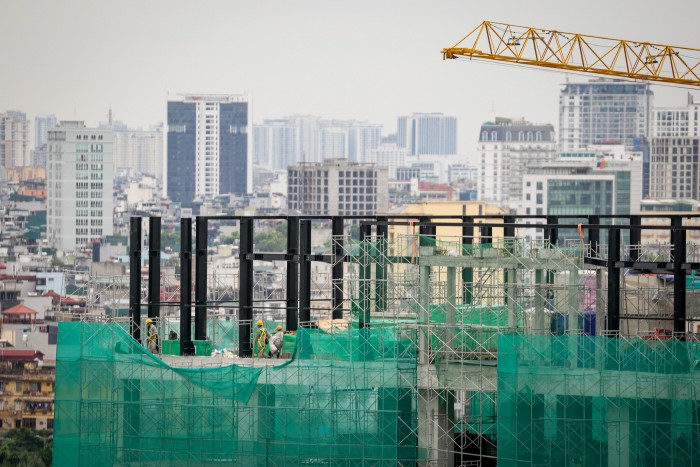 |
| Workers labor at a construction site in Hanoi, Vietnam, on the 5th (local time). / EPA, Yonhap News |
Workers labor at a construction site in Hanoi, Vietnam, on the 5th (local time). / EPA Yonhap News
The Vietnamese government has set next year's economic growth target at "over 10%" and submitted it to the National Assembly. Following a growth rate of 9.01% recorded from January to September this year under the same target, the plan seeks to sustain double-digit high growth for two consecutive years.
According to local media including VNExpress on the 18th (local time), Vietnamese Prime Minister Le Minh Hung unveiled a report titled "Results of the Implementation of the 2026 Socio-Economic Development Plan and the 2027 Draft Plan" containing these details during the opening session of the second meeting of the 16th National Assembly held the previous day.
The government's plan for next year contains a total of 45 indicators. Key targets presented include: gross domestic product (GDP) growth of over 10%, Consumer Price Index (CPI) inflation of approximately 4.5%, and GDP per capita of $6,100 (approx. 8.16 million won).
Vietnam's economic growth momentum this year accelerated with each passing quarter. According to the General Statistics Office of Vietnam, quarterly growth climbed from 8.15% in the first quarter to 8.81% in the second quarter, surging to 9.95% in the third quarter. According to government report figures, the industry and construction sector recorded a growth rate of 11.21% from January to September.
External trade and investment indicators also jumped significantly. Import and export trade volume from January to September rose 30.4% year-on-year, with the annual total estimated to reach $1.11 trillion (approx. 1,484.847 trillion won). Over the same period, registered foreign direct investment (FDI) soared 76.4% to $50.36 billion (approx. 67.3716 trillion won). Prime Minister Hung projected that 14 out of the 15 major socio-economic indicators set for this year will meet or exceed their targets.
Prime Minister Hung stated that during the remaining fourth quarter, the government will maintain macroeconomic stability and price control while doing its utmost to achieve original targets, including double-digit growth. To this end, measures to lower loan interest rates and ensure power and petroleum supplies will be pursued.
Earlier, the State Bank of Vietnam instructed financial institutions to lower lending rates by 1.5 to 2 percentage points for priority support sectors, such as manufacturing and business operations. In addition, it plans to concentrate credit supply on manufacturing, exports, science and technology, and small and medium-sized enterprises (SMEs), while diversifying funding sources through bond issuances, borrowing through official development assistance (ODA), expanding state-owned enterprise investments, and encouraging FDI enterprises to reinvest profits.
However, while evaluating these achievements of the government, the parliamentary review body added warnings regarding potential risk factors. Phan Van Mai, chairman of the National Assembly's Economic and Financial Committee, praised the government's economic management in an evaluation report while presenting six challenges to heed going forward.
The committee's assessment is that while outward high growth has been achieved, internal growth fundamentals are not yet solid. In particular, the projection that all four top economic regions (Ho Chi Minh City, Hanoi, Hai Phong, and Dong Nai), which account for approximately 47% of national gross regional domestic product (GRDP), are expected to fall short of this year's growth targets was cited as evidence.
Vulnerable private investment and an unbalanced import-export structure were also pointed out as problems. The growth rate of private investment, which accounts for 53% of total social investment, was limited to 14%, the lowest among the three major investment sectors. In terms of trade, while exports grew by 24.5%, imports surged by 36.7%, generating a trade deficit of $19.42 billion (approx. 25.98 trillion won), with excessive export dependence on FDI enterprises also coming under scrutiny. Financing difficulties faced by frontline enterprises and self-employed households, along with a sluggish recovery in purchasing power, were likewise cited as constraints.
Regarding next year's target setting, the committee recommended considering the possibility that economic shocks experienced this year could materialize with a time lag. Key risk factors cited included the possibility of energy prices remaining stuck at elevated peaks, and the possibility that previously suppressed inflationary pressures could surface if support measures—such as tax and fee exemptions, reductions, and payment deferrals that reached approximately 360 trillion dong (18.648 trillion won) this year—are adjusted.
The committee emphasized, "The economic management plan must be prepared with contingency plans and clear response baselines against adverse scenarios, and short-term demands for high growth must not undermine medium-term stability and capacity for development."
Jeong Ri-na
Most Read
-
1
Putin proposes trilateral U.S.-China-Russia summit..

-
2
U.S. weighs dropping MOAB, world's most powerful n..

-
3
Attention centers on APEC for possible Trump-Xi-Pu..

-
4
U.S., Israel plan to resume strikes on Iran after..

-
5
China tightens grip on boosting domestic demand an..

-
6
Amid health rumors, Chinese President Xi Jinping i..

-
7
ASEAN to discuss Myanmar's return next month

PEOPLE







-
Address : In-Young Bldg., 34, Uisadang-daero 1-gil, Yeongdeungpo-gu, Seoul
Copyright by ASIATODAY CO., LTD. All rights resereved