



Malaysia pushes tobacco tax hike as teen smokers near 40,000
Sep 23, 2026, 09:51 am


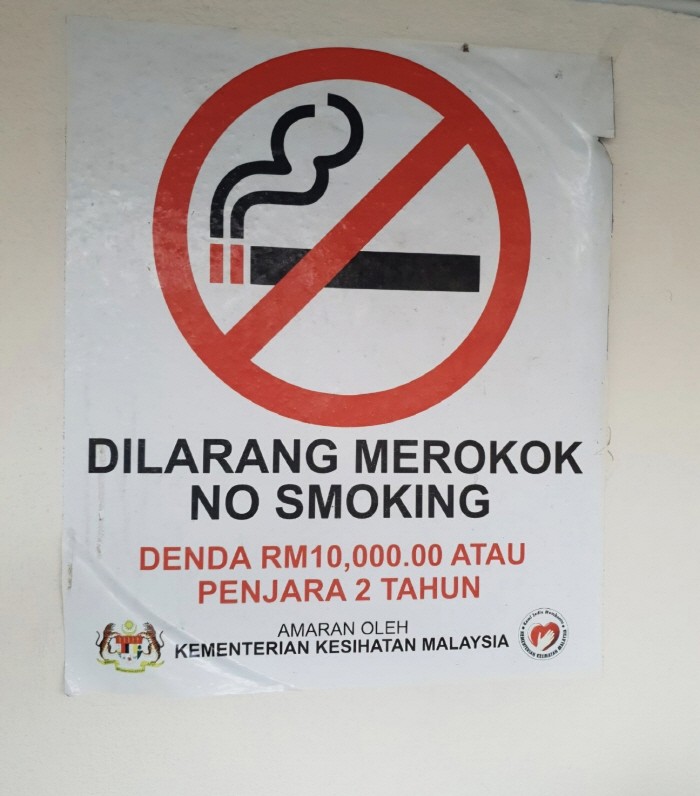 |
| A no-smoking notice is posted on a street in Kuala Lumpur. / Hong Seong-a, Kuala Lumpur Correspondent |
The Malaysian government is accelerating discussions on raising tobacco taxes to curb youth smoking ahead of its 2027 budget announcement on October 9. Arguments that higher cigarette prices will deter adolescents from initiating smoking while improving household finances and public health are gaining strong traction.
According to Malaysian daily The Sun Daily on the 21st (local time), N.V. Subbarow, senior education officer at the Consumers' Association of Penang (CAP), urged a significant tobacco tax hike, calling cigarette price increases one of the most effective measures to curb youth smoking.
A 2024 report by the Malaysian Ministry of Health revealed that 44,211 secondary school students were identified as smokers, accounting for 2.56% of all secondary school students. Even among primary school pupils, 230 were found to be smokers.
According to the 2023 Global Adult Tobacco Survey, about 4.8 million people, or 19.5% of the Malaysian population, smoke tobacco. E-cigarette users numbered approximately 1.4 million, representing 5.8%.
The health and economic toll of smoking remains substantial.
The Institute for Clinical Research (ICR) under the Ministry of Health estimated that 14.2% of all cancer cases nationwide in 2018 were smoking-related.
An average smoker spends around 700 ringgit (about 230,000 won) per month purchasing cigarettes.
While the World Health Organization (WHO) recommends tobacco tax increases as the single most effective policy to reduce consumption, critics point out that Malaysia's cigarette excise duty remains at roughly 8.40 ringgit (about 2,800 won) per pack even after an increase in November 2025, which is insufficient to keep youth from taking up smoking.
The Social and Economic Research Initiative (SERI), a Malaysian think tank, assessed that raising tobacco taxes is not simply a tax increase, but a policy that improves household expenditure patterns.
Given that spending on cigarettes produces a "crowding-out effect" by cutting into essential expenditures such as food and education, reducing consumption through price hikes allows disposable income to shift toward more productive areas.
A SERI survey showed that only 17% of all respondents and 38% of smokers considered a tobacco tax increase a major burden on the cost of living, indicating relatively low resistance to higher levies.
The researchers projected that an annual 5% increase in tobacco taxes would generate 146 million ringgit (about 48.77 billion won) in additional revenue each year, which could be channeled into public healthcare support and anti-illicit cigarette smuggling initiatives.
Hong Seong-a
Most Read
-
1
Trump demands rates fall below 1% as Fed hikes for..

-
2
Chinese e-commerce giants AliExpress, Temu and She..

-
3
Trump warns countries not helping U.S. must pay re..

-
4
Turkish Airlines named main club partner of Liverp..

-
5
China expels No. 2 military official Zhang Youxia..

-
6
Houthi rebels release video claiming downing of Sa..

-
7
U.S. allows Iranian delegation to attend UN Genera..

PEOPLE







-
Address : In-Young Bldg., 34, Uisadang-daero 1-gil, Yeongdeungpo-gu, Seoul
Copyright by ASIATODAY CO., LTD. All rights resereved