



S.Korean Navy and Marine Corps stage Decisive Action phase of division-level joint amphibious drill
Sep 17, 2026, 09:33 am


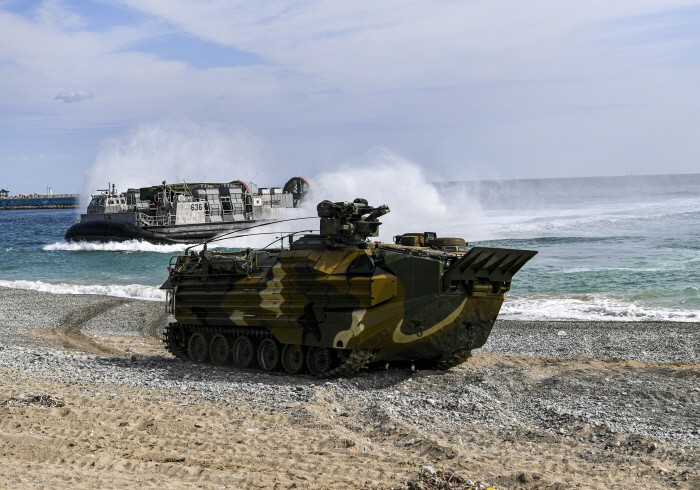 |
| South Korean Navy and Marine Corps conduct the Decisive Action phase of a division-level joint amphibious drill on the coast of Dokseok-ri in Pohang on the 16th. Landing craft air cushions (LSFs) and Korean Amphibious Assault Vehicles (KAAVs) make their way ashore. / Marine Corps |
The South Korean Navy and Marine Corps executed the "Decisive Action" phase on the coast of Dokseok-ri on the 16th as part of a division-level joint amphibious exercise.
This joint amphibious drill was conducted at a division-level scale, mobilizing some 5,700 joint troops across the Army, Navy, Air Force, and Marine Corps. A diverse array of manned and unmanned joint assets participated, including the amphibious assault ship ROKS Marado (LPH), other naval vessels, mobilized civilian ships, the Joint Logistics Over-the-Shore (JLOTS) system, Korean Amphibious Assault Vehicles (KAAV), MUH-1 Marineon amphibious transport helicopters, P-8A maritime patrol aircraft, FA-50 fighter jets, and AH-64E Apache attack helicopters.
To maximize the training outcomes, the Navy and Marine Corps integrated diverse joint forces to carry out seaborne, airborne, and air assault operations by the landing force in accordance with operational concepts. Training tasks tailored to diversified future threats were applied and implemented in connection with major scenarios.
In particular, unmanned assets linked with combat experiments based on modern warfare analyses took part in the drill. The forces verified their ship strike, defense, and counter-unmanned system capabilities during amphibious operations, while enhancing intelligence collection and battlefield visualization capabilities by utilizing direct-reception commercial satellite systems. They also worked to diversify transport methods for providing emergency supplies to landing forces by utilizing cargo transport drones and unmanned surface vessels.
After completing shaping operations to sweep naval mines and clear obstacles along the landing beach, the Navy and Marine Corps carried out the Decisive Action phase on Wednesday morning targeting the Dokseok-ri coast in Pohang. The Decisive Action phase is the climax of an amphibious operation, during which the Marine landing force secures beachhead footholds supported by naval gunfire and air assets before preparing for the transition to ground operations.
The Marine landing force launched multidimensional assaults by sea and air, steadily securing amphibious objectives. In this exercise, the MICLIC mine-clearing system was live-fired from the sea using practice rounds for the first time to breach obstacles on the landing beach.
Rear Admiral Joo Il-seok, commander of the amphibious task force, said, "The joint amphibious exercise is an important opportunity to reinforce seamless teamwork between the Navy and Marine Corps and enhance the jointness of supporting operational units." He added, "Through this drill, we will establish ourselves as a strong Marine Corps that earns the trust of our people as a national strategic mobile force and faithfully fulfills its assigned missions anytime, anywhere."
The Navy and Marine Corps plan to conduct drills through the 19th to strengthen mission execution capabilities across echelons in conjunction with the joint amphibious exercise, covering follow-on landings, joint search and rescue and medical exercises, airborne tactical command post operations, and mass-casualty treatment training. Based on the outcomes of this exercise, they plan to continuously refine amphibious operation plans and joint force employment procedures.
Lee Han-sol
Most Read
-
1
Celltrion’s Omlyclo gains ground in major European..

-
2
Hyundai Motor Group breaks ground on integrated st..

-
3
Trump demands rates fall below 1% as Fed hikes for..

-
4
U.S. strikes 3 Iranian oil tankers, Iran vows reta..

-
5
S. Korea seeks redemption from World Cup setback w..

-
6
Trump makes $1 trillion bet ahead of midterm elect..

-
7
Iran resumes ballistic missile production, assembl..

PEOPLE







-
Address : In-Young Bldg., 34, Uisadang-daero 1-gil, Yeongdeungpo-gu, Seoul
Copyright by ASIATODAY CO., LTD. All rights resereved