



Government pushes 4 major AI projects from predicting wildfire spread to curbing complaints
Sep 16, 2026, 09:16 am


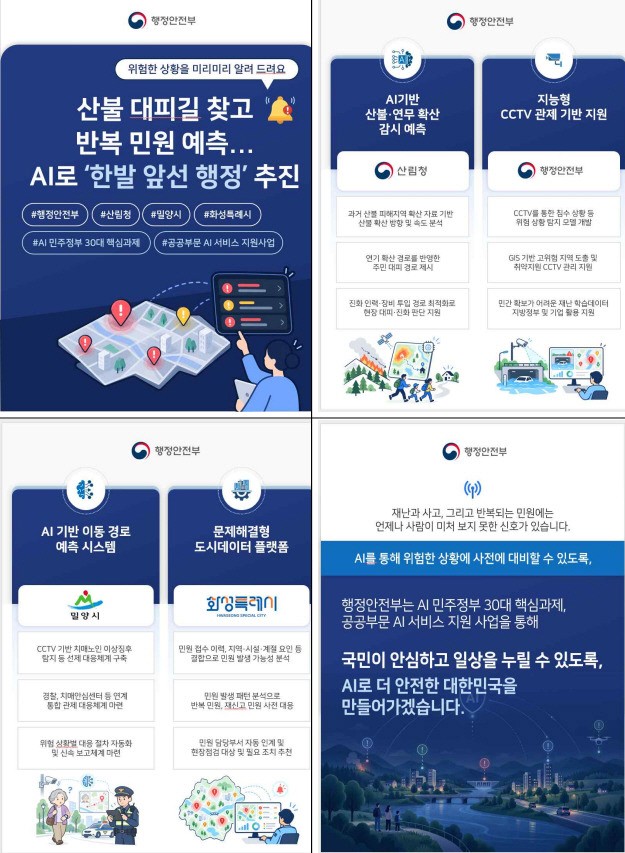 |
| Details of each project / Ministry of the Interior and Safety |
The government will build an AI-based preemptive disaster response system to predict evacuation routes for residents as wildfires spread, track anticipated movement paths of elderly individuals with dementia, and detect flooding risks early, while identifying the areas and timing of recurring civil complaints to strengthen disaster management and address public inconveniences through scientific administration.
The Ministry of the Interior and Safety announced on the 15th that it will develop artificial intelligence services across four projects in safety and public inconvenience, selected from its 30 innovation initiatives aimed at realizing an "AI Democratic Government" and public sector AI service support programs.
The main projects consist of four initiatives covering safety and public inconvenience, chosen from the 30 innovation projects for an AI Democratic Government and the public sector AI support efforts: wildfire spread prediction, intelligent CCTV control, movement path prediction for elderly dementia patients, and prevention of repetitive civil complaints.
Through these projects, the ministry aims to enhance disaster response, public safety, protection for vulnerable groups, and administrative efficiency, with a specific focus on linking predictive results directly to real administrative actions such as evacuation, search operations, and on-site inspections.
The Korea Forest Service is developing a system that combines past wildfire damage data with weather, topography, and fuel information to forecast the direction and speed of wildfire spread, as well as smoke movement. Based on these projections, the system will provide evacuation routes for residents and deployment paths for firefighting personnel and equipment, directly supporting on-site response.
In line with this, the government plans to develop AI models that detect hazard situations and inundation using intelligent CCTVs across 217 integrated control centers nationwide, while building disaster training datasets that are difficult for the private sector to secure and sharing them with local governments and businesses.
Project development will also proceed at the local government level. Miryang City in South Gyeongsang Province is establishing an AI-based movement path prediction system to detect early warning signs in elderly dementia patients and respond quickly to hazardous situations. The city will detect anomalies in real time using intelligent CCTVs and Internet of Things sensors, analyze projected movement paths, and roll out a pilot service by the end of this year.
Hwang Gyu-cheol, head of the AI Government Bureau, stated, "Detecting danger signals earlier to secure response time and preemptively resolving recurring inconveniences represent the kind of AI-driven administration the public can truly experience. We will deploy on-site AI services needed in wildfire response, everyday safety, and complaint prevention to safeguard public safety and everyday life."
Kim Bo-young
Most Read
-
1
U.S. Treasury Secretary Bessent publicly warns ove..

-
2
Celltrion’s Omlyclo gains ground in major European..

-
3
Hyundai Motor Group breaks ground on integrated st..

-
4
Russia faces warning signs over prolonged war econ..

-
5
U.S. strikes 3 Iranian oil tankers, Iran vows reta..

-
6
S. Korea seeks redemption from World Cup setback w..

-
7
Trump makes $1 trillion bet ahead of midterm elect..

PEOPLE







-
Address : In-Young Bldg., 34, Uisadang-daero 1-gil, Yeongdeungpo-gu, Seoul
Copyright by ASIATODAY CO., LTD. All rights resereved