



KDRT second team of eight to depart Sept. 11 for search, reconstruction mission
Sep 11, 2026, 09:16 am


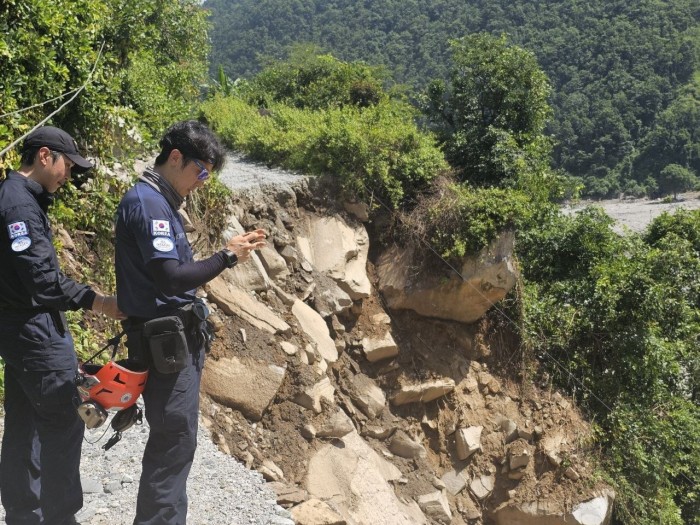 |
| KDRT members conduct a detailed safety assessment near the mountainous area of Ramche on Sept. 8 to determine whether a ground search can be carried out safely. / Courtesy of the Ministry of Foreign Affairs |
The government said on Sept. 10 that a second team of the Korea Disaster Relief Team (KDRT) will depart for Nepal early on Sept. 11. About four tons of relief supplies will also be transported aboard the KC-330 military transport aircraft carrying the team.
According to the Ministry of Foreign Affairs, the second KDRT team consists of eight members — two Foreign Ministry officials, two firefighters, two Korea International Cooperation Agency (KOICA) personnel and two medical staff. Comprising a small search-and-rescue contingent and a reconstruction and recovery team, they will operate in Nepal for seven days beginning Sept. 11.
The first KDRT team, dispatched on Sept. 2, will return home because its deployment period was set at 10 days under a decision by the government-private sector Overseas Emergency Relief Council. The Foreign Ministry said the second team’s seven-day mission could be adjusted depending on conditions on the ground.
While the first KDRT team consisted of 44 personnel focused primarily on search operations, the second is made up of a smaller group handling both search and reconstruction work. The change appears to reflect Nepalese authorities’ shift in focus from search and rescue to reconstruction and recovery.
“A decision was made that realistically it would be difficult to continue search operations at the previous level given the Nepalese authorities’ policy of transitioning to reconstruction and recovery,” a Foreign Ministry official told reporters.
However, as the second KDRT team includes search personnel, the government is expected to continue search-and-rescue operations in cooperation with Nepalese authorities.
“The second team will consist of a small number of search-and-rescue personnel along with a reconstruction and recovery team and will conduct reconstruction, relief and emergency relief activities in close consultation with Nepalese authorities,” Foreign Ministry spokesperson Park Doo-soon said at a regular briefing.
After arriving in Nepal, the second KDRT team will also deliver relief supplies worth about 180 million won, including tents, cold-weather clothing and blankets. The supplies were provided to the government by NGOs including Good Neighbors, World Vision and ChildFund Korea after receiving donations from South Korean companies.
Meanwhile, South Korea’s rapid response team and the first KDRT contingent carried out search operations for missing South Korean nationals for 13 days from Aug. 27 through Sept. 8 following the floods in Nepal, but failed to make significant progress in locating them.
According to the Foreign Ministry, the teams mobilized all available means, including helicopters, drones and ground searches, carrying out 32 search operations covering a total area of 93.8 square kilometers. That is about 21 times the size of Yeouido.
“The government has made every possible effort, but the rugged mountainous terrain, unstable ground conditions, difficult access and unpredictable monsoon weather created significant constraints, forcing us to conduct search operations while taking the safety of our personnel into account,” Park said. “We fully understand that the families may feel the search efforts so far have not been sufficient.”
“When the KDRT explained the constraints at the scene, it was not intended to arbitrarily set limits on the search, but to frankly explain the actual conditions under which the operations were carried out,” Park added. “The government will continue to listen closely to the families and review necessary measures in a way that respects and reflects their wishes.”
Mok Yong-jae
Most Read
-
1
Celltrion’s Omlyclo gains ground in major European..

-
2
Trump demands rates fall below 1% as Fed hikes for..

-
3
Hyundai Motor Group breaks ground on integrated st..

-
4
U.S. strikes 3 Iranian oil tankers, Iran vows reta..

-
5
Trump makes $1 trillion bet ahead of midterm elect..

-
6
Iran resumes ballistic missile production, assembl..

-
7
Samsung Electronics, Mistral AI to jointly develop..

PEOPLE







-
Address : In-Young Bldg., 34, Uisadang-daero 1-gil, Yeongdeungpo-gu, Seoul
Copyright by ASIATODAY CO., LTD. All rights resereved