



Hanwha Aerospace presents new paradigm 'One Sky' for aero-engine development
Aug 28, 2026, 10:04 am


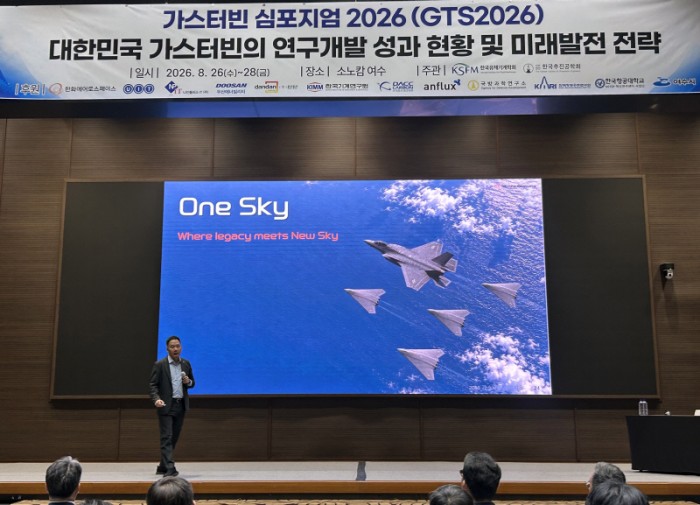 |
| Kim Sun, vice president of Hanwha Aerospace, explains the future aero-engine development paradigm 'One Sky' at the Gas Turbine Symposium 2026 held in Yeosu, South Jeolla Province, on the 27th. / Hanwha Aerospace |
Hanwha Aerospace has presented "One Sky" as a new aero-engine development paradigm. It establishes a virtuous cycle of utilizing technologies and experience accumulated from conventional engine businesses to develop future engines, and subsequently feeding back the acquired technologies into existing operations.
According to Hanwha Aerospace on the 28th, the company unveiled this strategy at the Gas Turbine Symposium 2026 held the previous day in Yeosu, South Jeolla Province.
Hanwha Aerospace envisions future battlefields where high-performance fighter jets, missiles, unmanned aerial vehicles (UAVs), and drones operate collaboratively. Accordingly, it is pursuing a strategy to develop performance-driven conventional aero-engines alongside UAV engines, where speed, cost-efficiency, and mass-producibility are paramount.
"To rapidly develop aero-engines that meet rapidly evolving security environments and new market demands, we must actively leverage our pre-existing technological and experiential assets," said Kim Sun, vice president of Hanwha Aerospace.
Over the past 47 years, Hanwha Aerospace has developed and mass-produced dozens of engine models. Throughout this process, it conducted over 10,000 engine test runs and resolved more than 1,000 trial-and-error cases. It also maintains a database of approximately 35,000 aero-engine materials.
"By leveraging the technology and experience Hanwha has accumulated over 47 years of developing and mass-producing dozens of engine types, we can develop aero-engines quickly and economically while minimizing risks," Vice President Kim explained. "It is like drawing blueprints while already knowing the answer sheet."
The company is also expanding its UAV engine development. In July, Hanwha Aerospace unveiled prototypes of an indigenous 5,500-lbf class turbofan engine for low-observable unmanned combat aerial vehicles and a 1,400-horsepower class turboprop engine for medium-altitude UAVs.
Going forward, it plans to take part in developing a 10,000-lbf class turbofan engine for stealth UAVs as well as advanced aero-engines intended to power next-generation fighter jets, including the KF-21.
Artificial intelligence (AI) is also being utilized. The concept is to train its proprietary AI model, "En-genius," on accumulated aero-engine data to reduce trial-and-error and risks throughout the development process.
"Each time an engine test fails, billions of won and at least several months of additional time are consumed, necessitating a development system that minimizes trial-and-error, and AI can play a pivotal role in that," Vice President Kim said. "Based on Hanwha's proprietary technology and experience, we will do our utmost so that South Korea can lead the 'New Sky' era in the future aviation market."
Kim Han-seul
Most Read
-
1
Kia Sportage outperforms Mazda CX-5 in German auto..

-
2
Houthis launch successive attacks on Saudi airport..

-
3
Saudi Arabia, Iran hold first diplomatic talks to..

-
4
U.S. deploys carrier, 10,000 more troops to Middle..

-
5
Saudi airport in Riyadh struck again, leaving at l..

-
6
Japan tracks Ukraine fiber-optic drones, bolsters..

-
7
Putin's ally visits China on the 8th ahead of APEC..

PEOPLE






HEADLINE NEWS
- Trump slams Nobel Peace Prize snub, claiming he is 'preventing war' between the two Koreas
- China makes tactical retreat following fierce pushback from EU
- Japan openly opposes U.S. sanctions on ICC, fueling tensions with Washingto..
- Military service exemptions for artists and athletes under scrutiny at parl..

-
Address : In-Young Bldg., 34, Uisadang-daero 1-gil, Yeongdeungpo-gu, Seoul
Copyright by ASIATODAY CO., LTD. All rights resereved