



Precision manufacturing and strong bio workforce build Samsung's stature as global CDMO leader
Aug 27, 2026, 10:06 am


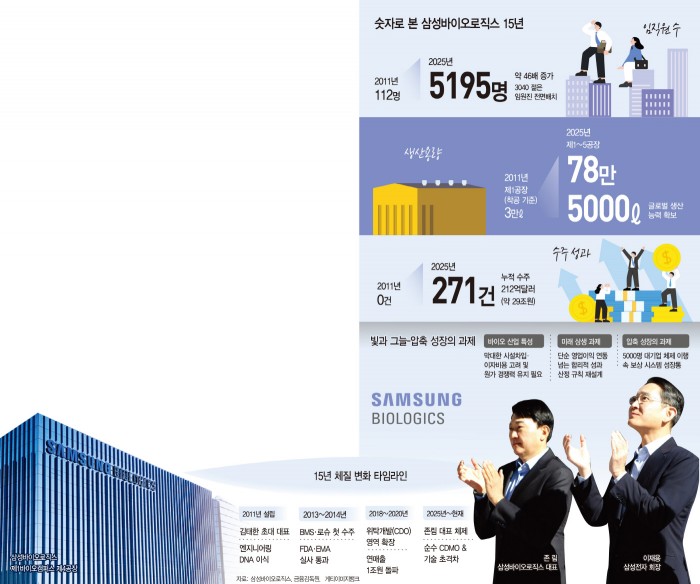 |
In April 2011, among the roughly 110 Samsung employees gathered on the tidal mudflats of Songdo, Incheon, those with prior biotechnology experience could be counted on one hand. The mission entrusted to this rookie team—mostly majoring in electronics, chemistry, and mechanical engineering—was to break ground in a bio wasteland. Starting from a barren field without a single client order, their endeavor completely overhauled South Korea's biopharmaceutical landscape in just 15 years. An organization of 112 at its inception has grown into a 5,000-strong bio powerhouse, and Songdo's manufacturing capacity has risen to the world's largest. The core drivers behind this explosive leap into a global top-tier contract development and manufacturing organization (CDMO) were people and systems.
According to Samsung Biologics on the 26th, the company had 5,195 employees as of the end of last year, a roughly 46-fold increase from 112 at its founding. Over the same period, manufacturing capacity in Songdo expanded from 30,000 L to 785,000 L.
The new business task force, initiated by a decisive move from the late Chairman Lee Kun-hee and led by inaugural CEO Kim Tae-han, laid the groundwork by selecting the Songdo site. The key legacy of that early leadership was grafting Samsung's process engineering and precision manufacturing DNA onto the new business. Facility experts from Samsung C&T and Samsung Engineering innovatively shortened plant construction timelines using modular methods. To secure credibility, the company established a joint venture with U.S.-based Biogen, landing global credentials in one fell swoop. Hong Ki-yong, professor emeritus of business administration at Incheon National University, explained, "Samsung had affiliates with plant engineering and construction capabilities, combined with the electronics division's track record in large-scale precision manufacturing, process control, and yield management," adding, "They completed large bio plants—which usually take several years—with shorter construction periods and lower costs than rivals, serving as a textbook example of successfully transferring existing group assets into a new growth industry."
Starting with drug substance (DS) supply contracts with U.S.-based BMS and Switzerland's Roche in 2013, global order acquisitions kicked into high gear. The following year, the company secured a drug product (DP) contract with BMS. When the company passed inspections by the U.S. Food and Drug Administration (FDA) and the European Medicines Agency (EMA) without major observations while maintaining a batch success rate above 98%, market skepticism turned into confidence. The consecutive construction of Plants 1 through 3, listing on the Kospi in 2016, expansion into contract development (CDO) services in 2018, and surpassing 1 trillion won in annual revenue in 2020 formed the legacy built by this engineering cadre.
CEO John Rim, who took office in late 2020, revamped the corporate profile based on his global network. Backed by Samsung Electronics Executive Chairman Lee Jae-yong, individual contract values were elevated to trillions of won, a manufacturing base in Rockville, Maryland, was secured, and customer touchpoints were expanded across Boston and New Jersey. In particular, the company completed a spin-off of its biosimilar business (Samsung Epis Holdings), resolving conflict-of-interest concerns and reinventing itself as a pure-play CDMO specialist. As Plant 4 and Plant 5 expansions secured a total capacity of 785,000 L in Songdo and global talent continued to join, the company achieved milestone records of over 5,000 employees and 271 cumulative contracts.
A strong generational transition is also sweeping internal talent ranks. Vacancies left by early founding figures, including former Executive Vice President Min Ho-sung, have been filled by young operational leaders such as Managing Director Casper Ohland (Head of CDO SE Team), a former executive from a global CDMO, alongside Managing Directors Ahn So-yeon and Hong Yeon-jin, both of whom joined through the 2011 open recruitment batch and were posted to Rockville. With top global experts such as Executive Vice President Diane Black (Head of Quality Operations Center) and Bram ten Kate, MSAT Team Lead, joining alongside an expansion of master's and doctoral research personnel to 650, the company is accelerating qualitative refinement. Jeong Yoon-taek, head of the Korea Pharmaceutical Industry Strategy Institute, noted, "By proving economies of scale, a virtuous cycle has been established where premier talent flows into the domestic bio industry, which used to be centered primarily around small and medium-sized firms."
Yet where there is light, there are also shadows. Compressed growth has brought new challenges regarding compensation and corporate culture within a large-enterprise framework of 5,000 employees. Recent friction surrounding collective bargaining agreements is viewed as a growing pain faced by an organization expanded to this scale. While younger generations, who form the core of the workforce, demand overhauls in compensation systems commensurate with corporate growth, management maintains that capital allocation must account for the nature of the bio CDMO business, which requires massive, continuous capital expenditures.
Professor Hong Ki-yong advised, "This issue stems from an institutional gap where compensation structures failed to keep pace with growth, and the solution lies not in haggling over amounts, but in redesigning the performance calculation rules," stressing that "establishing win-win standards reflecting industry dynamics is an urgent priority."
Moon Jeong-woo
Most Read
-
1
Kia Sportage outperforms Mazda CX-5 in German auto..

-
2
Houthis launch successive attacks on Saudi airport..

-
3
Saudi Arabia, Iran hold first diplomatic talks to..

-
4
U.S. deploys carrier, 10,000 more troops to Middle..

-
5
Saudi airport in Riyadh struck again, leaving at l..

-
6
Japan tracks Ukraine fiber-optic drones, bolsters..

-
7
Putin's ally visits China on the 8th ahead of APEC..

PEOPLE






HEADLINE NEWS
- Trump slams Nobel Peace Prize snub, claiming he is 'preventing war' between the two Koreas
- China makes tactical retreat following fierce pushback from EU
- Japan openly opposes U.S. sanctions on ICC, fueling tensions with Washingto..
- Military service exemptions for artists and athletes under scrutiny at parl..

-
Address : In-Young Bldg., 34, Uisadang-daero 1-gil, Yeongdeungpo-gu, Seoul
Copyright by ASIATODAY CO., LTD. All rights resereved