



Samsung's super-gap innovation unfolds with production network expanding into U.S.
Aug 27, 2026, 10:03 am


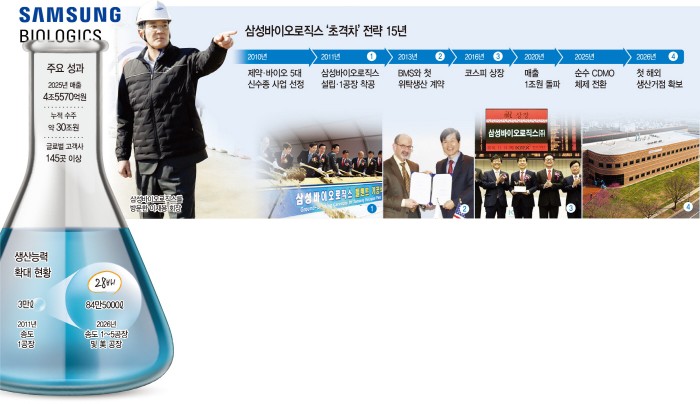 |
On the reclaimed land of Songdo, Incheon, where seawater once ebbed and flowed, bioreactors with a total capacity of 785,000 liters (L) are now operating around the clock. What began in 2011 as a single 30,000 L plant has grown into five operational facilities on site, with the manufacturing network stretching across the Pacific to the U.S. Adding the 60,000 L facility in Rockville, Maryland, Samsung Biologics has secured a total production capacity of 845,000 L. With annual revenue surpassing 4.5 trillion won, the "second semiconductor" envisioned by Samsung is emerging into reality after 15 years.
The starting point was a decisive move by the late Samsung Chairman Lee Kun-hee. In 2010, Samsung designated pharmaceuticals and biopharmaceuticals as one of its five new growth engine businesses, alongside solar cells, automotive batteries, light-emitting diodes (LEDs), and medical devices. At the time, the late chairman stressed that the group should invest boldly to seize early opportunities while other global companies hesitated. The following year, Samsung Biologics was established and broke ground on Plant 1 in Songdo, Incheon, marking the group's full-scale foray into the biopharmaceutical sector.
While the late chairman sowed the seeds of the bio business, it was Executive Chairman Lee Jae-yong who nurtured it into a core enterprise. Since taking the helm of group management, Executive Chairman Lee has treated biopharmaceuticals as a future growth engine on par with semiconductors, pursuing preemptive investments. The strategy centers on building facilities first, leveraging manufacturing capacity to win contract orders from global pharmaceutical giants, and then expanding facilities again to handle growing volume. The "preemptive investment leading to market dominance" formula accumulated in the semiconductor business has thus been applied to biotechnology.
Executive Chairman Lee visited the Songdo site in person at every major capacity expansion milestone to review investment progress and mid- to long-term growth strategies. He attended the groundbreaking ceremony for Plant 3 in 2015 and the completion ceremony for Plant 4 in 2022 to inspect manufacturing facilities and discuss business strategies with management. In 2024, he visited Songdo once again to tour Plant 4, then in full operation, and Plant 5 under construction. On that occasion, he called on employees "not to settle for current achievements, but to take on bolder challenges." Under this overarching direction, Samsung Biologics continues its preemptive investments, aiming to build Plants 5 through 8 by investing 7.5 trillion won by 2032 and expand total production capacity to 1.325 million L.
The aggressive capacity expansion strategy is driving gains in orders and revenue. Since signing its first contract manufacturing agreement with U.S.-based Bristol Myers Squibb (BMS) in 2013, the company has expanded its roster of global clients to more than 145. Cumulative order value since founding stands at $21.2 billion, or approximately 30 trillion won. Revenue, which stood at 464.6 billion won right after its stock market listing in 2017, surged to 4.557 trillion won in 2025—a roughly 9.8-fold increase in eight years. Operating profit in 2025 reached 2.0692 trillion won, with an operating margin of 45.4%.
However, analyses suggest that maintaining a super-gap through production capacity expansion alone will be difficult going forward. Global rivals are accelerating their own facility expansions, while Chinese CDMOs maintain aggressive price competition. Domestic competitors such as Lotte, Celltrion, and SK are also in pursuit. Furthermore, the competitive arena is shifting from the mass production of antibody therapeutics, where Samsung Biologics has held a strong edge, toward high-value-added fields such as antibody-drug conjugates (ADCs) and peptides.
The road ahead hinges on whether Samsung Biologics can extend the competitive strength it has built into next-generation modalities. Samsung Biologics is currently working across the value chain, from building dedicated ADC facilities to development collaborations, technology investments, and finished drug product manufacturing. It has also entered the peptide CDMO market through the acquisition of Switzerland's PolyPeptide Group. As a result, widening the gap with competitors in next-generation technologies and new business lines will determine the longevity of Lee Jae-yong's "bio super-gap."
Lee Seung-kyu, vice chairman of the Korea Biotechnology Industry Organization, said, "The global CDMO market, which was a blue ocean when Samsung Biologics first entered, has turned into a red ocean amid the influx of new entrants and expanded investments by competitors." He added, "Moving forward, beyond expanding manufacturing facilities, strategies that broaden business domains and technological capabilities—such as the recent acquisition of the peptide manufacturing facility in Switzerland—will become increasingly critical."
Bae Da-hyun
Most Read
-
1
Kia Sportage outperforms Mazda CX-5 in German auto..

-
2
Houthis launch successive attacks on Saudi airport..

-
3
Saudi Arabia, Iran hold first diplomatic talks to..

-
4
U.S. deploys carrier, 10,000 more troops to Middle..

-
5
Saudi airport in Riyadh struck again, leaving at l..

-
6
Japan tracks Ukraine fiber-optic drones, bolsters..

-
7
Putin's ally visits China on the 8th ahead of APEC..

PEOPLE






HEADLINE NEWS
- Trump slams Nobel Peace Prize snub, claiming he is 'preventing war' between the two Koreas
- China makes tactical retreat following fierce pushback from EU
- Japan openly opposes U.S. sanctions on ICC, fueling tensions with Washingto..
- Military service exemptions for artists and athletes under scrutiny at parl..

-
Address : In-Young Bldg., 34, Uisadang-daero 1-gil, Yeongdeungpo-gu, Seoul
Copyright by ASIATODAY CO., LTD. All rights resereved