



SKT and Upstage join hands to develop secure AI
Aug 27, 2026, 09:51 am


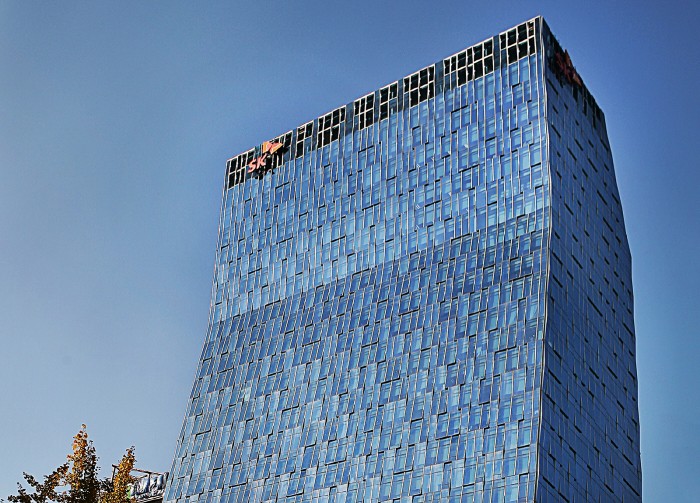 |
| SK Telecom Euljiro headquarters. / SK Telecom |
SK Telecom is joining forces with Upstage and major domestic cybersecurity firms to develop an artificial intelligence (AI) foundation model specialized in cybersecurity. With participation from academia and the Korea Information Security Industry Association (KISIA), the initiative envisions establishing a homegrown security AI framework that spans model development, on-site demonstration, and safety verification.
On the 27th, SK Telecom announced that it has formed a consortium bringing together two elite teams from among the top three contenders in the national proprietary AI foundation model project to participate in the cybersecurity-specialized AI foundation model development project promoted by the Ministry of Science and ICT.
Model development will be led by SK Telecom, with Upstage participating. SK Telecom has expanded its full-stack AI capabilities across megaprojects (infrastructure), proprietary AI foundation models (models), and AI for All (services) through its continued participation in pan-governmental AI initiatives.
Notably, SKT and Upstage recently passed the second-stage evaluation of the proprietary AI foundation model project overseen by the Ministry of Science and ICT. With two of the three teams that passed the second evaluation joining a single consortium, the plan is to leverage their proven track record of directly developing large-scale foundation models in South Korea and apply it to the security domain.
The two companies plan to develop security-specialized models based on the "A.X K" series and "Solar Open" series, which they have developed as their respective proprietary AI foundation models. The vision is to combine these models with AI agents in the future to automate security monitoring tasks—from threat detection to incident response—and reduce the operational burden on security monitoring personnel.
SKT also highlighted its own internal security expertise as a competitive edge. The company explained that it has accumulated relevant technical trends and capabilities by participating as an early investor in and maintaining cooperative relationships with global AI companies, including Anthropic. As efforts to leverage high-performance AI models for cyber defense continue abroad, SKT plans to reference these practices to adapt them to South Korea's security environment.
As a national primary telecommunications carrier, SKT also possesses systems and operational know-how for 24/7 round-the-clock monitoring of telecommunications infrastructure. The Chief Information Security Officer (CISO) organization is placed directly under the CEO to serve as the enterprise security control tower, and a dedicated team of 129 personnel under the CISO-led Integrated Security Center operates a 24-hour detection and response system. Including the Chief Privacy Officer (CPO) organization, the related workforce reaches 149 personnel.
The company also maintains a separate "Red Team" of white-hat hackers under the CISO to conduct vulnerability assessments from an attacker's perspective. Building on this internally accumulated response and recovery capability, SKT aims to establish a trusted security AI infrastructure.
Nine major domestic cybersecurity companies are participating in the consortium, contributing their expertise across specialized domains. SK shieldus and IGLOO Corporation are in charge of security monitoring and threat analysis, while AhnLab and Genians participate in endpoint security and malware analysis. SECUI and Genians take part in network and access control, while RaonSecure, SmartM2M, and Piolink handle penetration testing and vulnerability assessments. AIM Intelligence evaluates the safety of the AI model itself.
These security companies will utilize data accumulated from actual security operational sites to train the model, while also taking on the role of verifying the developed model within their commercial products and monitoring environments. The plan is to enhance the real-world operational utility of the model by establishing a circular framework in which the model trained on on-site data is validated in actual operational environments and then retrained.
From academia, the Industry-Academic Cooperation Foundations of Korea University and Soongsil University are participating to independently verify model performance and safety separately from the development leads, while also training specialized talent converging security and AI. KISIA is tasked with driving industrial dissemination of project outcomes and linking them to employee training programs.
Cho Dong-yeon, head of AI Convergence at SKT, said, "We will incorporate data and know-how from domestic security sites into homegrown AI models to build an action-oriented security AI system," adding, "We will expand the security AI ecosystem so that we can compete in the global market backed by the capabilities jointly built by domestic industry, academia, and research institutions."
Lee Ji-sun
Most Read
-
1
Trump shares map on social media labeling Strait o..

-
2
Kia Sportage outperforms Mazda CX-5 in German auto..

-
3
U.S. deploys carrier, 10,000 more troops to Middle..

-
4
Trump rejects Iran's offer to open Strait of Hormu..

-
5
N. Korea conducts first swarm attack drill with dr..

-
6
U.S.-China summit falls short on substance as Trum..

-
7
Japan tracks Ukraine fiber-optic drones, bolsters..

PEOPLE





HEADLINE NEWS
- Pyongyang calls DMZ explosion Seoul's fabrication and grave provocation
- U.S. Department of Defense completely halts use of blacklisted Anthropic AI
- 2026 Nobel Prize in Physics awarded to Francis Halzen for neutrino research
- French students take to streets, expressing frustration over economy, educa..

-
Address : In-Young Bldg., 34, Uisadang-daero 1-gil, Yeongdeungpo-gu, Seoul
Copyright by ASIATODAY CO., LTD. All rights resereved