



French students take to streets, venting frustration over economy, education
Oct 07, 2026, 09:29 am


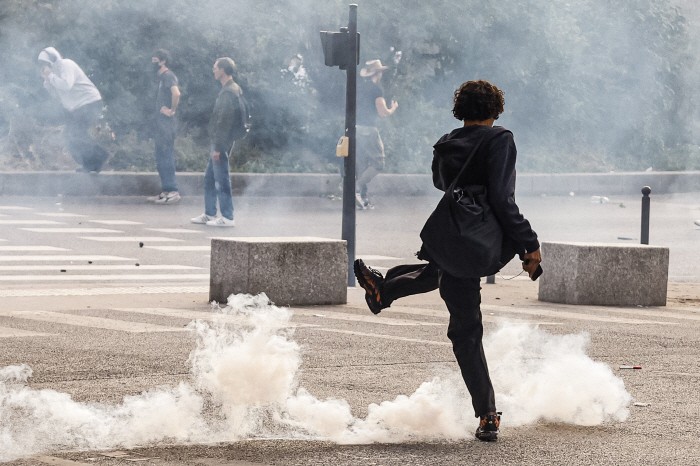 |
| High school students and education union members clash with police following a rally demanding improved schooling conditions in Paris, France, on the 6th (local time), as part of nationwide demonstrations. Protests have been spreading across France against teacher shortages, overcrowded classrooms, a lack of resources, and substandard learning environments, ahead of the government's upcoming national budget decisions. / EPA, Yonhap |
Article Summary:
1. Student protests joined by teachers, parents, and labor unions took place in more than 40 cities across France on the 6th, drawing 256,000 participants according to interior ministry estimates.
2. The Union Syndicale Lycéenne (USL) demanded an emergency education budget allocation of 10 billion euros, large-scale recruitment of new teachers, and an increase of 150,000 slots in higher education capacity.
3. France's 10-year government bond yield briefly climbed above 5% last week to hit its highest level since 2002, leaving the country with higher borrowing costs than Greece and Italy.
4. With national debt reaching approximately 119% of gross domestic product (GDP), the French government is pushing a 2027 draft budget featuring pension rule revisions and public-sector wage freezes.
Student-led demonstrations joined by teachers, parents, and trade unions swept more than 40 cities across France on the 6th (local time), drawing an estimated 256,000 participants according to interior ministry figures.
While students are calling for an increase in the education budget, the French government finds its hands tied on ramping up spending, weighed down by national debt reaching 119% of GDP and 10-year sovereign bond yields that briefly topped 5% last week. Ahead of the presidential election scheduled for next spring, the passage of the budget bill and volatility in bond markets have emerged as critical variables.
260,000 French students, teachers, and parents take to streets
The demonstrations drew 256,000 participants nationwide based on interior ministry estimates, including 56,000 in Paris, the Associated Press reported. Organizers estimated turnout at 450,000. Rallies took place in more than 40 cities ranging from Caen in the north to Marseille in the south, encompassing Paris, Lyon, Lille, Nantes, Strasbourg, Rennes, and Toulouse.
The protest movement originated at a school in the Paris suburbs in September before spreading to hundreds of high schools nationwide within roughly two weeks. The Washington Post reported that the spark was a rally held in late September in Créteil supporting striking teachers, while the AP reported that demonstrations began in mid-September at high schools across the Paris region.
Following teachers, parents, and university students, labor unions representing transit workers and farmers joined the rallies. The General Confederation of Labour (CGT) asserted in a statement that "today's high school and university students are tomorrow's workers," arguing they must not bear the costs of austerity policies.
According to the French Ministry of National Education, classes were fully or partially suspended at 891 schools that day. The Union Syndicale Lycéenne (USL) stated that 1,800 high schools were blockaded or closed and that 90% of universities faced blockades.
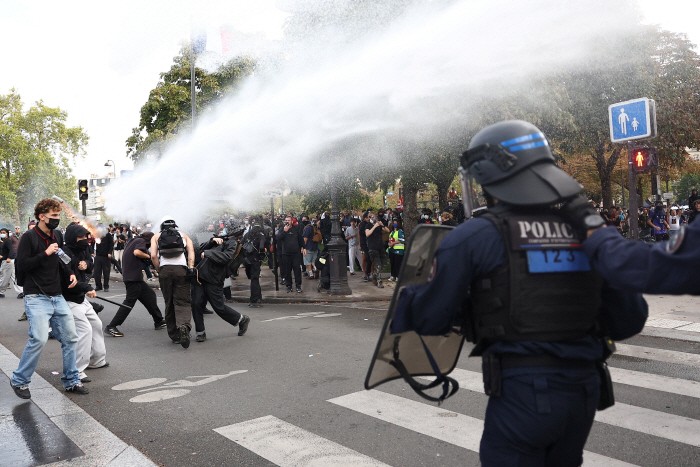 |
| Protesters react as police deploy water cannons during clashes at Place de la République in Paris, France, on the 6th (local time), amid nationwide demonstrations and school blockades staged by high school and university students backed by teachers' unions and parents. Students are protesting what they describe as years of chronic underinvestment leading to overcrowded classrooms, teacher shortages, and deteriorating school facilities. / Reuters, Yonhap |
French Prime Minister calls toll "heaviest price paid by school system in decades"
Prime Minister Sébastien Lecornu told parliament that 215 students and 85 school staff members were injured, calling it the "heaviest price the school system has paid in decades." The Prime Minister's Office stated that more than 700 police officers were injured, while Interior Minister Laurent Nuñez put the tally of wounded police at 715.
The Interior Ministry announced that 488 individuals were arrested and 48 security personnel were injured on that day alone. Cumulative arrests since the unrest began have surpassed 6,000, and the Ministry of Justice stated that roughly 1,800 people, including 1,483 minors, have been indicted.
Controversy surrounding police tactics is intensifying following a string of severe injuries. On the 30th of last month, a 16-year-old student lost vision in his right eye during a standoff with police, and on the 5th, a 15-year-old student in the northern town of Lens lost his left hand to an explosive device presumed to be a stun grenade. In Saint-Ouen-l'Aumône, a police officer was charged after allegedly firing a tear gas canister at a 14-year-old boy, causing him to lose most of his teeth, AFP reported.
Minister Nuñez stated that 10 internal inquiries are underway looking into misconduct during the crackdowns, but pushed back by insisting police responses were "proportionate in almost all instances." Prime Minister Lecornu criticized the unrest, declaring that "there is no room for tolerance when it comes to violence" and that "burning down schools does not improve them," while dismissing allegations of police racism as a "lie."
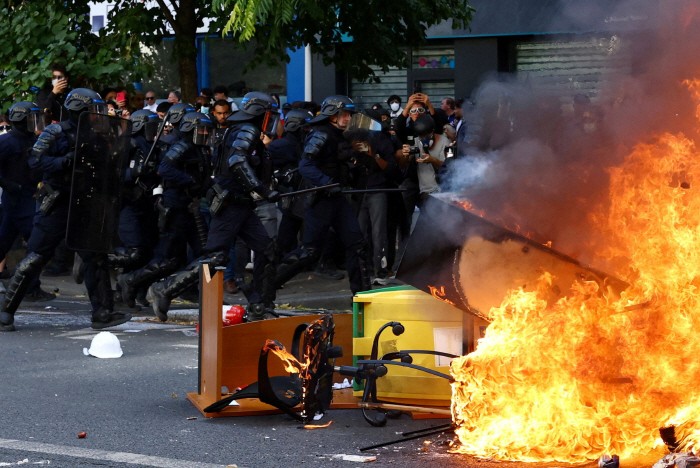 |
| A French riot police officer from the Compagnies Républicaines de Sécurité (CRS) runs past a burning object after clashing with protesters in Paris, France, on the 6th (local time), as high school and university students, backed by teachers' unions and parents, stage nationwide protests and school blockades. / Reuters, Yonhap |
High school union demands "€10B emergency budget"
The Union Syndicale Lycéenne (USL) reiterated its demands for an emergency school budget allocation of 10 billion euros (approx. 15.09 trillion won), large-scale recruitment of new teachers, and an increase of 150,000 slots in higher education capacity. Students cited leaking ceilings, rodent-infested classrooms, shortages of desks and chairs, uncooled classrooms in summer, instructional hours ranking among the longest in Europe, and college application portals that leave applicants waiting months for results as primary grievances.
According to Reuters, France's education spending has failed to keep pace with inflation, and data from the 2025 Programme for International Student Assessment (PISA) showed that the overall academic performance of French students lagged behind their OECD peers.
Prime Minister Lecornu directed relevant ministries to fill teacher vacancies, adjust the 8 a.m. to 6 p.m. school day, extend lunch breaks, and review renovation plans for deteriorating school infrastructure, ordering an initial proposal by the end of October. He announced that regular classes would be suspended on Thursday and Friday to allow school principals to hold consultations with students. Minister of National Education Édouard Geffray stated on French television that the government had "already begun implementing an action plan," while the education ministry launched an anonymous online portal where high schoolers can submit difficulties they encounter at school.
The core challenge remains funding. The 2027 draft budget pursued by the Lecornu administration seeks to raise certain taxes while freezing social welfare outlays, including housing and family allowances. The Washington Post reported that the draft budget also includes pension rule revisions, public-sector wage freezes, and curbs on healthcare expenditures.
Education represents one of the largest expenditure categories alongside defense, while interest payments on the national debt also consume an enormous share of state funds. Émilie Rhome, a parent protesting outside the Lycée Hélène-Boucher in Paris, argued government assurances fall short, pointing out: "Those words do not change our children's daily lives."
Suzanne Neydam, head of the student union coalition, pledged to continue demonstrations until authorities meet their demands, stressing, "Action must be taken now, and the ball is in the government's court."
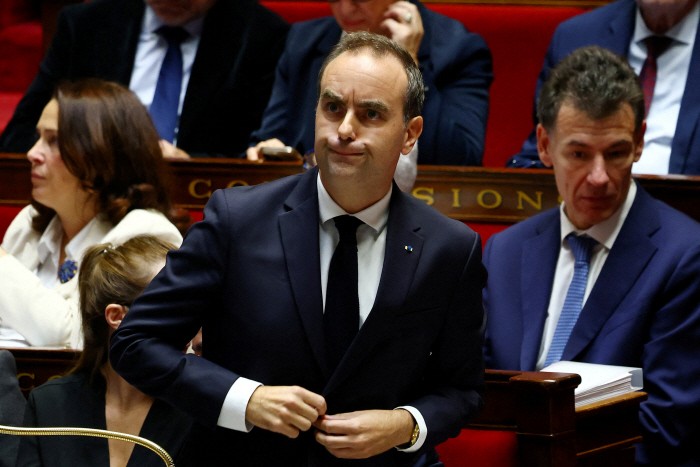 |
| French Prime Minister Sébastien Lecornu attends a government question time session held at the National Assembly in Paris on the 6th (local time). / Reuters, Yonhap |
France's 10-year sovereign bond yield tops 5%
Behind the wall facing education spending demands lies a surge in borrowing costs. France's benchmark 10-year government bond yield briefly crossed the 5% threshold last week, hitting a 24-year high. The Wall Street Journal (WSJ) assessed that France stands on the brink of a dangerous fiscal vicious cycle. Citing Tullett Prebon data, the WSJ noted that France's 10-year yield, which had dropped to minus 0.341% on December 31, 2020, rose to 4.867% on the 5th, surpassing both Italy (4.642%) and Greece (4.487%). According to the National Institute of Statistics and Economic Studies (INSEE), France's government debt-to-GDP ratio climbed from 60.5% in the first quarter of 2000 to over 110% in 2020, before surging to 119% in the second quarter of this year.
The New York Times (NYT) reported that France's public debt stands at roughly $4 trillion (5,360 trillion won)—amounting to 119% of annual economic output—with annual debt-servicing costs projected to expand to roughly $100 billion (134 trillion won) by 2027. Citing a treasury-commissioned report, the WSJ reported that interest outlays are set to surge by 59% by 2030, potentially far exceeding military expenditures around that time. The governor of the Bank of France described this tightening fiscal bind as a "gradual stranglehold."
The investor base has also deteriorated. The WSJ reported that the Bank of France is no longer purchasing sovereign debt and is letting bond holdings mature without reinvestment, while traditionally stable buyers such as Japanese asset management firms have retreated. Hedge funds that stepped in to fill the vacuum have sustained losses from recent volatility.
According to Agence France Trésor (AFT) data, maturities for medium- and long-term bonds are projected to peak from 60.19 billion euros (90.82 trillion won) in 2026 to 283.74 billion euros (428.12 trillion won) in 2029. France faces the task of refinancing over $1 trillion (1,340 trillion won) by 2030 and plans to issue a record $380 billion (509.2 trillion won) in bonds next year. The spike in borrowing costs has rippled across the broader eurozone, with euro weakness triggering fresh alarms, though Finance Minister Roland Lescure drew a line, asserting there is no need for European Central Bank (ECB) intervention.
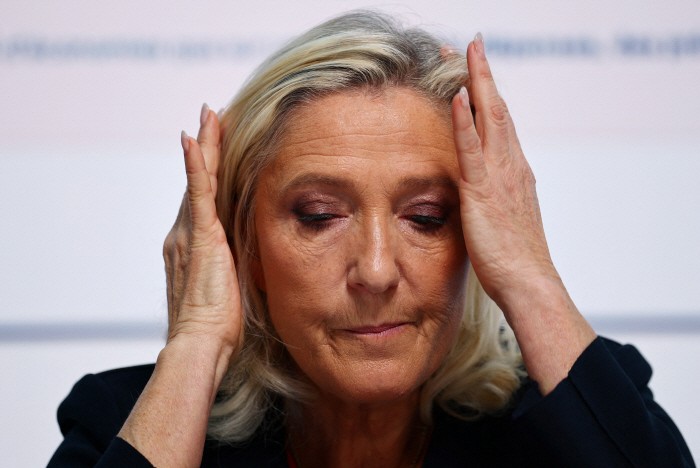 |
| Marine Le Pen, lawmaker of the right-wing National Rally (RN) and 2027 presidential candidate, presents the party's 2027 alternative budget proposal and fiscal strategy during a press conference in Paris on the 6th (local time). / Reuters, Yonhap |
France runs zero balanced budgets since 1974; debt hits 119% of GDP as interest burden surges
The Wall Street Journal analyzed that France's debt problem is rooted in decades of overspending to sustain its vast welfare state, noting that the country has not balanced a budget even once since 1974. Sylvain Maillard, a lawmaker from President Emmanuel Macron's centrist party, told the WSJ, "In France, there is a reflex to ask the state for a bit more 'magic money.'"
According to INSEE data, the fiscal balance has remained in deficit continuously since the mid-1970s, deteriorating to minus 8.9% of GDP in 2020, with deficits entrenched above 5% over the past three years. Citing a treasury-commissioned report, the WSJ reported that the deficit ratio could widen to 6.8% by 2030. The OECD estimated that without spending cuts, the debt-to-GDP ratio could reach 200% by 2050.
A confidential French Treasury memo dated December 7, 2023, obtained by the WSJ, warned that revenue shortfalls and underestimated expenditures could widen that year's deficit from 4.9% to 5.2%—opening a 9.2 billion euro (approx. 13.88 trillion won) hole—while recommending against making the figure public. By February 2024, another memo showed forecasts worsening further, leaving then-Finance Minister Bruno Le Maire confronting a shortfall of roughly 40 billion euros (approx. 60.35 trillion won).
At an Élysée Palace dinner in April that year, President Macron drew a firm line, remarking, "Some talk of an amended budget, but I do not see the need," and adding, "Our problem is not excessive spending. The problem is declining tax revenue." Following a crushing defeat in the European Parliament elections in June that year, Macron's dissolution of parliament cost the ruling camp its majority, prompting former Minister Le Maire to warn of a "regime crisis" (crise de régime).
Macron had previously released at least 10 billion euros (approx. 15.09 trillion won) to placate the Yellow Vest protests. During the COVID-19 pandemic and the war in Ukraine, he invoked a "whatever the cost" (quoi qu'il en coûte) doctrine, rolling out paid furlough subsidies and energy price caps.
Kenneth Rogoff, a Harvard University economics professor who specializes in financial crises, told the NYT, "France's situation looks unsustainable, and the bond market is telling you that, but it's not screaming yet," characterizing the dynamic as "a slow-motion train wreck."
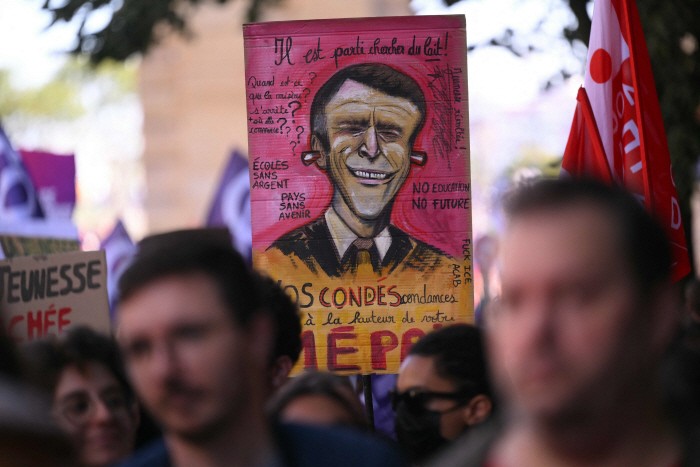 |
| A demonstrator holds a placard caricaturing French President Emmanuel Macron during nationwide protests demanding improved educational conditions in Bordeaux, southwestern France, on the 6th (local time). Since late September, students have blockaded entrances to hundreds of schools to protest teacher shortages, excessive course loads, deteriorating classrooms, and school infrastructure ill-equipped to handle rising temperatures. / AFP, Yonhap |
Next spring's presidential election emerges as top variable
Marine Le Pen, leader of the far-right National Rally (RN) and the front-runner in opinion polls, unveiled her economic platform on the same day, seeking to establish fiscal credibility by outlining cuts to public spending, including reductions in France's contributions to the European Union. However, the Wall Street Journal noted that her pledge to lower the retirement age to 60 would carry an additional cost of 9 billion euros (approx. 13.58 trillion won) per year.
Jean-Luc Mélenchon, leader of the far-left France Unbowed (LFI), urged the European Central Bank to freeze or write off 488 billion euros (approx. 736.31 trillion won) in French sovereign debt held by the Bank of France, declaring, "Throw it into the fire."
The National Rally holds 118 of the 577 seats in the National Assembly, making it the largest single party. The New York Times reported that analysts speculate Le Pen's faction might abstain during the budget vote, thereby allowing the bill to pass. Ales Koutny, head of international rates at U.S. asset manager Vanguard, observed that "everyone is just talking about how to spend more money."
Mujtaba Rahman, managing director for Europe at Eurasia Group, assessed that street unrest and financial market volatility are overshadowing the presidential race, noting that the government fears students' fury over schools could merge with broader grievances, such as soaring fuel prices, to fuel an uprising-like climate.
The surge in fuel costs spurred by the war in Iran has drawn parallels to the 2018–2020 Yellow Vest movement, and President Macron chaired a Group of Seven (G7) summit on the 1st, reaching an agreement to release 100 million barrels from strategic petroleum reserves.
U.S. President Donald Trump posted on social media platform Truth Social, claiming, "What is happening in France is nothing other than massive uncontrolled immigration," adding, "This is not about schools. This is about Islam taking over a once great country." Reuters pointed out that the students' demands are focused on staffing and budgetary shortages rather than religion or immigration, noting that even Le Pen's National Rally has refrained from linking the demonstrations to immigration policy. AFP interpreted President Trump's remarks as an effort to rally the global right ahead of the upcoming midterm elections.
Ha Man-ju
Most Read
-
1
Alteogen secures European patent for Keytruda SC,..

-
2
Trump shares map on social media labeling Strait o..

-
3
Celltrion seeks rheumatoid arthritis indication ex..

-
4
Kia Sportage outperforms Mazda CX-5 in German auto..

-
5
U.S. deploys carrier, 10,000 more troops to Middle..

-
6
Trump rejects Iran's offer to open Strait of Hormu..

-
7
N. Korea conducts first swarm attack drill with dr..

PEOPLE






HEADLINE NEWS
- Pyongyang calls DMZ explosion Seoul's fabrication and grave provocation
- U.S. Department of Defense completely halts use of blacklisted Anthropic AI
- 2026 Nobel Prize in Physics awarded to Francis Halzen for neutrino research
- French students take to streets, expressing frustration over economy, educa..

-
Address : In-Young Bldg., 34, Uisadang-daero 1-gil, Yeongdeungpo-gu, Seoul
Copyright by ASIATODAY CO., LTD. All rights resereved