



Hanwha Ocean develops low-carbon standard FPSO
Aug 25, 2026, 10:01 am


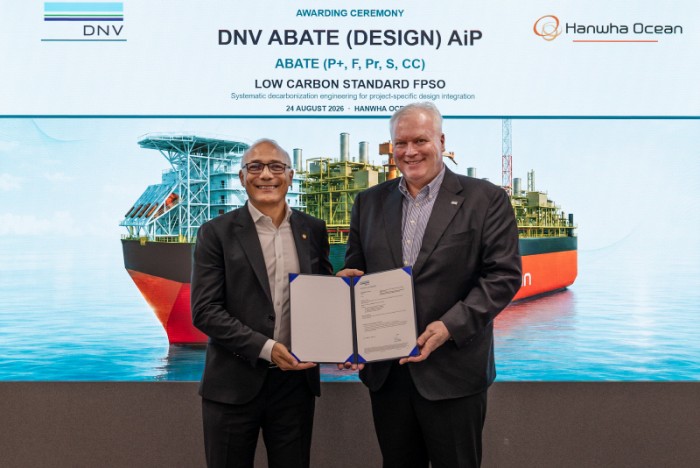 |
| Philippe Levy, president of the Offshore Business Division (EPU) at Hanwha Ocean (left), and Vidar Dolonen, regional manager of DNV Korea and Japan, pose for a commemorative photo after the AIP presentation ceremony on the 24th. / Hanwha Ocean |
Hanwha Ocean is accelerating efforts to strengthen its competitiveness in offshore plants by developing a standardized floating production, storage, and offloading (FPSO) unit incorporating low-carbon technologies. Amid rising demands from global corporations for carbon reduction, the company's strategy is to standardize low-carbon designs and sustainability execution frameworks to translate them into winning future orders.
On the 25th, Hanwha Ocean announced that it received Approval in Principle (AIP) from the Norwegian classification society DNV for the design framework of its low-carbon standard FPSO. It also obtained AIP from the American Bureau of Shipping (ABS), along with a Project Sustainability Execution Plan (PSEP) certificate.
AIP is a procedure in which a classification society verifies the technical feasibility and applicability of new technologies or design concepts. The PSEP is a structured framework detailing the responsible organization, key performance indicators, and verification procedures to ensure sustainability goals are implemented and managed throughout actual project execution.
In the FPSO market recently, eco-friendly competitiveness such as carbon reduction and energy efficiency has emerged as a key criterion for awarding contracts. Building upon its existing standard FPSO design, Hanwha Ocean is establishing a platform that systematizes applicable low-carbon technologies, allowing them to be selected and applied according to specific project requirements.
Previously, low-carbon technologies were reviewed and implemented on an individual project basis. Going forward, the plan is to standardize verified technologies so they can be repeatedly utilized across multiple projects.
Hanwha Ocean continues to expand its FPSO standardization strategy. In 2024, it developed a standard FPSO applicable to West Africa and secured certification from ABS and the French classification society Bureau Veritas (BV). This year, it developed a standard FPSO optimized for South America and obtained certifications from ABS and DNV.
Hanwha Ocean plans to leverage the low-carbon design and execution framework validated through this AIP in future client negotiations, bidding, front-end engineering design (FEED), and project execution. The low-carbon technologies will be advanced into reusable technology packages and applied according to project-specific demands.
A Hanwha Ocean official said, "This certification is meaningful in that both pillars—low-carbon design and the sustainability execution framework—have been validated," adding, "We plan to develop these verification results into reusable low-carbon technology packages and sustainability execution frameworks for future projects to strengthen our bidding competitiveness and project execution capabilities."
Kim Han-seul
Most Read
-
1
Kia Sportage outperforms Mazda CX-5 in German auto..

-
2
Houthis launch successive attacks on Saudi airport..

-
3
Saudi Arabia, Iran hold first diplomatic talks to..

-
4
U.S. deploys carrier, 10,000 more troops to Middle..

-
5
Saudi airport in Riyadh struck again, leaving at l..

-
6
Japan tracks Ukraine fiber-optic drones, bolsters..

-
7
Putin's ally visits China on the 8th ahead of APEC..

PEOPLE






HEADLINE NEWS
- Trump slams Nobel Peace Prize snub, claiming he is 'preventing war' between the two Koreas
- China makes tactical retreat following fierce pushback from EU
- Japan openly opposes U.S. sanctions on ICC, fueling tensions with Washingto..
- Military service exemptions for artists and athletes under scrutiny at parl..

-
Address : In-Young Bldg., 34, Uisadang-daero 1-gil, Yeongdeungpo-gu, Seoul
Copyright by ASIATODAY CO., LTD. All rights resereved