



S. Korea's military sees N. Korea preparing more troops for Russia, but no imminent signs
Aug 24, 2026, 09:04 am


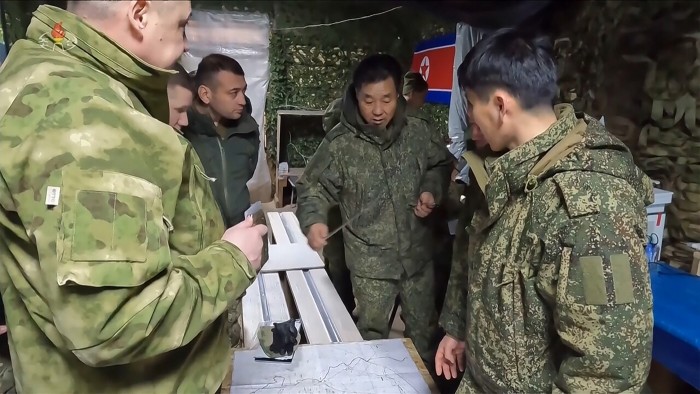 |
| A scene from video documentary footage of North Korean troops participating in the war in Ukraine, released about a year ago in late August of last year by North Korea's Korean Central Television (KCTV). North Korean military officers are engaged in tactical discussions with Russian military officials. / Yonhap |
South Korean military authorities stated that "no imminent signs have been identified so far" regarding the possibility of North Korea deploying additional troops to Russia, a claim recently raised by Ukraine. This marks the first time that our military authorities' assessment of trends regarding additional North Korean troop deployments has been made public.
According to data submitted on the 23rd to the office of Representative Yu Yong-weon of the People Power Party by the Defense Intelligence Agency of the Ministry of National Defense, the ministry stated, "North Korea's preparations for deployment are ongoing, but no signs of an imminent additional deployment have been identified at present," adding, "We are tracking North Korea's additional deployment trends through intelligence cooperation with related countries."
Earlier, Ukrainian President Volodymyr Zelenskyy claimed last month that more than 30,000 North Korean troops had been additionally deployed to Russia. South Korea's military assesses that North Korea has sent approximately 15,000 combat troops and more than 6,000 engineering and construction personnel to Russia since October 2024.
The scale of North Korea's weapons support to Russia was also found to be substantial. The military authorities assessed that artillery shells provided by North Korea to Russia amount to more than 15 million rounds when converted into 152 mm artillery shells. They also analyzed that North Korea has continued to provide various weapons systems, including short-range ballistic missiles, since the outbreak of the Russia-Ukraine war.
In particular, the military is paying close attention to the possibility that the performance of North Korean-made missiles deployed on Russian battlefields has improved. The analysis suggests that the accuracy and reliability of North Korean weapons systems may have increased, given that flight and hit data have been accumulated in actual combat operations, and considering the possibility of Russian technical advice and parts support. Such battlefield experience has the potential to lead to the advancement of North Korea's tactical weapons targeting the Korean Peninsula directly.
The Defense Intelligence Agency assessed that the Hwasong-11 series tactical ballistic missiles and 600 mm super-large multiple rocket launchers, which are intended for strikes against South Korea, have mostly entered the final stages of development. It views them as easier to operate than existing Scud-series missiles, with improved accuracy, interception evasion capabilities, and mass-launch capacity.
The military authorities judge that there is a possibility these will be deployed to North Korean frontline corps near the Military Demarcation Line in the future to replace aging missiles and reinforce long-range firepower.
However, regarding the new tactical ballistic missile that North Korea announced it would deploy 250 launchers of to the front line, the agency stated that "preparations for fielding are underway," but added, "no signs of operational deployment have been captured so far."
The Hwasong-12 intermediate-range ballistic missile, capable of putting the U.S. territory of Guam within range, was identified as undergoing preparations for operational deployment following development. In addition, intercontinental ballistic missiles (ICBMs) were analyzed to have acquired the flight capability to reach the U.S. mainland. However, core technologies such as the warhead's atmospheric reentry remain unverified, the Defense Intelligence Agency added.
Representative Yoo Yong-won stated, "We must not take lightly the fact that the combat experience and data accumulated by North Korea in the war could return as a threat directed at the Korean Peninsula," adding, "As the threat of provocation is advancing to a more sophisticated and lethal stage, we must focus all our efforts on maintaining a steadfast military readiness posture and the South Korea-U.S. combined defense posture."
Lee Han-sol
Most Read
-
1
Kia Sportage outperforms Mazda CX-5 in German auto..

-
2
Houthis launch successive attacks on Saudi airport..

-
3
Saudi Arabia, Iran hold first diplomatic talks to..

-
4
U.S. deploys carrier, 10,000 more troops to Middle..

-
5
Saudi airport in Riyadh struck again, leaving at l..

-
6
Japan tracks Ukraine fiber-optic drones, bolsters..

-
7
Putin's ally visits China on the 8th ahead of APEC..

PEOPLE






HEADLINE NEWS
- Trump slams Nobel Peace Prize snub, claiming he is 'preventing war' between the two Koreas
- China makes tactical retreat following fierce pushback from EU
- Japan openly opposes U.S. sanctions on ICC, fueling tensions with Washingto..
- Military service exemptions for artists and athletes under scrutiny at parl..

-
Address : In-Young Bldg., 34, Uisadang-daero 1-gil, Yeongdeungpo-gu, Seoul
Copyright by ASIATODAY CO., LTD. All rights resereved