



With 30 years of CJ's culture investment, K-Life drives its next growth chapter in North America
Aug 18, 2026, 09:53 am


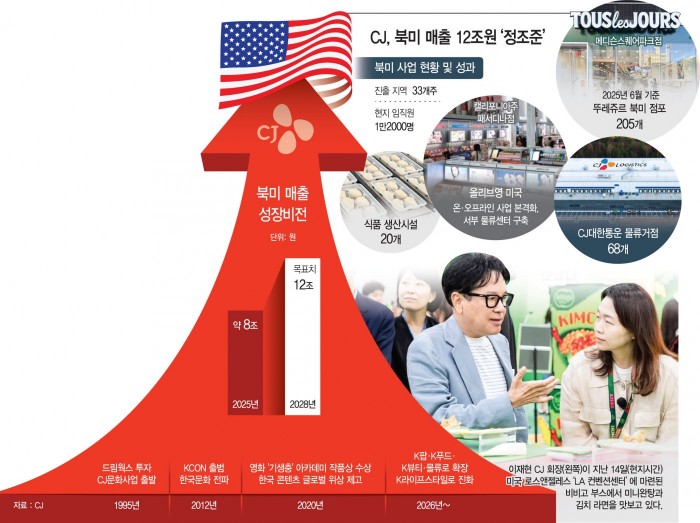 |
CJ Group Chairman Lee Jay-hyun visited the U.S. again just three months after his last trip in May, this time to see firsthand how CJ's cultural business — launched in America 30 years ago — has expanded beyond K-pop and K-dramas into K-food and K-beauty, becoming woven into locals' daily lives. During his visit, at KCON and the Olive Young Festa, American consumers were seen enjoying Korean music, sampling Korean food, and trying Korean cosmetics in a seamless flow. Content that once introduced Korea to the world through separate cultural channels is now converging into a single experience, evolving into a new consumer culture called "K-Lifestyle."
CJ Group is treating this trend as a new growth engine for its North American business, aiming to boost synergy across its affiliates and expand its local business foundation toward a goal of 12 trillion won in revenue by 2028.
On the 15th (local time), Chairman Lee, joined by CJ ENM Vice Chair Miky Lee and Brand Strategy Office head Lee Kyung-hoo, attended a KCON concert at Crypto.com Arena in Los Angeles. He watched as the audience sang along to ILLIT's "Not Cute Anymore" and cheered for performances by IZNA and ZEROBASEONE, both under CJ ENM affiliate WAKEONE.
Lee visited the KCON venue every day for three days starting on the 14th. He toured the Olive Young Festa and the "K-Collection" booth supporting small and medium-sized enterprises' global expansion, both set up at the LA Convention Center near the concert venue. At the roughly 4,600-square-meter Olive Young Festa, he observed young American consumers lining up for skin-scan experiences, and after sampling Bibigo Kimchi Noodles, recently launched in the U.S., remarked that it needed more of a "kick." After touring the venues, Lee said that just as CJ's cultural business began 30 years ago with the belief that "culture is the future industry," the company should now advance toward becoming a "global K-Lifestyle leader" filling people's daily lives worldwide with content, food, and beauty.
CJ's cultural business began with its 1995 investment in DreamWorks in the U.S. At the time, there was considerable skepticism about a food company investing in the film industry, but CJ pressed forward, guided by its belief that culture would be a future industry. Lee set out a vision at the time that people around the world would watch two to three Korean films a year, eat Korean food once or twice a month, watch one or two Korean dramas a week, and listen to one or two Korean songs a day.
From there, starting with multiplex chain CGV, CJ expanded into film, broadcasting, music, and other content businesses, and in 2012 launched KCON to introduce Korean culture, centered on K-pop, to the world. When the film "Parasite" won the Academy Award for Best Picture in 2020, elevating the global standing of Korean content, CJ's own trajectory reached a new turning point as well.
CJ CEO Huh Min-hoe stressed at a press briefing held at the Hilton Glendale on the 15th that the vision CJ laid out 30 years ago is now becoming reality. Citing recent visits to Tous les Jours, Olive Young, and CJ CheilJedang facilities, as well as KCON and the Olive Young Festa, he said the journey that began with culture is now becoming embedded in Americans' everyday habits, explaining that "K-Lifestyle has become part of daily life."
CJ currently operates in 33 U.S. states, with local employees now exceeding 12,000. The company operates 20 food production facilities and 55 CJ Logistics warehouses, the result of nearly 10 trillion won invested in the U.S. market over the past two to three decades to build out local production, distribution, and logistics infrastructure. North American revenue currently stands at about 8 trillion won.
CJ's U.S. business is also expanding beyond content-driven cultural outreach into building out local business infrastructure spanning food production, logistics, and beauty retail. Tous les Jours began operating an automated production plant spanning about 90,000 square meters in Georgia in late last year, securing a supply base to support its North American expansion. As of June, the number of North American stores had grown to 205, and the U.S. subsidiary has posted net profit for eight consecutive years since 2018. CJ Logistics operates 68 logistics hubs across North America, strengthening its cold-chain logistics network targeting high-value industries such as food and pharmaceuticals. Olive Young has also launched its online and offline business in earnest this year based on its U.S. subsidiary, built a West Coast logistics center, and is expanding local distribution for small and medium-sized K-beauty brands through a partnership with Sephora. KCON, meanwhile, started in Irvine, California in 2012 with about 10,000 attendees and has grown into a global festival drawing 125,000 attendees last year, with cumulative offline attendance from 2012 to 2025 reaching 2.35 million.
CJ now plans to move fully into a new growth phase for its North American business. Kim Jin-sik, co-CEO of CJ America, stressed that the company is internally developing a strategy for this "phase two" growth and is looking to Olive Young's expansion as new momentum, adding, "We aim to reach 12 trillion won in revenue in the Americas region by 2028."
Jeong Moon-kyung
Most Read
-
1
Kia Sportage outperforms Mazda CX-5 in German auto..

-
2
Houthis launch successive attacks on Saudi airport..

-
3
Saudi Arabia, Iran hold first diplomatic talks to..

-
4
U.S. deploys carrier, 10,000 more troops to Middle..

-
5
Saudi airport in Riyadh struck again, leaving at l..

-
6
Japan tracks Ukraine fiber-optic drones, bolsters..

-
7
Putin's ally visits China on the 8th ahead of APEC..

PEOPLE






HEADLINE NEWS
- Trump slams Nobel Peace Prize snub, claiming he is 'preventing war' between the two Koreas
- China makes tactical retreat following fierce pushback from EU
- Japan openly opposes U.S. sanctions on ICC, fueling tensions with Washingto..
- Military service exemptions for artists and athletes under scrutiny at parl..

-
Address : In-Young Bldg., 34, Uisadang-daero 1-gil, Yeongdeungpo-gu, Seoul
Copyright by ASIATODAY CO., LTD. All rights resereved