



How far has K-defense's ultra-cheap kamikaze drone come?
Aug 14, 2026, 09:15 am


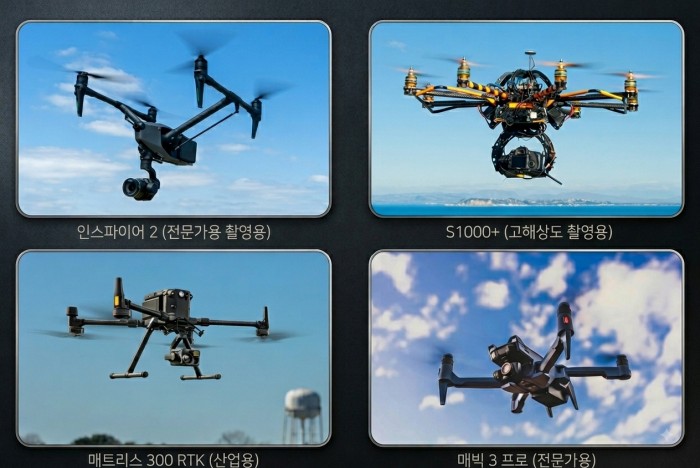 |
| An Inspire 2 (for professional filming) and an S1000+ (for high-resolution filming) are positioned at the top of the photo, showcasing their capabilities as high-performance filming equipment. Specific labels — "flight test phase," "mass production model," "ultra-low-cost mass-market model," and "precision-strike mini model" — visually demonstrate that kamikaze drones have moved beyond the conceptual stage into mass production and technical refinement for actual deployment, showing they are on the verge of real-world use in the field of low-cost, high-efficiency asymmetric warfare. / Photo: Courtesy of U2SR |
The U.S.-Iran war has proven one thing: even a $10 million interceptor missile can hit the wall of "ammunition depletion" when faced with a swarm of $10,000 drones.
Korea's defense industry has quickly absorbed this lesson. Unmanned systems being developed by companies like Poongsan, LIG Nex1, NearThLab, and Pablo Air are showcasing warfare's new "cost-performance formula."
Poongsan, designated Korea's first defense contractor in 1973 and known as an ammunition powerhouse, has taken a simple approach to entering the kamikaze drone market: instead of developing new warheads, it mounts existing 40mm DPICM submunitions and grenades (M67, K413) that the military already operates — sharply cutting development costs and unit prices.
The Army's multi-purpose combat drone "MCD-2," being fast-tracked under the "Ultra-Small Kamikaze Drone-I" program, is built on this same concept. The math is straightforward: the cost of a single SM-3 interceptor missile could instead field hundreds to thousands of drones. Being able to leverage existing ammunition production lines is also seen as a strength in a prolonged war of attrition.
LIG Nex1 is likewise focused on the "low-cost mass warfare" approach — the opposite concept from expensive precision-guided munitions. The AI-based swarm drone system it unveiled at Drone Show Korea (DSK 2026) in February, led by the Agency for Defense Development (ADD), is a small kamikaze drone launched in rapid succession from canisters like rockets, then swarming together to strike targets.
LIG Nex1 handled the manned-unmanned integrated weapons system and AI development for the project — meaning a defense company that builds precision-guided munitions costing billions of won is simultaneously building out a new mode of warfare involving mass deployment of cheap drones.
NearThLab, a startup that started out with drones for inspecting wind turbines, has also delivered results just two years after entering the defense sector, landing a $10 million (about 14 billion won) contract in the Middle East last year — considered a major deal in Korea's defense drone industry.
The contract centers not on the interceptor drone "KAiDEN" but on the swarm kamikaze drone "XAiDEN." Its core technology is "physical AI," designed to carry out missions autonomously even on battlefields where GPS and communications are jammed. According to the company, a single operator can control up to 100 units simultaneously. KAiDEN has separately completed export to Singapore, and the company passed preliminary review for a KOSDAQ listing this year.
Pablo Air, known for its drone light shows, is also stepping up its push into the defense market. According to the company, it acquired precision machining firm Volk, which has 40 years of manufacturing experience, in August of last year to secure military-spec (mil-spec) certified manufacturing infrastructure, and has built out a mass-production system for kamikaze drones under its dedicated defense brand, "Pablo M."
Pablo Air says it has become the first Korean company to reach Stage 4 — "leaderless, fully distributed collaboration" — on a five-stage scale of domestic swarm drone technology.
The lesson of the U.S.-Iran war is clear: relying solely on $10 million interceptor systems to keep shooting down $10,000 drones is unsustainable in a prolonged war of attrition.
From Poongsan's ammunition infrastructure to LIG Nex1's swarm-based mass warfare approach, NearThLab's jamming-resistant AI, and Pablo Air's mass production system, the blueprint Korea's defense industry is drawing ultimately converges on one point: the ability to deploy drones "cheaply, in large numbers, and without interruption" will determine the outcome of future battlefields.
Koo Pil-hyun
Most Read
-
1
Kia Sportage outperforms Mazda CX-5 in German auto..

-
2
Houthis launch successive attacks on Saudi airport..

-
3
Saudi Arabia, Iran hold first diplomatic talks to..

-
4
U.S. deploys carrier, 10,000 more troops to Middle..

-
5
Saudi airport in Riyadh struck again, leaving at l..

-
6
Japan tracks Ukraine fiber-optic drones, bolsters..

-
7
Putin's ally visits China on the 8th ahead of APEC..

PEOPLE






HEADLINE NEWS
- Trump slams Nobel Peace Prize snub, claiming he is 'preventing war' between the two Koreas
- China makes tactical retreat following fierce pushback from EU
- Japan openly opposes U.S. sanctions on ICC, fueling tensions with Washingto..
- Military service exemptions for artists and athletes under scrutiny at parl..

-
Address : In-Young Bldg., 34, Uisadang-daero 1-gil, Yeongdeungpo-gu, Seoul
Copyright by ASIATODAY CO., LTD. All rights resereved