



Hyundai Rotem, KAI integrate long-range missile into KF-21
Aug 13, 2026, 09:50 am


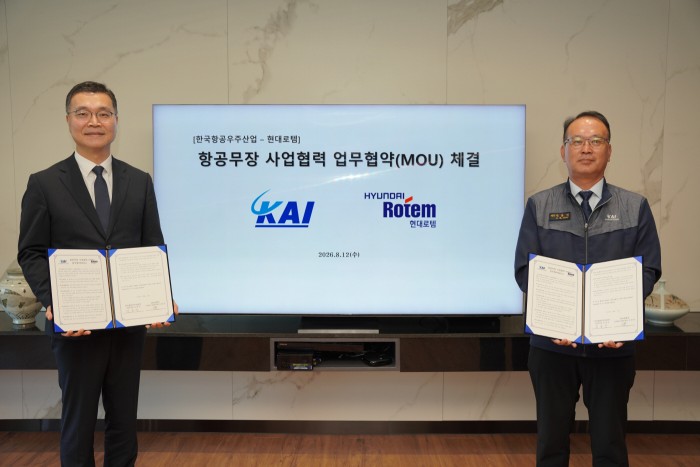 |
| Cho Hyung-jun, head of Hyundai Rotem's AD&RH Business Division (left), and Kim Yong-min, head of KAI's Business Division, pose for a photo at the signing ceremony for an "MOU on Aviation Weapons Business Cooperation," held at KAI's headquarters in Sacheon, South Gyeongsang Province, on the 12th. / Hyundai Rotem |
Hyundai Rotem is teaming up with Korea Aerospace Industries (KAI) to internalize aviation weapons technology, including long-range air-to-air missiles, for South Korea's indigenous supersonic fighter jet, the KF-21. The move goes beyond simple technical cooperation, aiming to build an export model that packages the domestic fighter jet together with its weapons systems, boosting competitiveness in the global defense market.
Hyundai Rotem announced on the 13th that it signed a memorandum of understanding (MOU) with KAI on the 12th at KAI's headquarters in Sacheon, South Gyeongsang Province, for cooperation in the aviation weapons business.
Cho Hyung-jun, head of Hyundai Rotem's AD&RH Business Division, and Kim Yong-min, head of KAI's business division, attended the signing ceremony, among others. The core of the partnership is securing system integration capabilities between aircraft platforms and onboard weapons.
The two companies plan to expand technical cooperation in developing aircraft platforms like the KF-21 alongside aviation weapons, including long-range air-to-air missiles, and to advance integration technology linking platforms and weapons so they can be mounted and operated on actual aircraft.
Through this, the companies aim to eventually move away from selling fighter jets and missiles separately, instead developing a package-style export model that bundles "aircraft plus weapons" together.
The growing trend of package-style exports in the global defense market is also part of the backdrop for this partnership. For countries acquiring fighter jets, receiving a platform and weapons that are pre-integrated offers greater operational convenience and business efficiency compared to purchasing the aircraft and weapons separately and then handling integration on their own.
In particular, once KF-21 exports move into full swing, being able to offer domestically made air-to-air missiles and other onboard weapons alongside the aircraft itself could broaden the scope of export deals.
Since business can continue even after the initial aircraft sale — through additional weapons purchases, maintenance, and follow-on support — the partnership is also expected to yield long-term export benefits.
Hyundai Rotem, which has built up various future aerospace technologies, also sees this partnership as an opportunity to expand its business portfolio — traditionally centered on ground weapons — into the aerospace and guided weapons sectors.
KAI, for its part, holds development capabilities for aircraft platforms including the KF-21, so as the partnership moves forward, it could lead to the creation of a domestic aviation weapons ecosystem combining Hyundai Rotem's guided weapons and propulsion technology with KAI's aircraft systems expertise.
Industry observers see this partnership as likely to affect the KF-21's future export competitiveness. Since export competitiveness hinges not just on a fighter jet's own performance but on how diverse a range of weapons it can integrate, building domestic capability to jointly develop and integrate aircraft and weapons could take Korea's defense export model to a new level.
A Hyundai Rotem official said, "Based on both companies' expertise and business capabilities, we will contribute to strengthening national defense and self-reliant defense capacity through healthy competition, and work to help Korea's defense industry grow through diversity."
Kim Jeong-kyu
Most Read
-
1
Kia Sportage outperforms Mazda CX-5 in German auto..

-
2
Houthis launch successive attacks on Saudi airport..

-
3
Saudi Arabia, Iran hold first diplomatic talks to..

-
4
U.S. deploys carrier, 10,000 more troops to Middle..

-
5
Saudi airport in Riyadh struck again, leaving at l..

-
6
Japan tracks Ukraine fiber-optic drones, bolsters..

-
7
Putin's ally visits China on the 8th ahead of APEC..

PEOPLE






HEADLINE NEWS
- Trump slams Nobel Peace Prize snub, claiming he is 'preventing war' between the two Koreas
- China makes tactical retreat following fierce pushback from EU
- Japan openly opposes U.S. sanctions on ICC, fueling tensions with Washingto..
- Military service exemptions for artists and athletes under scrutiny at parl..

-
Address : In-Young Bldg., 34, Uisadang-daero 1-gil, Yeongdeungpo-gu, Seoul
Copyright by ASIATODAY CO., LTD. All rights resereved