



ISA reform sparks debate: Can restricting overseas investment boost domestic market?
Aug 11, 2026, 09:50 am


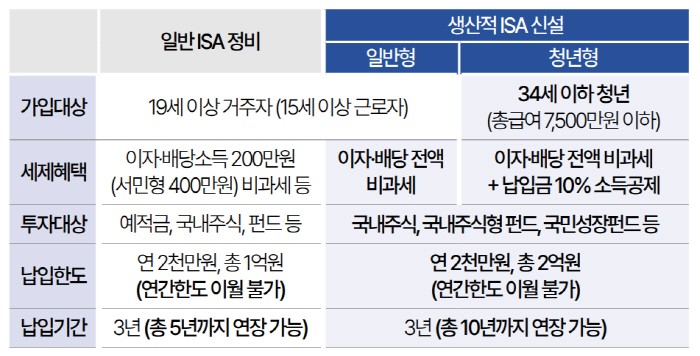 |
| ISA amendments included in the 2026 tax reform bill / Ministry of Economy and Finance |
 |
Since the government's tax reform announcement, backlash from individual investors over changes to the Individual Savings Account (ISA) hasn't let up. News broke that starting next year, new ISA accounts will be capped at a maximum five-year term, and the system allowing unused annual contribution limits to carry over will be scrapped. On social media and community forums, people have even been posting screenshots — half-joking, half-panicked — of extending their existing account's maturity date to the year "9999" to dodge the new rules.
ISA was originally introduced to help people build stable long-term assets. In particular, people in their 20s and 30s just starting their careers, often short on initial capital, have relied on the carryover feature — even if they couldn't max out their contribution limit every year, they could make up for it in a lump sum whenever they came into extra money. Combined with unlimited term extensions, this let younger investors dollar-cost average into domestic and overseas index ETFs over the long term and benefit from compounding — a genuinely useful "ladder" for building wealth.
Now, however, concerns are growing that this revision could cut that ladder out from under younger investors. According to the Korea Financial Investment Association, people in their 20s and 30s make up 40% of all ISA holders, yet account for just 27% of total deposited funds. Given that younger investors often need to gradually build up their contributions due to limited funds early on, scrapping the carryover system would make it much harder for them to catch up with a lump-sum deposit once they do come into money.
An even bigger concern is that the appeal of using ISA accounts to invest in domestically listed ETFs tracking overseas indices — long considered a standout performer — will drop sharply. Until now, account holders have used ISA's tax-exempt and separate-taxation benefits to dollar-cost average into Korea-listed ETFs tracking indices like the S&P 500 or Nasdaq 100. But with the new term limit and the end of contribution carryover, analysts say this kind of investing will become much more constrained.
The government's proposed alternative, the "Productive Finance ISA," has also drawn a cool reception from the market. This account excludes overseas assets entirely, designed to invest only in purely domestic assets such as Korean stocks and domestic equity funds. The government is offering a 10-year term and full tax exemption on interest and dividend income as incentives. But the Kospi 200's average dividend yield sits at just around 0.88%. That means the real tax benefit from dividend exemption on the maximum annual contribution of 20 million won comes to only around 20,000 won a year. Critics note that for investors, capital gains — not dividends — typically drive investment returns, and restricting the account to domestic assets sharply narrows investor choice. Given that the Kospi's gains over the past decade have been only about half those of the Nasdaq, some question how many investors would actually be willing to lock up funds in domestic assets for 10 years in exchange for such a modest tax break.
A thriving stock market and capital inflows are the natural result of building a market worth investing in — one driven by shareholder returns and genuine corporate growth potential. If Korea's stock market fails to offer that kind of appeal, it's only a matter of time before investors turn to direct overseas investment instead, even if it means giving up some tax benefits. This is the reasoning behind growing calls for policy to focus on building a market that can genuinely compete globally, rather than artificially locking capital inside the country by restricting overseas investment. If this ISA overhaul isn't going to end up driving investors' money away instead, authorities will need to genuinely listen to the market's concerns and investors' voices.
Han Hye-seong
Most Read
-
1
Celltrion nears additional contract with major U.S..

-
2
Putin proposes trilateral U.S.-China-Russia summit..

-
3
U.S. weighs dropping MOAB, world's most powerful n..

-
4
"Aren't those foreigners on welfare?": M..

-
5
Attention centers on APEC for possible Trump-Xi-Pu..

-
6
Saudi Arabia, Iran hold first diplomatic talks to..

-
7
China tightens grip on boosting domestic demand an..

PEOPLE







-
Address : In-Young Bldg., 34, Uisadang-daero 1-gil, Yeongdeungpo-gu, Seoul
Copyright by ASIATODAY CO., LTD. All rights resereved