



Russia-Ukraine air war intensifies, targets key infrastructure
Aug 11, 2026, 10:12 am


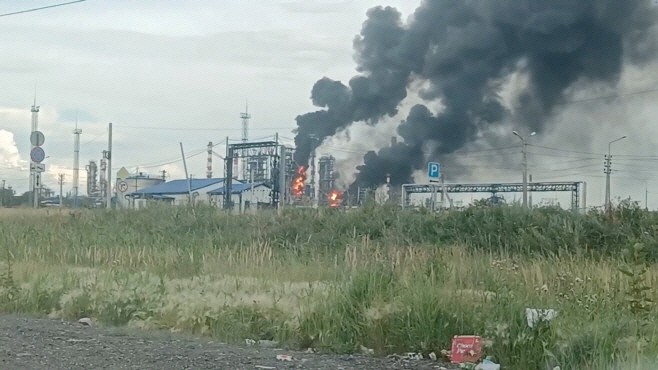 |
| A fire breaks out at an oil refinery in Omsk, Russia, following a drone strike attributed to Ukraine on the 6th (local time). The photo is a screen capture from social media video. / Reuters-Yonhap |
As Russia's attacks on Ukraine intensify in the air war, key infrastructure and economic facilities are being destroyed and civilian casualties are surging, CNN reported on the 9th (local time).
According to a UN report, at least 1,396 people were killed and 7,978 wounded in Ukraine in the first half of this year, including in June — the deadliest single month for civilians since 2022. That represents a 37% increase in casualties compared to the same period last year.
Russia's Foreign Ministry said at least 797 of its own civilians have been killed this year, though CNN and international monitoring groups said they could not independently verify the figure.
Ukraine has significantly advanced its drone technology over the past year. President Volodymyr Zelensky announced a 40-day operation in late June to intensify drone strikes on Russian territory, and aides have said the campaign will continue.
Ukraine has recently broken through St. Petersburg's air defenses and repeatedly struck Moscow — a strategy widely seen as aimed at pressuring Russia's business elite, who are close to the government, in hopes of pushing them to press for an end to the full-scale invasion.
Analysts say strikes increasingly target the broader Russian economy, citing an attack on a warehouse belonging to Wildberries, Russia's largest online retailer, as one example. Ukraine's government justified the strike by saying the facility supplied Russian frontline units, making it a legitimate military target.
A Ukrainian military source told CNN that early in the war, Russia concentrated its air defenses along the border and front lines, but Ukraine has since struck a wide range of regions to force Russian forces to disperse their air defense systems more broadly.
Natia Seskuria, a senior research fellow at the UK's Royal United Services Institute (RUSI), said Russia's interception capability weaknesses have been exposed over the past 40 days as Ukraine has successfully struck its targets, adding that this is placing significant strain on Russia.
Seskuria projected that President Vladimir Putin's strategic calculus is only likely to shift if internal pressure rises as Russia's economy deteriorates further, adding that the alternative — escalation of the war — currently appears more likely.
Olha Polishchuk, Eastern Europe research manager at global conflict monitor ACLED (Armed Conflict Location & Event Data Project), said attacks are becoming more frequent, casualties are rising, and the range of targets has also broadened.
Polishchuk explained that Ukraine has frequently struck Russian energy infrastructure such as oil refineries, tankers, and substations, and has also increased strikes aimed at disrupting Russian military logistics in occupied eastern territories.
Ukraine, meanwhile, continues to face difficulty securing weapons. President Zelensky has repeatedly asked allies for additional Patriot interceptor missiles, but U.S. stockpiles are reported to have declined due to the conflict in the Middle East.
President Donald Trump pledged at last month's NATO summit to allow weapons production for Ukraine, but later walked that commitment back.
Park Jin-sook
Most Read
-
1
Trump shares map on social media labeling Strait o..

-
2
Kia Sportage outperforms Mazda CX-5 in German auto..

-
3
Houthis launch successive attacks on Saudi airport..

-
4
U.S. deploys carrier, 10,000 more troops to Middle..

-
5
Trump rejects Iran's offer to open Strait of Hormu..

-
6
N. Korea conducts first swarm attack drill with dr..

-
7
U.S.-China summit falls short on substance as Trum..

PEOPLE






HEADLINE NEWS
- Seoul dismisses Ukraine's claim of 'S. Korean support for Russia' as "inaccurate and inappropriate"
- S. Korea, Japan race to develop nuclear-powered submarines
- Henri Kagan, Kenso Soai win Nobel Prize in Chemistry for uncovering how mol..
- Vance says Alaska LNG cooperation will move forward with Seoul's current or..

-
Address : In-Young Bldg., 34, Uisadang-daero 1-gil, Yeongdeungpo-gu, Seoul
Copyright by ASIATODAY CO., LTD. All rights resereved