



Japan's Self-Defense Forces adopt domestically developed AI for command and control for first time
Aug 11, 2026, 10:07 am


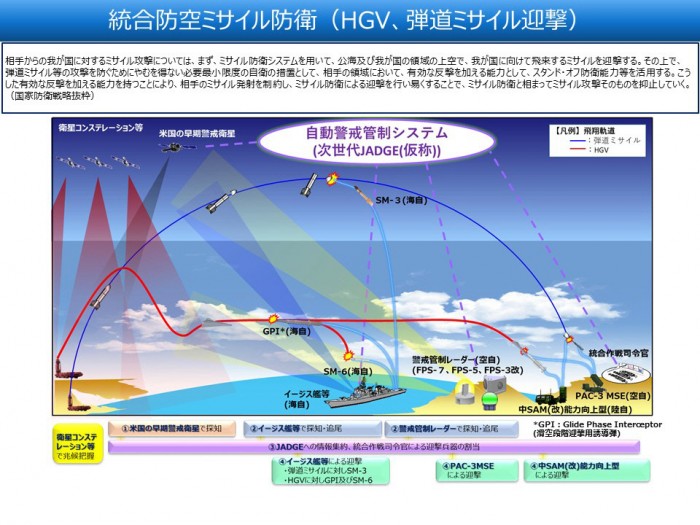 |
| Conceptual diagram of Japan's integrated air and missile defense system, released by the Ministry of Defense. It shows how information detected and tracked by satellites, radar, and Aegis vessels is integrated to counter ballistic missiles and hypersonic glide vehicles (HGVs). The Japanese government is pursuing plans to introduce domestically developed AI into this Self-Defense Forces command-and-control process for the first time. / Japan Ministry of Defense website |
The Japanese government plans to introduce domestically developed artificial intelligence for the first time at the core of the Self-Defense Forces' command-and-control system — the process that determines operational direction and unit deployment. The key aim is to have AI collect, analyze, and evaluate the flood of information streaming in from drones, satellites, and various sensors, reducing the time commanders need to make decisions.
Japan is also moving to secure "AI sovereignty" in the military domain, excluding Chinese-made AI models and limiting development personnel to Japanese nationals.
According to the Yomiuri Shimbun on the 10th, citing multiple Japanese government officials, the government plans to include a policy of using AI in Self-Defense Forces command and control in the three security-related documents, including the National Security Strategy, set to be revised by year-end.
Command and control forms the backbone of military operations — identifying enemy threats, developing response plans, and issuing orders down to frontline units. Japan's government envisions having AI support information gathering, analysis, and evaluation to speed up commanders' decision-making in time-sensitive situations such as missile defense.
Japan's Ministry of Defense is also elevating AI as a core pillar of next-generation defense capability. In materials on defense force restructuring released in March, the ministry outlined a direction of integrating and processing various data through AI to achieve "battlefield visualization" and "future prediction and recommendations," securing an edge in decision-making. A dedicated AI adoption task force reporting directly to the defense minister is also underway.
The AI system considered most likely to be adopted for Self-Defense Forces command and control is "Sakana Fugu," developed by Tokyo-based startup Sakana AI. Rather than relying on a single massive AI model to handle every task, Sakana Fugu uses an "orchestration" approach that distributes tasks among multiple specialized AI models and integrates their results. Sakana AI officially launched Fugu in June, describing it as a system designed so that new, high-performance AI models can be added into the framework as they emerge.
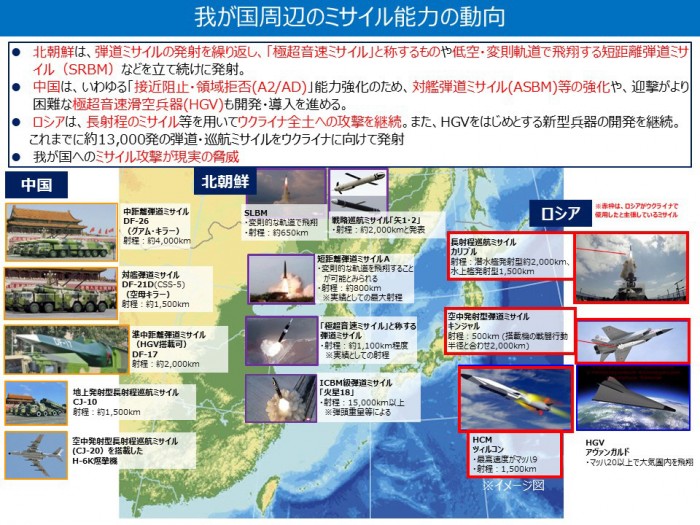 |
Overview of missile forces surrounding Japan, released by Japan's Ministry of Defense. As China, North Korea, and Russia advance development of ballistic missiles and hypersonic weapons, Japan plans to introduce AI into Self-Defense Forces command and control to speed up its response. / Japan Ministry of Defense website |
Sakana AI was founded in Tokyo in 2023 by David Ha, a former Google researcher, Ren Ito, a former Japanese Foreign Ministry official, and Llion Jones, a co-author of the original Transformer paper — the foundational technology behind today's generative AI. The company is regarded as one of the leading emerging startups among the domestic AI firms the Japanese government is fostering.
However, Fugu's version applied to military use will strictly exclude Chinese-made AI. While Chinese AI models were used in developing the general-purpose version of Fugu, they will be excluded from the system provided to the Self-Defense Forces, with the development team also limited to Japanese nationals. This reflects an "AI sovereignty" strategy — the idea that military and classified data must be manageable by Japan itself, without excessive reliance on foreign technology.
Japan appears to be moving to keep pace as the U.S. military increasingly leverages AI in command and control and intelligence analysis. The Ministry of Defense has officially designated AI as a core technology for command and decision-support, information processing, unmanned systems, and cyber operations, and is expanding cooperation with private-sector startups.
South Korea, too, is pursuing an AI transition in its military command system. The Ministry of National Defense established the Defense AI Center in 2024 and has been working to develop its joint all-domain command and control system into an AI-based next-generation system. This year's defense budget also designated a "Defense AI Transformation" as a key initiative, with related investment expanded. With Japan's latest decision, competition between South Korea and Japan to build future command-and-control systems — where AI analyzes vast battlefield data to support human commanders' decisions — looks set to accelerate further.
Choi Young-jae
Most Read
-
1
Trump shares map on social media labeling Strait o..

-
2
Kia Sportage outperforms Mazda CX-5 in German auto..

-
3
Houthis launch successive attacks on Saudi airport..

-
4
U.S. deploys carrier, 10,000 more troops to Middle..

-
5
Trump rejects Iran's offer to open Strait of Hormu..

-
6
N. Korea conducts first swarm attack drill with dr..

-
7
U.S.-China summit falls short on substance as Trum..

PEOPLE





HEADLINE NEWS
- Seoul dismisses Ukraine's claim of 'S. Korean support for Russia' as "inaccurate and inappropriate"
- S. Korea, Japan race to develop nuclear-powered submarines
- Henri Kagan, Kenso Soai win Nobel Prize in Chemistry for uncovering how mol..
- Vance says Alaska LNG cooperation will move forward with Seoul's current or..

-
Address : In-Young Bldg., 34, Uisadang-daero 1-gil, Yeongdeungpo-gu, Seoul
Copyright by ASIATODAY CO., LTD. All rights resereved