



S. Korea, U.S. to hold 5-day UFS exercise this month
Aug 11, 2026, 09:07 am


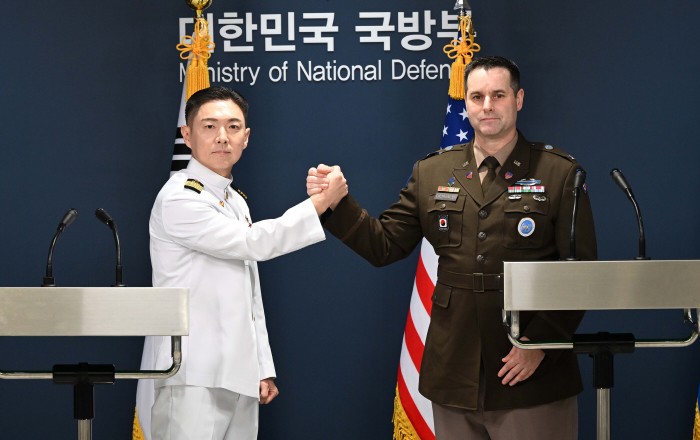 |
| Jang Do-young, spokesperson for the Joint Chiefs of Staff (left), shakes hands with Ryan Donald, spokesperson for United States Forces Korea, at the "2026 UFS Exercise Korea-U.S. Joint Briefing" held at the Ministry of National Defense briefing room in Yongsan-gu, Seoul on the 10th. / Joint Press Corps |
South Korea and the U.S. will hold the "Ulchi Freedom Shield" (UFS) exercise, a regular joint drill aimed at defending the Korean Peninsula in the event of a contingency, from the 17th to the 21st of this month.
South Korea and the U.S. released this year's UFS exercise schedule in a joint statement on the 10th. The two sides said this year's UFS exercise is an annual, defensive-natured drill that incorporates realistic conditions, including recent lessons-learned analysis, into its scenario, adding that it will serve as an opportunity to strengthen the combined defense posture of the Korea-U.S. alliance — including combined and joint all-domain operations — and to continue advancing preparations for the conditions-based transfer of wartime operational control (OPCON), as agreed by both countries.
They added that the exercise will support government agencies' wartime preparedness drills and actual training, improving the government's whole-of-government capacity to conduct a total national war effort, and that alliance training essential to Korea's defense will be conducted in connection with the exercise scenario to strengthen realism and combat readiness.
This year's UFS will include 70 participants from 11 member nations of the United Nations Command. They will train alongside existing UNC personnel to explore how specialized capabilities held by member nations — such as intelligence and cyber — can be integrated into the actual combined defense system. A Joint Chiefs of Staff official said about 18,000 South Korean troops are expected to participate, a scale similar to previous years.
South Korea and the U.S. will also conduct a joint assessment for OPCON transfer during this exercise. The evaluation and verification process for OPCON transfer is divided into three stages: Initial Operational Capability (IOC), Full Operational Capability (FOC), and Full Mission Capability (FMC).
The government aims to complete FOC verification of the Future Combined Forces Command — which will lead wartime combined Korea-U.S. operations after OPCON transfer — by this year's Security Consultative Meeting (SCM), with the goal of determining the so-called "X-year" for the transfer.
Rather than completing verification during this exercise itself, the military is reportedly focusing all its efforts on completing the assessment by the SCM and presenting recommendations to both sides. The exercise is expected to be conducted under the leadership of the Combined Forces Command commander rather than the South Korean military.
Field Training Exercises (FTX) linked to the command post exercise scenario will also be conducted during this UFS period. South Korea and the U.S. reportedly plan to carry out 14 combined battalion-level or larger FTXs. During last year's UFS, a total of 22 combined FTXs were conducted, including 17 battalion-level or larger exercises and others at company level or above.
Lee Han-sol
Most Read
-
1
Trump demands rates fall below 1% as Fed hikes for..

-
2
Celltrion seeks rheumatoid arthritis indication ex..

-
3
Chinese e-commerce giants AliExpress, Temu and She..

-
4
Trump warns countries not helping U.S. must pay re..

-
5
Turkish Airlines named main club partner of Liverp..

-
6
China expels No. 2 military official Zhang Youxia..

-
7
Houthi rebels release video claiming downing of Sa..

PEOPLE







-
Address : In-Young Bldg., 34, Uisadang-daero 1-gil, Yeongdeungpo-gu, Seoul
Copyright by ASIATODAY CO., LTD. All rights resereved