



Southeast Asia tightens AI infrastructure regulations amid public backlash
Nov 13, 2026, 09:29 am


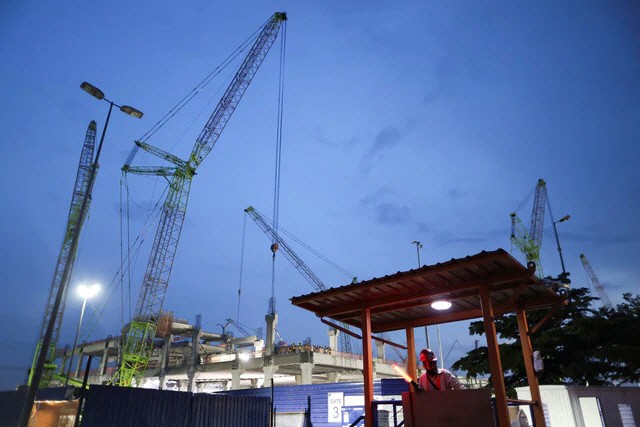 |
| A worker watches passing vehicles outside a data center construction site in Gelang Patah, Johor, Malaysia, which had become Southeast Asia's fastest-growing data center hub, in May. /Reuters-Yonhap News Agency |
Southeast Asian countries that have competed to attract data centers amid the artificial intelligence (AI) boom are increasingly tightening regulations on facility locations and water and electricity use. As residents voice growing opposition over concerns about water shortages, noise and deteriorating living conditions, Thailand has approved environmental standards requiring large data centers to be located in industrial estates, while construction has begun on a dedicated seawater desalination facility for data centers in Batam, Indonesia. Governments across the region are also beginning to scrutinize the tangible benefits that investments bring to local economies, including local employment and participation by domestic companies in supply chains, rather than focusing solely on investment size.
According to the Thai government and local media outlets, including The Nation, on Nov. 12 (local time), Thailand's Cabinet recently approved regulatory policies and standards governing data center locations, noise, heat emissions and cooling water. Under the new rules, data centers with power demand below 20 megawatts (MW) may be located in commercial areas, while larger facilities requiring 20 MW or more must be built in industrial estates. The environmental standards also set specific limits, capping noise from emergency generators at 70 A-weighted decibels (dBA) at site boundaries and restricting temperature increases near facility boundaries caused by discharged heat to approximately 1–2 degrees Celsius. Cooling water used for servers must be recirculated and reused, and its quality must be tested before discharge. Existing projects that received construction permits or investment promotion approval by Aug. 14 this year will be given a one-year grace period to meet the new environmental standards, while new projects will be subject to the new requirements immediately.
The Thai government also plans to establish a one-stop service center to coordinate approval procedures previously handled by multiple agencies. Through the center, authorities will comprehensively assess water and electricity efficiency, employment of Thai nationals, technical training and participation by local companies in supply chains, alongside investment amounts. Ekniti Nitithanprapas, Thailand's Deputy Prime Minister and Minister of Finance, said, "Data centers are essential infrastructure for the digital economy, but they consume large amounts of electricity and water and can affect surrounding communities. Clear regulatory standards are therefore necessary."
Southeast Asian countries are tightening oversight because surging data center investment has increasingly come into conflict with local water and electricity constraints and residents' concerns. After Singapore suspended new data center development from 2019 to 2022 due to resource shortages and other concerns, investment flowed into neighboring locations such as Batam, Indonesia, and Johor, Malaysia. Since then, soaring AI demand has made securing the enormous amounts of electricity needed to run servers and water needed for cooling a key prerequisite for business expansion.
On Indonesia's Batam Island, south of Singapore, severe shortages of household water have fueled local opposition to data centers. According to an AFP report on Nov. 8, dozens of residents staged protests outside Nongsa Digital Park, a data center complex, demanding the restoration of water supplies after tap water stopped flowing in parts of Batam, making even cooking and bathing difficult. Juniardi Adinda Sembiring Gurukinayan, a resident who initially welcomed the arrival of new industries but has sometimes had to skip showers because of worsening water outages, told AFP, "We cannot eat rice without water. We cannot cook vegetables without water." Another resident, Sulastri, said, "Many of us here run small stalls. We used to make ice cubes, but we can't anymore."
While residents associate the water shortages with data center construction, local water utility Air Batam Hilir (ABH) maintains that the supply disruptions were caused by falling water levels at Nongsa Reservoir due to drought, compounded by an electrical equipment failure.
In Malaysia, securing water and electricity supplies and addressing concerns about residential living conditions have also become key factors in data center development. The Malaysian government stated in July that it would approve data center projects only after confirming sufficient energy and water supply capacity. Some projects have also been derailed by local opposition. According to local daily The Star, residents in Kota Damansara, on the outskirts of Kuala Lumpur, demanded that shops originally planned for a site be built instead of a data center, citing concerns about noise, heat and electricity consumption. The developer subsequently withdrew its planning permission application to reassess the feasibility of the project. In Johor, near Singapore, residents have continued protesting against dust and flash flood damage as data center construction moves closer to residential areas.
Jeong Ri-na
Most Read
-
1
AMD's Lisa Su floated as potential Nvidia successo..

-
2
Ukraine halts strikes on Russian oil refineries un..

-
3
Southeast Asian auto parts makers hit hard by Chin..

-
4
U.S. links Myanmar peace efforts to rare earth acc..

-
5
Hegseth rejects calls for impeachment over Iran wa..

-
6
Democrats flip U.S. Congress in historic midterm s..

-
7
Xi secures fourth term as China reshuffles next-ge..

PEOPLE







-
Address : In-Young Bldg., 34, Uisadang-daero 1-gil, Yeongdeungpo-gu, Seoul
Copyright by ASIATODAY CO., LTD. All rights resereved