



U.S.-North Korea summit prospects remain murky
Nov 12, 2026, 09:39 am


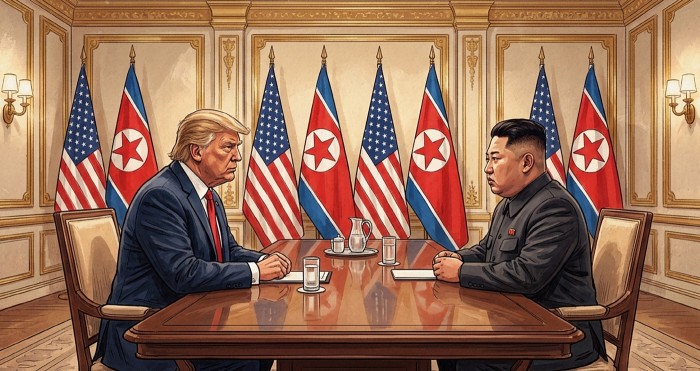 |
| This image was generated by AI. |
Uncertainty is growing over a potential summit between the United States and North Korea that President Donald Trump has been pursuing, following the ruling Republican Party's crushing defeat in the U.S. midterm elections. Analysts are divided between those who believe Trump's weakened political standing will make it difficult to implement any agreement and those who expect him to push more actively for a summit as he becomes increasingly desperate for a diplomatic achievement. Some also predict that even if a summit takes place soon, it could turn into a largely symbolic event focused more on the meeting itself than on reaching a substantive agreement.
North Korea has yet to issue an official response to the U.S. midterm election results as of Nov. 11. Major state media outlets, including the Rodong Sinmun and the Korean Central News Agency (KCNA), have also not reported on the election. This contrasts with the messages directed at Washington that Kim Yo-jong, director of the General Affairs Department of the Workers' Party of Korea, had been issuing until just before the election.
Earlier, on Nov. 3, Kim warned that "there are issues that will need to be reconsidered in various respects regarding the United States' hostile attitude." On Nov. 4, she again condemned hostile signals from Washington but left open the possibility of negotiations, saying that dialogue was among the options for preserving peace.
Above all, North Korea's silence is being interpreted as a move to weigh the impact of Trump's changing political standing on negotiations. Pyongyang may calculate that it could gain the upper hand in negotiations if Trump becomes determined to secure a summit to achieve results during the remainder of his term. At the same time, some analysts believe North Korea will become more cautious about dialogue given the growing uncertainty over whether any agreement can be implemented.
Lim Eul-chul, a professor at the Institute for Far Eastern Studies at Kyungnam University, said, "Even if President Trump pursues a U.S.-North Korea summit to turn the political situation around, he will face obstacles such as Congress' control over the budget, subpoenas and investigations, and legislation to strengthen sanctions." He added, "From North Korea's perspective, it will want to avoid a 'second Hanoi no-deal summit,' in which an agreement with Trump could collapse at any time." Lim explained, "Given the considerable uncertainty over implementing any agreement, there seems to be no reason for North Korea to engage in dialogue and take risks that offer no tangible benefits."
Trump himself has not publicly proposed talks with North Korean leader Kim Jong-un since the election. He may send a message before departing for the Asia-Pacific Economic Cooperation (APEC) Economic Leaders' Meeting, scheduled to begin in Shenzhen, China, on Nov. 18, but analysts say whether contact between the two leaders would lead to meaningful negotiating outcomes is a separate matter.
Stephen Biegun, former U.S. deputy secretary of state and special representative for North Korea who led working-level negotiations with Pyongyang during the first Trump administration, said at a seminar jointly hosted by the Sejong Institute and the Stimson Center in Washington, "Both President Trump and Chairman Kim enjoy being the center of global attention," adding, "Both would willingly take part in a kind of performative summit that they would enjoy."
Some observers believe the midterm election results have actually increased the likelihood of a summit. Victor Cha, Korea Chair at the Center for Strategic and International Studies (CSIS), said during an online press briefing, "There is no one making North Korea policy in the United States other than the president. Therefore, President Trump will focus on his legacy." Cha explained that North Korea may also view a politically weakened Trump as an easier negotiating partner.
Meanwhile, former U.S. Deputy Secretary of State Kurt Campbell said he understood that Trump had asked Chinese President Xi Jinping to help facilitate U.S.-North Korea dialogue. He also said North Korea had presented U.S. recognition of its status as a nuclear-armed state as the only condition under which it would consider a summit.
Lee Han-sol
Most Read
-
1
Ukraine halts strikes on Russian oil refineries un..

-
2
Southeast Asian auto parts makers hit hard by Chin..

-
3
AMD's Lisa Su floated as potential Nvidia successo..

-
4
U.S. links Myanmar peace efforts to rare earth acc..

-
5
Hegseth rejects calls for impeachment over Iran wa..

-
6
Democrats flip U.S. Congress in historic midterm s..

-
7
USFK commander cites interoperability gaps, urges..

PEOPLE







-
Address : In-Young Bldg., 34, Uisadang-daero 1-gil, Yeongdeungpo-gu, Seoul
Copyright by ASIATODAY CO., LTD. All rights resereved