



U.S. military nearly exhausts long-range precision missiles in Iran war
Aug 05, 2026, 02:02 pm


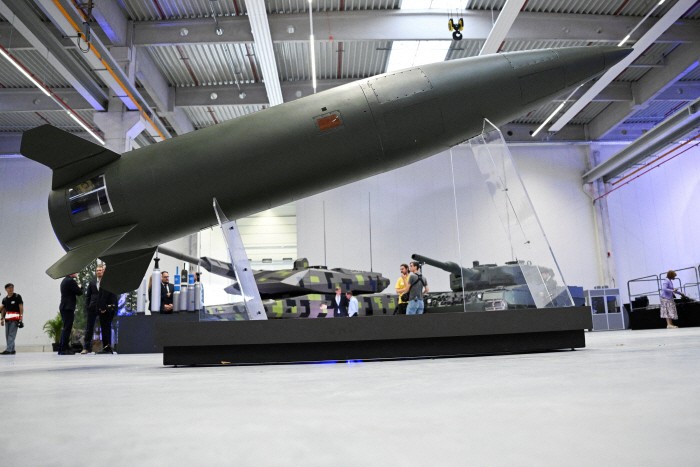 |
| A U.S. Army ATACMS missile is displayed at the opening ceremony of a new artillery shell factory built by German defense and automotive parts manufacturer Rheinmetall in Unterlüss, Germany, on August 27, 2025 (local time). / Reuters-Yonhap |
As the U.S. enters its fifth month of war with Iran, an internal assessment has reportedly found that stockpiles of key long-range precision missiles and air defense interceptors have fallen to critically low levels.
Citing multiple sources, Reuters reported on the 4th (local time) that the U.S. Army's inventory of key surface-to-surface missile systems — the Army Tactical Missile System (ATACMS) and the Precision Strike Missile (PrSM) — has effectively been depleted.
These long-range missiles, costing more than $1 million each, have played a critical role in striking distant targets while reducing the risk of casualties associated with deploying pilots.
The depletion of defensive missile systems is similarly severe. CNN reported that the U.S. military has used up about 80% of its Terminal High Altitude Area Defense (THAAD) interceptor stockpile compared to pre-war levels, and roughly half of its total Patriot interceptor inventory. Senior military commanders have reportedly warned that the Pentagon's munitions reserves are "dangerously low."
The Center for Strategic and International Studies (CSIS) had estimated the U.S.'s pre-war stockpile at around 2,200 Patriot interceptors (based on the two newest variants) and 452 THAAD interceptors.
Military leadership has warned that this depletion of weapons could weaken deterrence against other potential adversaries such as China and Russia. In particular, the decline in precision missile stockpiles means the U.S. would have to rely more heavily on higher-risk manned aircraft bombing missions if it needs to launch another large-scale offensive in the future.
Fierce debate has reportedly broken out within the White House recently over how much longer the offensive against Iran can continue without undermining overall U.S. military readiness. Accounts differ on why President Donald Trump held off on a further large-scale strike last week — some point to military warnings over depleted weapons stockpiles, while officials have pushed back, attributing it instead to diplomatic pressure from Gulf states.
The White House dismissed concerns over shortages, saying the U.S. has more missiles than it needs. President Trump said American defense companies are expanding their factories and facilities and are producing missiles at record levels.
Major U.S. defense contractors, including Lockheed Martin and Raytheon, are currently pursuing long-term contracts to boost production of Tomahawk missiles and interceptors, among others.
Military analysts believe that even with expanded production capacity, it will take considerable time to restore stockpiles to previous levels, meaning concerns over capability gaps stemming from the prolonged conflict are likely to persist for some time.
Lee Jeong-eun
Most Read
-
1
Celltrion’s Omlyclo gains ground in major European..

-
2
Trump demands rates fall below 1% as Fed hikes for..

-
3
Trump makes $1 trillion bet ahead of midterm elect..

-
4
Iran resumes ballistic missile production, assembl..

-
5
Samsung Electronics, Mistral AI to jointly develop..

-
6
Trump warns countries not helping U.S. must pay re..

-
7
Apple launches first foldable, 1 million won prici..

PEOPLE






HEADLINE NEWS
- Trump to roll out ‘unprecedented welcome’ for Xi with B-2 bombers, F-22 fighters
- S. Korea, U.S., and Japan form united front on Taiwan and economic coercion..
- Trump administration moves to impose sweeping sanctions on International Cr..
- Xi to make state visit to U.S. Sept. 23-25, dispelling rumors over his heal..

-
Address : In-Young Bldg., 34, Uisadang-daero 1-gil, Yeongdeungpo-gu, Seoul
Copyright by ASIATODAY CO., LTD. All rights resereved