



Criminal Procedure Act revision clears National Assembly, next battle heads to Constitutional Court
Aug 04, 2026, 10:12 am


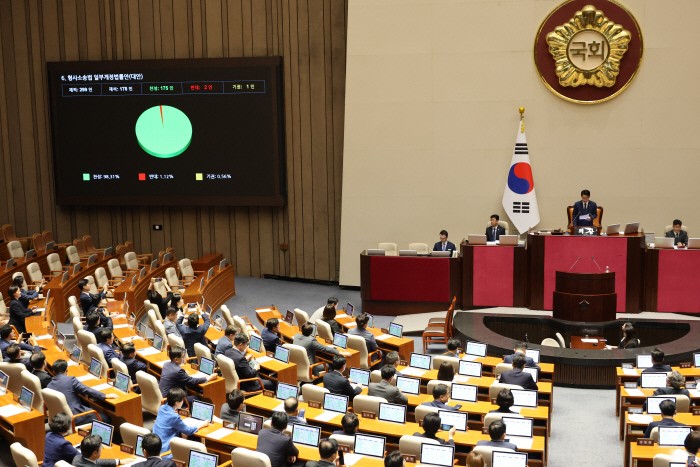 |
| A revised Criminal Procedure Act abolishing prosecutors' supplementary investigative power, tabled the previous day, passes with the ruling party's backing at the third plenary session of the July extraordinary National Assembly session held on the 31st of last month. / Yonhap |
As a revised Criminal Procedure Act abolishing prosecutors' supplementary investigative power passed the National Assembly under the Democratic Party's lead, attention is turning to how the Constitutional Court will rule on the revision's constitutionality.
According to legal circles on the 3rd, the revised Criminal Procedure Act, which cleared the National Assembly's plenary session on the 31st of last month, is now awaiting deliberation and approval at a Cabinet meeting. President Lee Jae-myung is expected to put the bill before the Cabinet as early as the 4th and have it approved.
Legal circles have raised the possibility that a competence dispute case or constitutional complaint could be filed with the Constitutional Court over the revised law. Since such petitions can typically be filed after a law is promulgated but before it takes effect, the process could move forward once the revision is promulgated.
If such a case is filed, the core issue the Constitutional Court would need to decide is whether prosecutors' investigative authority constitutes a right guaranteed under the Constitution. The Constitution requires that a warrant issued by a judge upon a prosecutor's request be presented in the process of arrest, detention, seizure, or search, but it does not itself establish prosecutors' investigative authority. This could give rise to arguments that restricting investigative authority ultimately infringes on prosecutors' constitutionally specified right to request warrants.
On this point, the Supreme Prosecutors' Office said on the 29th of last month that barring prosecutors from requesting warrants without a request from judicial police would effectively hollow out prosecutors' constitutional right to request warrants.
How the Constitutional Court has ruled in the past on prosecutors' investigative authority is also a key variable. In 2023, the court dismissed a competence dispute case over the so-called "prosecution reform law" (which fully stripped prosecutors of investigative authority) in a 5-4 ruling. At the time, the court held that it was difficult to conclude that prosecutors' constitutional right to request warrants also implies a constitutional investigative authority for prosecutors.
Still, some analysts say that even if a competence dispute case or constitutional complaint is filed, its actual impact on ongoing trials would likely be limited. One constitutional law scholar, speaking on condition of anonymity, explained that it would take the Constitutional Court considerable time to rule on constitutionality, and that since laws generally take effect once their effective date passes after promulgation, the revised Criminal Procedure Act could remain in force as written until the court issues its ruling.
Hwang Do-su, a lawyer and former Constitutional Court research judge, similarly predicted that unless the court grants an injunction to temporarily suspend the law's effect while reviewing the case, the trial would proceed as normal.
Meanwhile, Justice Minister Jung Sung-ho told reporters after a swearing-in ceremony for new prosecutors at the Government Complex Gwacheon that day, "The criminal justice system is important for protecting the public's life, property, and safety," adding, "If side effects worsen harm to victims or leave them inadequately protected, and the law doesn't match realities on the ground, it should be swiftly revised."
Son Seung-hyun
Most Read
-
1
Trump demands rates fall below 1% as Fed hikes for..

-
2
Celltrion seeks rheumatoid arthritis indication ex..

-
3
Chinese e-commerce giants AliExpress, Temu and She..

-
4
Trump warns countries not helping U.S. must pay re..

-
5
Turkish Airlines named main club partner of Liverp..

-
6
China expels No. 2 military official Zhang Youxia..

-
7
Houthi rebels release video claiming downing of Sa..

PEOPLE







-
Address : In-Young Bldg., 34, Uisadang-daero 1-gil, Yeongdeungpo-gu, Seoul
Copyright by ASIATODAY CO., LTD. All rights resereved