



China strongly responds to forced-labor tariffs and AI pressure from U.S.
Jul 28, 2026, 10:16 am


The Chinese government strongly pushed back against the U.S. Trump administration's decision to impose additional tariffs on major trading partners, including South Korea and China itself, over "forced labor," calling it "typical protectionism." Regarding the plan to investigate intellectual property (IP) infringement by artificial intelligence (AI) companies, it also asserted that "(China) reserves the right to take all necessary measures."
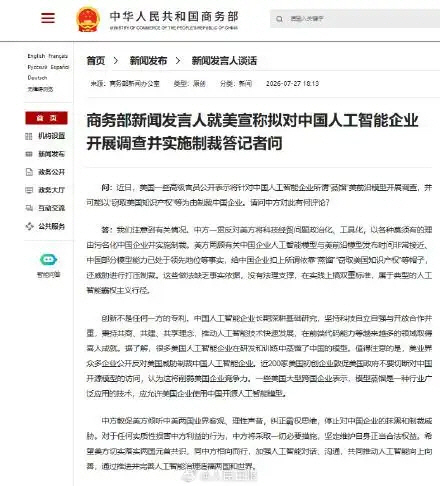 |
| A statement issued under the name of a spokesperson by the Chinese Ministry of Commerce on July 27, strongly opposing forced-labor tariffs and AI pressure from the U.S. / People's Daily |
China's Ministry of Commerce stated in a comment issued in the name of its spokesperson on the 27th that "China has consistently opposed forced labor, and has established relevant laws and systems to strictly prevent and crack down on acts of forced labor." It went on to claim that "the U.S. has long politicized the issue of forced labor," and emphasized that "imposing unilateral tariffs under this pretext is a typical act of unilateralism and protectionism. China firmly opposes this."
It also claimed that "the U.S. has repeatedly expressed its position to replace tariffs based on the International Emergency Economic Powers Act (IEEPA), which has already lost its effect, and import surcharges under Section 122 of the Trade Expansion Act with Section 301 tariffs," adding that "in the China-U.S. economic and trade negotiations, it clearly promised that the replacement tariffs on Chinese goods would not exceed 20%."
At the same time, it warned that "China's response measures to the so-called 'fentanyl tariffs' and reciprocal tariffs remain valid," adding that "we will closely monitor and comprehensively evaluate the U.S. follow-up measures, and reserve the right to take all necessary measures."
Furthermore, addressing the U.S., it urged that "the U.S. should correct its wrong actions and withdraw its unilateral tariff measures," and added that "we hope to resolve the concerns of both sides by continuing dialogue in accordance with the principles of mutual respect, equality, and mutual benefit, and jointly implement the consensus reached in economic and trade negotiations."
Prior to this, the U.S. Trade Representative (USTR) imposed a 10–12.5% 'forced labor tariff' on 60 countries, including South Korea and China, on the 23rd (local time) based on Section 301 of the Trade Act. An additional tariff of 12.5% was applied to Chinese goods, exactly the same as South Korea.
Hong Soon-do
Most Read
-
1
U.S. Treasury Secretary Bessent publicly warns ove..

-
2
Celltrion’s Omlyclo gains ground in major European..

-
3
Hyundai Motor Group breaks ground on integrated st..

-
4
Russia faces warning signs over prolonged war econ..

-
5
U.S. strikes 3 Iranian oil tankers, Iran vows reta..

-
6
S. Korea seeks redemption from World Cup setback w..

-
7
Trump makes $1 trillion bet ahead of midterm elect..

PEOPLE




-
Address : In-Young Bldg., 34, Uisadang-daero 1-gil, Yeongdeungpo-gu, Seoul
Copyright by ASIATODAY CO., LTD. All rights resereved