



Health insurance premiums to be levied on daily workers earning over 20 million won annually
Jul 28, 2026, 10:15 am


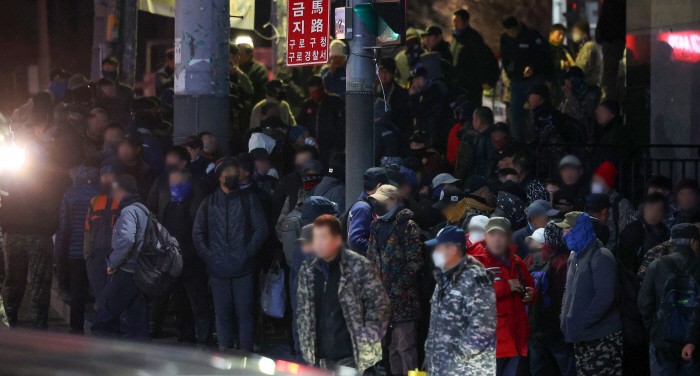 |
| The sidewalk near Namguro Station in Seoul, dense with day labor agencies, is filled with daily job seekers looking for work early in the morning on February 18 last year / Yonhap |
With the health insurance system expected to shift into a deficit starting this year, the South Korean government is reviewing a plan to levy health insurance premiums on high-income daily wage earners who earn more than 20 million won annually. However, concerns are rising, primarily from labor groups, that without careful system design beforehand, this move could end up increasing the burden on vulnerable domestic workers.
According to healthcare industry sources on July 27, the Ministry of Health and Welfare reported this health insurance premium system reform plan to a subcommittee of the Health Insurance Policy Review Committee on July 23. Under current law, daily wage income is subject to health insurance premiums, but its assessment has been deferred to protect vulnerable groups.
Among daily wage earners reported to the National Tax Service in 2024, those earning over 20 million won annually account for about 5.2 percent of the total. The government aims to correct loopholes where individuals earning high incomes exceeding 100 million won have avoided paying premiums by remaining registered as dependents or paying only minimum premiums.
The problem is that informal employment practices, where income is not properly recorded, remain prevalent in the daily labor market. Most notably in the construction industry, practices where workers experiencing debt issues like credit bad standing work under another person's name through job agencies have been widespread. Pointing out this context, critics argue that imposing premiums uniformly without considering these industry characteristics could cause significant side effects.
Earlier in 2018, the Ministry of Health and Welfare strengthened the National Pension and Health Insurance subscription criteria for daily construction workers from working 20 days or more a month to working 8 days or more a month. In response, field observers pointed out that split work arrangements, where both employers and workers restricted work to less than 7 days at a single site to avoid taxes and social insurance premiums, became widespread. Furthermore, criticism emerged that incentives grew to hire undocumented immigrants who incur no four major insurance burdens.
Because this reform plan uses annual income rather than work days as its standard, it is expected to curb employers' evasion tactics to some extent. However, concerns remain that it could push vulnerable domestic workers who avoid income exposure, such as credit-impaired individuals, out of the market.
Kim Sung-hee, a professor at Korea University's Graduate School of Labor Studies, diagnosed, "While bringing workers into the formal system to protect them is the right policy direction, a contradiction may arise in reality where it inflicts disadvantages on the individuals involved." He added, "Unlike other occupations that cannot be replaced by foreign labor, construction sites may experience a crowding-out effect where domestic workers are displaced from jobs," emphasizing that "sophisticated system design is needed to prevent reverse discrimination against citizens and broaden protection effects."
Polarization at construction sites is another factor to consider. Unlike sites led by major construction companies, criticism exists that employment stabilization measures for domestic workers have been largely neglected, even though informal employment issues have accumulated at small-scale sites such as local villas and commercial buildings.
Kim Jun-tae, director of education and publicity at the Korean Construction Workers' Union under the Korean Confederation of Trade Unions, pointed out, "Large sites already apply the four major insurance systems as a standard, so there is no major issue, but small sites are the problem." He added, "Due to the nature of the work, many laborers move around multiple sites for a few days at a time, and uniformly levying premiums just because their annual income exceeds 20 million won could increase their burden."
He noted, "Even in Seoul alone, many people sign labor contracts lasting no more than 7 days," adding, "From wages to insurance-related aspects, considering pure labor costs, illegally hiring migrant workers yields greater profits, making it a rampant practice." He further added, "Currently, the construction site structure involves job-related conflicts between migrant workers and domestic workers, yet employment stabilization measures for domestic workers have hardly been established for years."
Lee Jeong-yeon
Most Read
-
1
Trump demands rates fall below 1% as Fed hikes for..

-
2
Celltrion seeks rheumatoid arthritis indication ex..

-
3
Chinese e-commerce giants AliExpress, Temu and She..

-
4
Trump warns countries not helping U.S. must pay re..

-
5
Turkish Airlines named main club partner of Liverp..

-
6
China expels No. 2 military official Zhang Youxia..

-
7
Houthi rebels release video claiming downing of Sa..

PEOPLE







-
Address : In-Young Bldg., 34, Uisadang-daero 1-gil, Yeongdeungpo-gu, Seoul
Copyright by ASIATODAY CO., LTD. All rights resereved