



U.S.-Iran armed clashes halt after two weeks, entering an uneasy lull
Jul 27, 2026, 08:58 am


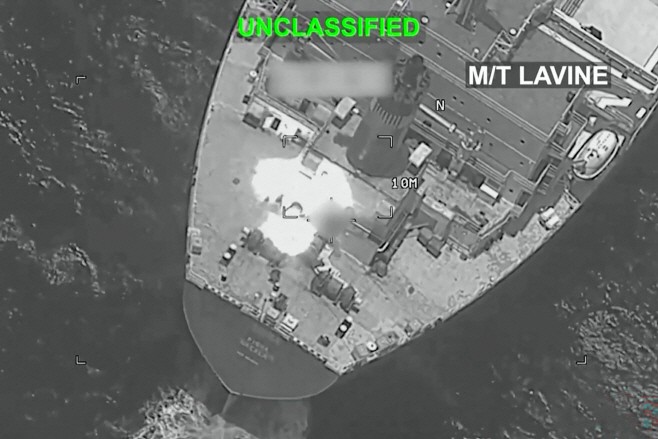 |
| U.S. Central Command released an undated video on July 25 local time, and this screen capture shows what was described as an operation enforcing a maritime blockade against Iran. As the U.S. halted the escalation of the war now entering its fifth month, Iran spent another day on July 26 without U.S. airstrikes. Reports also emerged that concerns over dwindling U.S. munitions stockpiles are limiting plans for further escalation. / Courtesy of U.S. Central Command, AFP, Yonhap |
U.S. forces refrained from launching airstrikes on Iran for three consecutive days through July 26 local time, following instructions from U.S. President Donald Trump. Iran also halted its retaliatory operations over the past two days in response to the pause in U.S. attacks.
Oman continued negotiations with Iran regarding safe passage through the Strait of Hormuz. However, Iran's aggressive rhetoric against the U.S., clashes in the Caspian Sea and Red Sea, and Israeli Prime Minister Benjamin Netanyahu's visit to the U.S. remain variables that could determine whether the lull will hold.
Trump withholds approval for new Iran airstrikes on July 24; U.S. military reports depleted targets and interceptor shortages
President Trump was briefed on new strike plans targeting Iran's southern coast and the Strait of Hormuz on July 24 but chose not to approve them, U.S. news outlet Axios reported. The U.S. military had conducted airstrikes against Iranian military facilities for 13 consecutive days from July 11 through July 23.
President Trump stated that "serious talks" are underway with Iran, noting that negotiation is the wiser path forward. He also maintained his stance that military action could resume should talks fail.
Brad Cooper, Commander of U.S. Central Command, assessed that previous airstrikes significantly degraded Iran's capacity to attack shipping. Axios reported that day that Cooper advised the White House and the Department of Defense (Department of War) that most designated targets had been hit, making it impractical to maintain the same level of strikes.
Commander Cooper reported that about 20% of the targets designated during Operation 'Epic Fury' remained unhit. He explained that hitting those remaining targets would require restarting large-scale combat operations.
Dan Caine, Chairman of the U.S. Joint Chiefs of Staff, and U.S. Vice President J.D. Vance also expressed concern over escalation. U.S. forces had used more than 1,200 Patriot interceptors through late April. Each interceptor costs over $4 million (5.8508 billion won). A simple tally for 1,200 missiles comes to at least $4.8 billion (7.02096 trillion won). Stockpiles deteriorated further following the subsequent 13 days of attacks and retaliation, reported U.S. daily The New York Times (NYT).
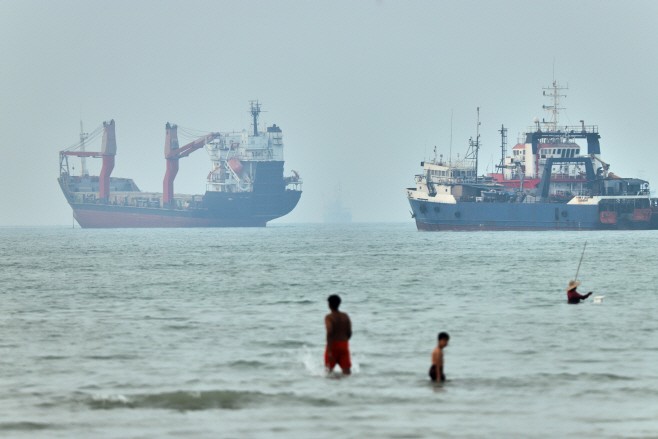 |
| Children walk through the water in the Strait of Hormuz off Bandar Abbas, Iran, on June 30 local time. Cargo ships at anchor and a fisherman are visible in the background. / Courtesy of AP, Yonhap |
Iran and Oman discuss safe passage operations in Hormuz; actual shipping traffic unchanged
Diplomatic channels concerning the Strait of Hormuz resumed during the military pause. Iran and Oman held deputy foreign minister-level talks in Tehran on July 24–25. Both sides discussed common principles and an operational framework to manage the safe passage of vessels while respecting each country's sovereignty.
Negotiations focused on adjusting operational terms for the southern passage along the Omani coast, which receives U.S. protection, and the route through Iranian territorial waters. Iranian Foreign Ministry spokesperson Esmaeil Baghaei noted the talks were "very productive and made meaningful progress," according to state-run broadcaster IRIB. However, he stated there has been no change in actual vessel traffic conditions.
U.S. Ambassador to the UN Mike Waltz mentioned on NBC that President Trump is allowing "some space" for negotiations. He noted that discussions are taking place at every level, from working groups to the highest leadership.
White House Communications Director Steven Cheung emphasized that it would be "wise" for Iran to work toward a deal. Although U.S. forces paused airstrikes, they maintained the maritime blockade against Iranian ports.
U.S. forces announced on July 24 that they neutralized a Mozambique-flagged vessel in the Gulf of Oman after it ignored warnings and attempted to run the naval blockade.
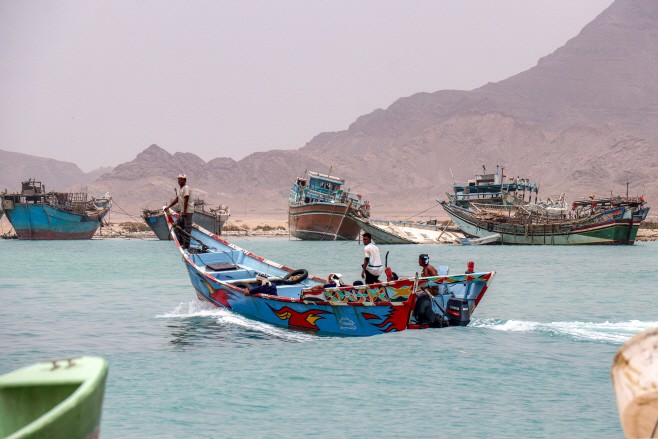 |
| A fishing boat operates in the Bab-el-Mandeb Strait off Taiz Governorate in southern Yemen on July 25 local time. / Courtesy of AFP, Yonhap |
Iranian military halts retaliation following pause in U.S. airstrikes; Foreign Minister Araghchi warns of response to Caspian Sea merchant ship attack
Separate from active diplomatic channels, Iran maintained its aggressive messaging against the U.S. Iranian Supreme Leader Mojtaba Khamenei posted on X at 1:08 p.m. local time (2:08 a.m. July 27 KST) that the world is tired of tyranny from the U.S. government and "criminal Zionists." He stated that "there is no way forward other than jihad and resistance."
Mohammad Akraminia, spokesperson for the Iranian armed forces, stated that Iran halted its retaliatory operations because the U.S. paused airstrikes over the past two days. He warned that if the U.S. resumes attacks, "the war will spread to other regions."
A senior Iranian official told Reuters that Iran has already communicated an "attack for attack" stance to the U.S. He noted that skepticism outweighs optimism, with many viewing the pause in U.S. airstrikes as a tactical lull rather than a genuine shift in policy.
The Iranian Foreign Ministry claimed that Ukraine attacked an Iranian merchant vessel in the Caspian Sea on July 25, killing one crew member and injuring another. Iranian Foreign Minister Abbas Araghchi claimed on X that Ukraine carried out the attack at Israel's instigation. Araghchi warned that this attack "will not go unanswered."
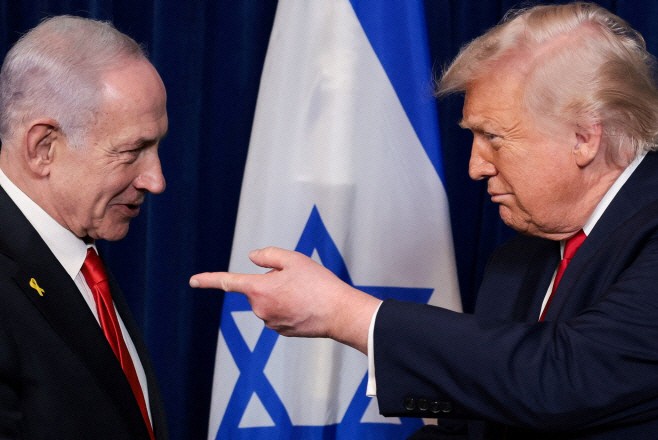 |
| U.S. President Donald Trump, right, points at Israeli Prime Minister Benjamin Netanyahu during a press conference following their meeting at the Mar-a-Lago club in Palm Beach, Florida, on Dec. 29, 2025 local time. / Courtesy of Reuters, Yonhap |
Netanyahu plans to press Trump on Iran nuclear monitoring on 28th as Houthis threaten Saudi crude bypass route
Tensions have flared in the Caspian and Red Seas while direct clashes between the U.S. and Iran hang in a lull.
Prime Minister Netanyahu will visit the U.S. on the 27th and hold a summit with President Trump at the White House on the 28th. He stated that the war can only end if the Iranian regime is changed or weakened enough to realize it must halt its nuclear program and change course.
Netanyahu said he could accept a deal if President Trump can pull one off without a large-scale military conflict. However, he stressed the need for continued monitoring and pressure on Iran, emphasizing that its nuclear program must be kept under constant watch.
Yemen's Houthi rebels claimed the previous day that they attacked Aramco-related facilities in Jizan and Yanbu, Saudi Arabia, using missiles and drones. The Houthis also attacked three Saudi-linked oil tankers and declared a blockade on Saudi crude shipments through the Red Sea.
A Saudi-led coalition launched airstrikes against Houthi-controlled military facilities in Yemen. This marks one of the coalition's first strikes in Yemen since the UN-brokered ceasefire in 2022.
Saudi Arabia is shipping about 4.9 million barrels per day to the Red Sea coast, bypassing the Strait of Hormuz. Roughly 3.5 million barrels of this volume head to Asia via the Bab el-Mandeb Strait. If this sea route is blocked, Saudi crude will have to move to the Mediterranean through the Suez Canal or the Sumed Pipeline, and then travel around Gibraltar and the Cape of Good Hope to reach Asia.
Suezmax-class tankers can carry about 1 million barrels. Very Large Crude Carriers carrying over 2 million barrels can barely pass through the Suez Canal fully loaded. The detour route delays arrivals in Asia by 20 to 30 days while inflating freight rates and war risk insurance premiums.
Brent crude fell back to around $98 (143,000 won) per barrel after topping $100.95 (148,000 won) on the 24th. Actual traffic changes in the Strait of Hormuz, the U.S.-Israel summit on the 28th, and whether the Houthis launch further attacks will be the next key variables determining if the pause in airstrikes will last long-term.
Ha Man-ju
Most Read
-
1
U.S. Treasury Secretary Bessent publicly warns ove..

-
2
Celltrion’s Omlyclo gains ground in major European..

-
3
Hyundai Motor Group breaks ground on integrated st..

-
4
Russia faces warning signs over prolonged war econ..

-
5
Anti-Western solidarity strengthens amid Trump's e..

-
6
U.S. strikes 3 Iranian oil tankers, Iran vows reta..

-
7
S. Korea seeks redemption from World Cup setback w..

PEOPLE







-
Address : In-Young Bldg., 34, Uisadang-daero 1-gil, Yeongdeungpo-gu, Seoul
Copyright by ASIATODAY CO., LTD. All rights resereved