



Hyundai Motor accelerates robotaxi commercialization in U.S.
Jul 23, 2026, 09:55 am


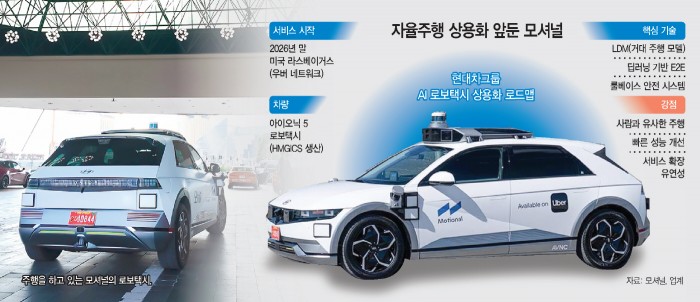 |
Hyundai Motor Group is set to commercialize driverless robotaxis in Las Vegas, United States, late this year. Led by its autonomous driving joint venture Motional, the group is transitioning to an artificial intelligence-based autonomous driving system while leveraging Hyundai Motor Group's vehicle development and production capabilities to accelerate its push into the global autonomous driving market.
According to the automotive industry on July 22, Motional plans to launch Level 4 autonomous robotaxi services in Las Vegas late this year via the Uber platform. Rather than a simple pilot project or demonstration run, this will be a commercial service open to the general public. This marks a transition for Hyundai Motor Group's autonomous driving business from the technical verification stage to full-scale commercialization.
AI-centered redesign: Transition from rule-based to LDM
The most significant change Motional made ahead of commercialization lies in the core architecture of its autonomous driving system. Moving away from traditional rule-based software structures, the company redesigned its system around a large driving model (LDM) utilizing generative AI.
Laura Major, CEO of Motional, said, "The most meaningful change is that we restructured the entire autonomous driving system to be AI-centered," adding, "We redesigned the system architecture from scratch to effectively apply the latest AI technology to vehicles."
LDM combines a deep learning-based end-to-end (E2E) approach that learns from vast amounts of driving data with traditional rule-based algorithms. It is designed to allow AI to learn human-like judgment capabilities while rule-based systems maintain safety during unexpected situations.
CEO Major explained, "Combining existing rule-based systems with deep learning-based E2E ensures both adaptability to unexpected situations and overall safety," adding, "Our goal is to implement reliable autonomous driving services based on the latest AI technology."
With this architecture, Motional expects to expand services rapidly to new cities by leveraging accumulated driving data rather than building systems from scratch.
Combining manufacturing capabilities: Emphasizing competitiveness
Hyundai Motor Group's strength lies in integrating AI technology with vehicle development and production capabilities.
The IONIQ 5 robotaxi operated by Motional was not modified from an existing mass-produced electric vehicle; it was developed from the initial design stage specifically for robotaxi services. Sensors, computing platforms, vehicle design, and verification processes were unified into a single platform, with production handled by the Hyundai Motor Group Innovation Center Singapore (HMGICS).
CEO Major noted, "The IONIQ 5 robotaxi represents a leading example where a vehicle manufacturer and an autonomous technology company collaborated closely from the initial design stage," describing it as "a product created through the collaboration between Hyundai Motor Group and Motional."
Industry observers view the securing of both autonomous driving technology and mass-production systems as a key differentiator for Hyundai Motor Group. This setup is expected to provide a competitive edge in quality control and mass production during future robotaxi business expansions.
Late-year commercialization: A testbed for autonomous competitiveness
This commercialization serves as the first real-world test for Hyundai Motor Group's AI strategy. It is expected to act as a comprehensive testbed evaluating autonomous technology, vehicle supply, operations, and service quality.
In the United States, Waymo is expanding its robotaxi service, while Tesla is accelerating its AI-driven autonomous driving business. In China, commercialization competition is intensifying around Baidu.
An industry official stated, "The core competitiveness in autonomous driving has shifted from pure technology development to how quickly AI can learn and how safely it can be commercialized," adding, "Motional's robotaxi service late this year will mark a crucial turning point proving the competitiveness of Hyundai Motor Group's AI strategy."
Nam Hyun-soo
#Hyundai Motor
Copyright by Asiatoday
Most Read
-
1
Kia Sportage outperforms Mazda CX-5 in German auto..

-
2
Houthis launch successive attacks on Saudi airport..

-
3
Saudi Arabia, Iran hold first diplomatic talks to..

-
4
U.S. deploys carrier, 10,000 more troops to Middle..

-
5
Saudi airport in Riyadh struck again, leaving at l..

-
6
Japan tracks Ukraine fiber-optic drones, bolsters..

-
7
Putin's ally visits China on the 8th ahead of APEC..

PEOPLE






HEADLINE NEWS
- Trump slams Nobel Peace Prize snub, claiming he is 'preventing war' between the two Koreas
- China makes tactical retreat following fierce pushback from EU
- Japan openly opposes U.S. sanctions on ICC, fueling tensions with Washingto..
- Military service exemptions for artists and athletes under scrutiny at parl..

-
Address : In-Young Bldg., 34, Uisadang-daero 1-gil, Yeongdeungpo-gu, Seoul
Copyright by ASIATODAY CO., LTD. All rights resereved