



Oil passes through Hormuz, yet refiners still lack trading edge
May 21, 2026, 04:31 pm


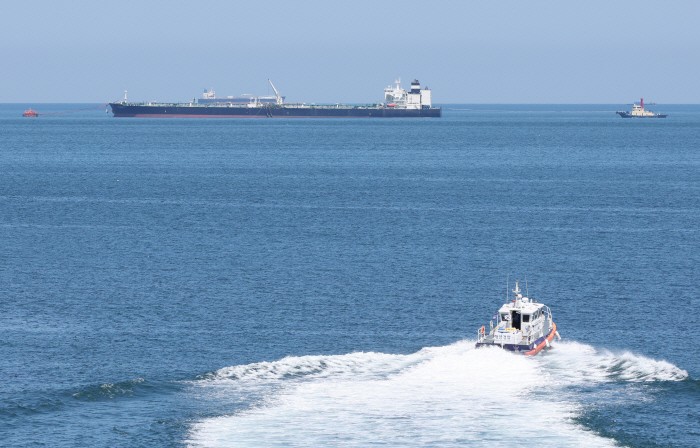 |
| The tanker Zouzou N, which sailed through the Strait of Hormuz last month, discharges crude oil to S-Oil via a single point mooring (SPM), an offshore oil unloading facility, off Onsan in Ulju County, Ulsan, on May 13. / Photo courtesy of Yonhap News Agency |
The domestic refining industry is breathing a sigh of relief as a tanker successfully navigated the Strait of Hormuz for the first time since the outbreak of the Middle East crisis. However, inside and outside the industry, critics point out that aside from short-term supply stabilization, this crisis has once again exposed Korean refiners' structural vulnerability: a fundamental lack of energy trading competitiveness.
According to industry sources on May 21, the Universal Winner, a very large crude carrier (VLCC) operated by national flag carrier HMM, became the first vessel to pass through the Strait of Hormuz following an nearly three-month blockade. The vessel is reported to be carrying approximately 2 million barrels of crude oil destined for SK Innovation. However, a cautious outlook prevails within the industry, with many arguing it is premature to interpret this single passage as a signal of immediate supply normalization, given the remaining possibility that this was merely a restrictive transit allowance granted to a specific vessel. An industry official explained, "While it covers only a single day of national crude oil consumption and will have a short-term effect, we anticipate positive outcomes if direct shipping routes are partially resumed in the future."
The core issue is that this crisis is not a mere one-off event. Some experts point out that simply diversifying import sources has inherent limitations in responding to recurring geopolitical risks. Fundamentally, domestic refiners' lack of energy trading capacity makes them highly vulnerable to price volatility, a structural weakness that repeats itself. Within the industry, concerns are rising over the increasing possibility of negative lagging effects and inventory valuation losses in the second quarter. If international oil prices decline just as high-priced crude oil is fed into the production process, the expensively imported oil turns into a driver of financial losses. Consequently, a structure persists where corporate earnings experience wild swings depending solely on the direction of global oil prices.
Regarding this issue, Cho Hong-jong, an economics professor at Dankook University, cited a rigid corporate culture that refuses to tolerate failure as the primary barrier preventing the growth of Korean global energy trading firms. "Global majors like ExxonMobil or Vitol monitor 24-hour crude and gas flows to generate profits and manage risks by capitalizing on price volatility," Professor Cho noted. "In contrast, domestic refiners largely remain confined to the role of simple buyers." Although Korean refiners are expanding their trading units, centering operations around hubs like Singapore, a significant gap remains in scale and influence when compared to global major trading houses.
Professor Cho emphasized, "Energy trading is inherently a high-risk, high-reward industry. However, in South Korea, short-term losses immediately trigger allegations of breach of trust or management accountability, making aggressive risk management difficult." He added, "The industry must shift away from short-term, earnings-centric evaluations toward appraisal systems based on long-term cumulative returns." Furthermore, he stressed that an institutional environment must be established to grant immunity to traders, provided they have adhered to sound risk management protocols.
Structural hurdles in securing talent were also highlighted. While ultra-high, performance-linked compensation packages are standard in the global energy trading market, the seniority-based compensation structures typical of Korean conglomerates make it difficult to attract top-tier global talent.
Lee Seo-yeon
Most Read
-
1
Kia Sportage outperforms Mazda CX-5 in German auto..

-
2
Houthis launch successive attacks on Saudi airport..

-
3
Saudi Arabia, Iran hold first diplomatic talks to..

-
4
U.S. deploys carrier, 10,000 more troops to Middle..

-
5
Saudi airport in Riyadh struck again, leaving at l..

-
6
Putin's ally visits China on the 8th ahead of APEC..

-
7
Chinese military support and training center opens..

PEOPLE






HEADLINE NEWS

-
Address : In-Young Bldg., 34, Uisadang-daero 1-gil, Yeongdeungpo-gu, Seoul
Copyright by ASIATODAY CO., LTD. All rights resereved