



'K-modular housing' backed by gov't and major firms
May 21, 2026, 03:23 pm


 |
The domestic construction industry is facing a complex, structural crisis characterized by surging construction costs, a shortage of skilled labor, and tightened safety regulations. Against this backdrop, both the government and the private sector are turning their attention to modular construction as a next-generation growth engine. Off-site construction (OSC)—a method where primary structures are prefabricated in factories and assembled on-site—is rapidly expanding its market share due to its proven competitiveness in shortening construction timelines, ensuring stable quality, and optimizing labor efficiency. However, challenges such as high initial construction costs compared to traditional reinforced concrete (RC) methods, a lack of standardization, and the burden of securing profitability remain to be addressed. Experts point out that for modular construction to transition from a mere alternative method to a full-fledged industry, public procurement expansion must be accompanied by regulatory overhauls and market infrastructure development.
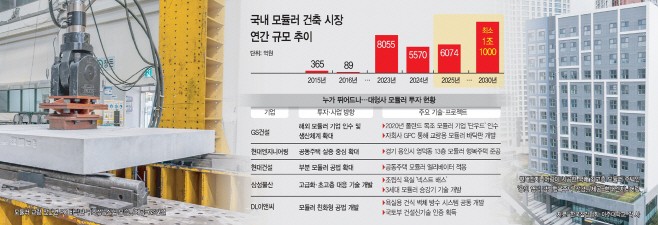
According to the "Domestic Modular Market Survey" released on May 21 by the Modular Construction Committee of the Korea Iron & Steel Association, commissioned by the Prefabricated Architecture Laboratory at Ajou University, the domestic modular construction market reached 607.4 billion won last year. This marks a 9.0% increase from 557.0 billion won in the previous year. The market, which stood at a mere 36.5 billion won in 2015, has grown more than 16-fold in a decade.
A total of 1,166 modular projects were executed over the past 23 years from 2003 to last year, with cumulative construction costs reaching approximately 2.9649 trillion won. During the same period, the market recorded an average annual growth rate of 35.4%. If the current growth momentum continues, the domestic market size is projected to expand to a minimum of 1.1 trillion won and a maximum of 4.4 trillion won by 2030.
Analysts attribute this robust growth to the demand-creation policies spearheaded by the government and public institutions. As a follow-up to the "September 7 Housing Supply Expansion Plan" announced last year, the Ministry of Land, Infrastructure and Transport is pushing for the enactment of the "Special Act on Supporting the Activation of Modular Construction." The special act outlines a comprehensive institutional framework to foster the industry, including establishing a legal definition for modular construction, creating manufacturing and architectural certification systems, designating promotional zones, and granting regulatory exemptions.
Public entities are also accelerating efforts to expand procurement. The Korea Land and Housing Corporation (LH) presented a roadmap to supply 3,000 modular housing units annually this year and scale up to 5,000 units per year after 2030. In the third-generation new towns of Goyang Changneung and Namyangju Wangsuk 2, 29-story modular apartment complex projects are currently underway. Consequently, the modular market, which was previously confined to low-rise structures such as school classrooms and dormitories, is expanding into mid-to-high-rise residential complexes.
In alignment with public sector policy initiatives, major construction firms are ramping up their investments. GS E&C acquired Danwood, a Polish wooden modular specialist, in 2020. Through its subsidiary GPC, the company developed a modular bridge deck technology applying glass fiber reinforced plastic (GFRP) and ultra-high-performance concrete (UHPC), recently completing structural safety verification with the Korea Institute of Civil Engineering and Building Technology.
Hyundai Engineering completed construction of the 13-story "Gyeonggi Happiness House" in Yeongdeok-dong, Yongin, Gyeonggi Province in 2023—the tallest modular apartment building in the country—and continues to expand its pilot projects. Hyundai E&C has also moved forward with partial modular methods, becoming the first domestic builder to apply modular elevators to residential complexes.
Samsung C&T's Construction Division is developing "Next Bath," a modular prefabricated bathroom system, alongside third-generation modular elevator technology capable of high-rise application. DL E&C obtained a new construction technology certification from the ministry for its dry-wall waterproofing system for bathrooms, jointly developed with Hansol Homedeco, as part of its expanding lineup of modular-friendly construction methods.
Despite high growth expectations, however, modular construction must resolve the practical hurdle of profitability to become a mature industry. According to industry sources, modular construction costs are roughly 20% to 30% higher than conventional RC methods. Factory overhead costs and heavy shipping expenses for large-scale modules inevitably exacerbate the overall cost burden.
The difficulty of establishing a mass-production system due to design variations across individual projects poses another limitation. Without sufficient manufacturing standardization, maintaining stable factory utilization rates becomes a challenge, which ultimately hinders the realization of economies of scale.
For this reason, the current market is dominated by major builders with significant capital investment capacity, while the participation of mid-sized and small-scale construction firms remains restricted. In fact, according to the Korea Iron & Steel Association survey, only 40 manufacturers have participated in domestic modular projects since 2003. As of last year, only about 20 manufacturers were actively executing business. Analysts note that initial facility investment burdens and operational risks act as high barriers to entry.
Securing profitability remains a challenge for major firms as well. A prime example is Posco A&C, a subsidiary of Posco E&C and one of the pioneers in the domestic modular market, which exited the business last year after selling its modular business assets and workforce to Yuchang E&C, a specialized firm.
"The modular business requires substantial upfront capital to establish manufacturing facilities, and it is difficult to maintain factory utilization rates unless public procurement remains steady," an executive from a mid-sized construction firm remarked. "Even major corporations find it hard to expect short-term profits, and the structure makes it highly difficult for mid-sized firms to enter the market in the first place."
Experts emphasize that establishing a regulatory foundation is critical to not missing the "golden hour" for market expansion. Given that expanding public procurement alone is insufficient to induce private investment and establish a stable production ecosystem, the enactment of the special act, the formulation of standardized criteria, and the building of certification systems must occur in tandem. Furthermore, suggestions have been made to expand the participation of public institutions holding idle land—such as Korail and Kamco, alongside housing supply agencies like LH and SH—and to formulate modular procurement and management guidelines for public entities and local governments to utilize.
"Now, when market expectations are building up through the expansion of public procurement, is the optimal time to materialize policy support," said Yoo Il-han, a senior research fellow at the Construction Policy Institute of Korea. "Only when pilot projects are scaled up alongside the establishment of standardization and certification frameworks can modular construction position itself as a new growth axis for the domestic construction industry."
Most Read
-
1
Celltrion’s Omlyclo gains ground in major European..

-
2
Trump demands rates fall below 1% as Fed hikes for..

-
3
Trump makes $1 trillion bet ahead of midterm elect..

-
4
Iran resumes ballistic missile production, assembl..

-
5
Trump warns countries not helping U.S. must pay re..

-
6
Apple launches first foldable, 1 million won prici..

-
7
Turkish Airlines named main club partner of Liverp..

PEOPLE






HEADLINE NEWS
- Trump to roll out ‘unprecedented welcome’ for Xi with B-2 bombers, F-22 fighters
- S. Korea, U.S., and Japan form united front on Taiwan and economic coercion..
- Trump administration moves to impose sweeping sanctions on International Cr..
- Xi to make state visit to U.S. Sept. 23-25, dispelling rumors over his heal..

-
Address : In-Young Bldg., 34, Uisadang-daero 1-gil, Yeongdeungpo-gu, Seoul
Copyright by ASIATODAY CO., LTD. All rights resereved