



Rumors of Xi's NK visit rife; peninsula landscape may shift
May 21, 2026, 02:44 pm


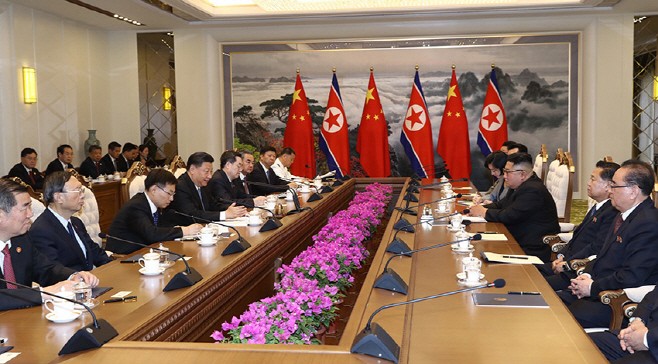 |
| Chinese General Secretary and State President Xi Jinping and State Affairs Commission Chairman Kim Jong-un during Xi's visit to Pyongyang in June 2019. The two leaders are holding a summit meeting at the Kumsusan Guest House in Pyongyang. Rumors are spreading widely in Beijing that President Xi could visit Pyongyang as early as next week. / Xinhua News Agency |
A rapid succession of U.S.-China and China-Russia summits held in Beijing over the past week has raised the possibility of an upcoming meeting between the leaders of North Korea and China in Pyongyang as early as next week. If materialized, this visit could serve as a major catalyst to fundamentally alter the geopolitical landscape around the Korean Peninsula and inter-Korean relations, which have remained locked in a prolonged stalemate. Analysts suggest that such a development is highly likely to yield favorable outcomes for South Korea, even if the implications for North Korea remain ambiguous.
This outlook has gained substantial traction within Beijing's diplomatic circles over the past week. Even without relying on the initial report by the U.S. current affairs weekly Time, the rumor carries significant weight given the current geopolitical dynamics. The shifting landscape is particularly plausible when analyzing the rigid trilateral blocs of South Korea-U.S.-Japan versus North Korea-China-Russia. Following their consecutive high-level meetings, the leaders of China and Russia would naturally find it necessary to share the outcomes of their discussions with Pyongyang.
Furthermore, reality dictates that U.S. President Donald Trump has almost certainly expressed a strong desire to Chinese President Xi Jinping to help broker a U.S.-North Korea summit with North Korean leader Kim Jong-un. For President Xi, facilitating this request carries little to no political risk. It is highly plausible that Xi would proceed with a visit to Pyongyang to demonstrate goodwill toward President Trump, especially since a successful U.S.-North Korea summit would ultimately elevate China's diplomatic standing on the global stage.
The issue of North Korea's denuclearization, which was addressed during the two consecutive summits in Beijing, provides further justification for the trip. Although Beijing and Moscow may not explicitly state it, both powers covertly share the goal of regional denuclearization. When factoring in that the two leaders went so far as to include North Korea and the Tumen River maritime access issue in their joint statement, a swift visit to Pyongyang by President Xi appears to be an almost inevitable diplomatic step.
Leader Kim Jong-un's recent definition of the two Koreas as hostile, separate nations adds a more urgent dimension to the visit. According to diplomatic sources in Beijing, China and Russia view South Korea through a fundamentally different lens than North Korea does. It is safe to assert that both nations view South Korea as a vital partner and strongly desire robust bilateral relations, short of an outright alliance.
However, if Kim refuses to back down from his "hostile two-state" stance, both Beijing and Moscow will find themselves in a diplomatic dilemma, entangled in the contradiction of maintaining deep ties with the adversary of their strategic ally. Consequently, President Xi faces a clear imperative to persuade Kim and actively manage the geopolitical risks surrounding the Korean Peninsula. This strategic necessity is precisely why the rumored visit has become the most debated topic in Beijing's diplomatic circles.
The Chinese government has yet to release an official statement regarding President Xi's potential visit to Pyongyang, which would mark his first in over seven years. While no one can guarantee whether the trip will take place next week, the strong plausibility of these rumors underscores the undeniable reality of deepening ties within the North Korea-China-Russia bloc. For the foreseeable future, breaking the entrenched confrontation between the South Korea-U.S.-Japan and North Korea-China-Russia trilateral alignments will remain a complex challenge.
Most Read
-
1
Celltrion’s Omlyclo gains ground in major European..

-
2
Trump demands rates fall below 1% as Fed hikes for..

-
3
Trump makes $1 trillion bet ahead of midterm elect..

-
4
Iran resumes ballistic missile production, assembl..

-
5
Samsung Electronics, Mistral AI to jointly develop..

-
6
Trump warns countries not helping U.S. must pay re..

-
7
Apple launches first foldable, 1 million won prici..

PEOPLE






HEADLINE NEWS
- Trump to roll out ‘unprecedented welcome’ for Xi with B-2 bombers, F-22 fighters
- S. Korea, U.S., and Japan form united front on Taiwan and economic coercion..
- Trump administration moves to impose sweeping sanctions on International Cr..
- Xi to make state visit to U.S. Sept. 23-25, dispelling rumors over his heal..

-
Address : In-Young Bldg., 34, Uisadang-daero 1-gil, Yeongdeungpo-gu, Seoul
Copyright by ASIATODAY CO., LTD. All rights resereved