



Now is the era of documentaries
May 21, 2026, 02:16 pm


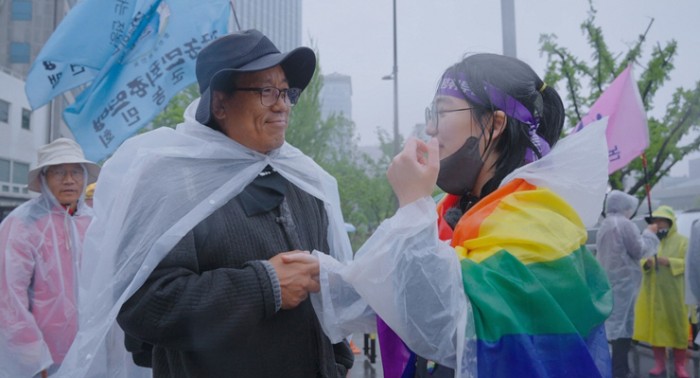 |
| Namtaeryeong, the closing film of the 27th Jeonju International Film Festival, hit theaters on May 20. Reconstructing hour by hour the journey of a farmers' advocacy group marching to Seoul on tractors last year to demand a presidential impeachment, the documentary also highlights the solidarity between farmers and sexual minorities. / Photo courtesy of Cinema Dal |
Documentaries are flooding into theaters.
According to the Korean Film Council's integrated computer network for theater tickets on May 21, the documentary Ran 12.3 attracted an exceptional 240,000 viewers within just a month of its release—an unusually high figure for an indie or art house film. Concurrently, Namtaeryeong, the closing film of the 27th Jeonju International Film Festival (JIFF) that concluded earlier this month, and 1026: Toward a New World were released side by side on May 20. This brings the number of domestic documentaries premiered between April and May alone to five. When factoring in Miyazaki Hayao's How Do You Live? and Ryuichi Sakamoto: Diary, which respectively illuminate the artistic philosophies and final years of the two iconic masters of Japanese animation and contemporary music, the total number of documentaries greeting audiences during this period rises to seven. Given that this is typically a theater off-season with few box office hits, the volume of releases is remarkably high.
What stands out is that South Korean documentaries are experiencing a qualitative leap alongside this quantitative growth. A prime example is that four out of the ten films selected for the Korea Competition section at this year's JIFF were documentaries, accounting for nearly half of the category. This signals that beyond a simple increase in volume, a greater number of highly polished, well-crafted works are emerging compared to previous years.
Film industry insiders analyze that this trend primarily stems from recent domestic political developments, which have unfolded in ways more dramatic than any fictional movie. This includes Ran 12.3, where Director Lee Myung-se, regarded as one of Korea's premier visual stylists, brings the tense and urgent events of the emergency martial law on the night of December 3, 2024, to the silver screen. It also includes Namtaeryeong, which reconstructs hour by hour the journey of a farmers' advocacy group marching to Seoul on tractors to demand a presidential impeachment. Ironically, major historic milestones—such as the December 3 martial law and the second upheld presidential impeachment in the nation's constitutional history—have served as powerful creative inspirations for filmmakers, encompassing both veterans and rookies alike.
"Major historical events that a person might experience only once in a generation occurred consecutively within a span of just one or two years," noted a film producer who started their career in independent and art house cinema. "For documentary directors who are ready to rush anywhere as long as they have a camera, there could not have been better subject matter or live locations."
The South Korean film industry, which has contracted sharply since the COVID-19 pandemic, is also believed to be fueling this documentary boom. As the investment climate deteriorated due to a decline in theater audiences, the production volume of feature films dropped. Consequently, talented aspiring directors as well as seasoned veterans like Lee Myung-se have turned their attention to documentaries, leading to a rise in well-made non-fiction productions.
"The feature films submitted to the Korea Competition section this year suffered from both a reduced pool of submissions and a general level of quality that made it difficult to draw positive assessments," stated JIFF programmers Moon Seok, Moon Sung-kyung, and Kim Hyo-jung in a joint commentary. "In contrast, the documentaries showed a noticeably vibrant energy, tackling a diverse range of subjects with a bold yet prudent approach, even when they did not necessarily focus on 'grand narratives' like martial law or the impeachment."
On the flip side, as documentaries that blatantly represent the narratives of specific political camps—whether conservative or progressive—multiply simultaneously, concerns are being raised that theaters could degenerate into arenas for political propaganda and agitation. Critics point out that among the domestic documentaries released between last year and this year, several utilized flawed approaches, such as resorting to factual distortion, to rally support bases, foster hatred toward opposing camps, and stoke social conflict. Furthermore, multiplex chains suffering from financial difficulties are no longer in a position to rigorously vet films across various criteria as they once did, which is cited as another reason substandard political documentaries are flooding into cinemas.
"Due to the inherent nature of the genre, cinema—particularly documentaries, alongside literature—can easily drift into propaganda when addressing politics and ideology," observed Ha Chul-seung, a professor of creative writing at Dongduk Women's University. "Director Park Chan-wook recently stated at the Cannes Film Festival regarding his criteria for judging the competition section that 'artistic achievement must come first, no matter how excellent the political message is.' If domestic documentary producers and directors fail to take this advice to heart, they will ultimately be rejected by audiences." |
Most Read
-
1
U.S. Treasury Secretary Bessent publicly warns ove..

-
2
Celltrion’s Omlyclo gains ground in major European..

-
3
Hyundai Motor Group breaks ground on integrated st..

-
4
Russia faces warning signs over prolonged war econ..

-
5
Anti-Western solidarity strengthens amid Trump's e..

-
6
U.S. strikes 3 Iranian oil tankers, Iran vows reta..

-
7
S. Korea seeks redemption from World Cup setback w..

PEOPLE






-
Address : In-Young Bldg., 34, Uisadang-daero 1-gil, Yeongdeungpo-gu, Seoul
Copyright by ASIATODAY CO., LTD. All rights resereved