



How 22 years of hallyu is reshaping traditional Japanese family values
May 21, 2026, 11:57 am


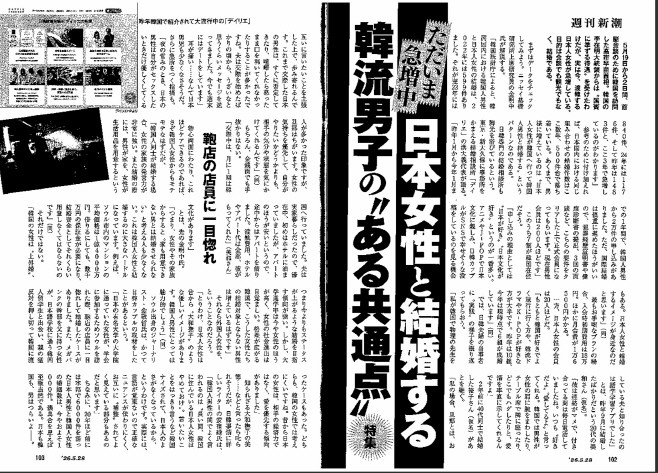 |
| The May 28 issue of the Japanese weekly magazine Shukan Shincho, published on May 21, highlighted the growing trend of Japanese women marrying Korean men, a phenomenon colloquially dubbed the "Hallyu husband" craze. / Photo captured from Shukan Shincho |
The growing trend of Japanese women choosing Korean men as their spouses is drawing significant attention from local media. Analysts suggest that the Korean Wave, which originally began with television dramas and K-pop, has progressively expanded into beauty, fashion, food, and tourism, and is now actively influencing the private spheres of romance and marriage.
This shift did not emerge overnight. Positive perceptions of young Korean individuals were first deeply etched into the collective memory of Japanese society in 2001, following the heroic sacrifice of Lee Soo-hyun, a Korean international student who lost his life while attempting to rescue a Japanese passenger who had fallen onto the tracks at Tokyo's Shin-Okubo Station. In 2004, the broadcasting of the hit Korean drama Winter Sonata on NHK and the subsequent "Yonsama" syndrome centered around lead actor Bae Yong-joon expanded this awareness into mainstream pop culture. While that initial wave cultivated an image of romantic and gentle Korean men primarily among middle-aged and older Japanese women, the current phenomenon has seamlessly integrated into the daily lifestyle of younger generations through K-pop, Korean-style cosmetics, fashion, cuisine, and travel to Seoul.
This trend unfolds against the backdrop of a sharp contraction in Japan's broader domestic marriage market. According to vital statistics from the Ministry of Health, Labour and Welfare, the number of marriages in Japan dropped to 474,717 in 2023, representing a nearly 6 percent decline from the previous year. This marked the first time since the 1930s that annual marriages in Japan fell below the 500,000 threshold. Amid this overall decline in marriages, the settlement of foreign residents and expanding international exchanges are emerging as catalyst forces for broader social changes. Reuters reported that the foreign population in Japan reached 3.8 million in 2024, a 10.5 percent increase year-on-year, accounting for roughly 3 percent of the country's total population.
The Korean diaspora and human exchanges related to South Korea continue to maintain a substantial presence within Japan. As of 2024, there are approximately 409,000 South Korean nationals residing in Japan, alongside roughly 23,000 individuals registered with Chosen-seki—a legacy nationality designation assigned to residents of Korean descent following Japan's defeat in World War II, which does not equate to North Korean citizenship. Complemented by study abroad programs, employment opportunities, tourism, and robust online interactions, the common ground connecting young people from both nations has become significantly broader than ever before.
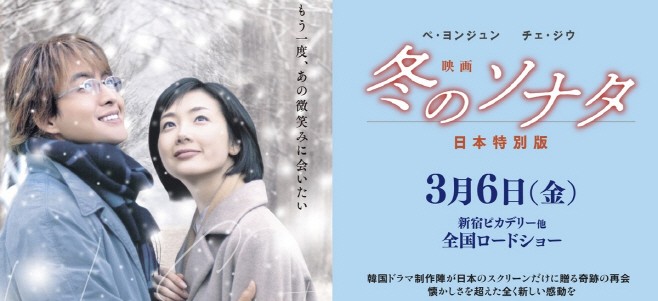 |
| A special Japanese theatrical edition of the hit drama Winter Sonata. Director Yoon Seok-ho and the original production crew re-edited the 1,400-minute television series, which aired on Japan's NHK 22 years ago, into a two-hour feature film that was re-released in theaters nationwide across Japan on March 6. / Photo courtesy of Yonhap News Agency |
From content consumption to matrimonial choice
Against this backdrop, the May 28 issue of the Japanese weekly magazine Shukan Shincho, published on May 21, highlighted the growing trend of Japanese women marrying Korean men—a phenomenon colloquially dubbed the "Hallyu husband" craze. The publication noted that the image Japanese women project onto Korean men includes a sophisticated appearance, an expressive and proactive attitude toward emotional communication, and a strong emphasis on self-care. Analysts observe, however, that these attributes represent a collective impression cultivated through Hallyu content rather than an objective generalization of all Korean men.
The significant takeaway is that this positive image is actively lowering the threshold for real-life interactions. While coverage directly framing the rise in marriages between Korean men and Japanese women as a mainstream socioeconomic shift remains limited across major Japanese dailies and broadcasters, local media have consistently reported on how Korean dramas, K-pop, cosmetics, cuisine, and tourism have integrated into the daily lifestyle of young Japanese women. In this sense, the Shukan Shincho report captures a pivotal moment where the accumulation of Hallyu consumption is spilling over into the private domains of romance and matrimonial choices.
This shift is further fueled by evolving perspectives on marriage among Japanese women. Amid prolonged economic stagnation and the widespread trend of delayed marriage or remaining single, an increasing number of women feel disconnected from the traditional marital model characterized by male breadwinners and female domestic care. Under these circumstances, some Japanese women view Korean men as an alternative path that diverges from conventional Japanese marital norms. While the initial Yonsama wave transformed Korean men into objects of romanticized admiration, the contemporary Korean Wave brings them into the realm of practical relationships and real-life choices.
Naturally, a media-driven image does not guarantee the success of marital reality. Cross-border couples still face inherent challenges typical of international marriages, including language barriers, differing family dynamics, child education, and matters of nationality or legal residency. Experts also caution against idealizing individuals based solely on their nationality. Nevertheless, the recent phenomenon of Korea-Japan international marriages signals that the influence of the Korean Wave has entered a new dimension. Hallyu has transcended the mere consumption of music and television dramas, actively shaping how people meet, marry, and form families. This demonstrates that even when political and diplomatic relations between Seoul and Tokyo fluctuate, grassroots human exchanges continue to deepen in an entirely different direction.
Most Read
-
1
Celltrion’s Omlyclo gains ground in major European..

-
2
Trump demands rates fall below 1% as Fed hikes for..

-
3
Hyundai Motor Group breaks ground on integrated st..

-
4
U.S. strikes 3 Iranian oil tankers, Iran vows reta..

-
5
Trump makes $1 trillion bet ahead of midterm elect..

-
6
Iran resumes ballistic missile production, assembl..

-
7
Samsung Electronics, Mistral AI to jointly develop..

PEOPLE






-
Address : In-Young Bldg., 34, Uisadang-daero 1-gil, Yeongdeungpo-gu, Seoul
Copyright by ASIATODAY CO., LTD. All rights resereved