



Worst 'Super El Nino' in 150 years threatens Korean Peninsula
May 21, 2026, 10:59 am


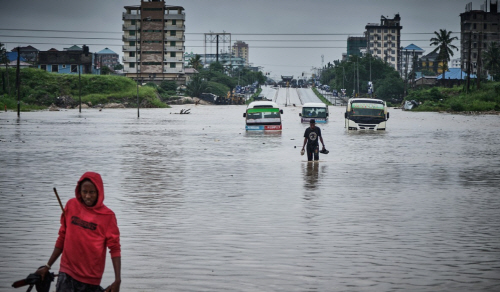 |
| Tanzania experiences extreme weather events driven by El Niño in 2024. / EPA-Yonhap News Agency |
Forecasts indicate that a "Super El Niño," potentially the most powerful in recorded history, could hit this summer. Concerns are mounting over rapid increases in sea surface temperatures, which are expected to trigger unprecedented extreme weather events—including intense heatwaves, torrential rains, and severe droughts—across the globe, including the Korean Peninsula. Depending on the pace of its development, this climate phenomenon could begin impacting South Korea as early as this summer.
The World Meteorological Organization (WMO) announced on April 24, "Climate models project that a 'strong El Niño' is likely to emerge around May to July this year." Concurring with this outlook on May 14, the US National Oceanic and Atmospheric Administration (NOAA) and the European Centre for Medium-Range Weather Forecasts (ECMWF) further noted, "There is a strong possibility that this El Niño will intensify into a 'strong' or 'very strong' stage by this winter."
El Niño refers to a phenomenon where sea surface temperatures in the equatorial Pacific rise significantly above long-term averages. It is officially recognized when the average sea surface temperature remains at least 0.5°C above the norm for five consecutive months, with the first month marking its onset. Typically occurring in cycles of two to seven years and lasting between 9 to 12 months, the phenomenon drives global climate anomalies. The resulting surge in ocean temperatures elevates average global temperatures and triggers extreme precipitation or droughts depending on the region. Following the 2023–2024 El Niño cycle, the world recorded its hottest year on history.
This year, observations suggest a plausible scenario for a Super El Niño, characterized by a three-month average sea surface temperature spike of 2.0°C or higher. During the most recent Super El Niño between 2015 and 2017, catastrophic weather plagued the globe, with India enduring an extreme heatwave that pushed temperatures to 48°C and Southeast Asia suffering from devastating downpours. Some meteorologists estimate that this upcoming cycle could see ocean temperatures surge by over 3°C, surpassing the historic 2.7°C increase recorded in 1877 to break a 150-year record.
Should this materialize, South Korea will not be immune to the fallout. With the nation's average summer temperatures already on a steady upward trajectory, expectations are growing for an unprecedented, extreme heatwave. Experts also warn of a sharp increase in summer torrential rains, underscoring the urgent need for preparedness.
"For the Korean Peninsula, a developing strong El Niño during the summer tends to bring a meaningful increase in precipitation, particularly across the southern regions, which demands preemptive measures for localized heavy rains and water resource management," said Jong-Seong Kug, a professor of Earth and Environmental Sciences at Seoul National University. "Furthermore, because global average temperatures spike sharply following an El Niño event, there is an exceptionally high probability that global warming will temporarily breach the 1.5°C threshold this year and next."
Conversely, some analysts argue that the phenomenon may have little to no impact on the Korean Peninsula this summer, or that this particular El Niño remains entirely decoupled from South Korea's immediate climate patterns.
"Discussions regarding El Niño's impact are only meteorologically sound when focused on the winter, which represents the peak of its cycle," pointed out Goo Ja-ho, a professor of Atmospheric Sciences at Yonsei University. "Attempting to characterize its direct effects on temperature and rainfall during its developmental phase between May and July is highly likely to diverge from actual outcomes."
Heo Chang-hoe, a professor of Climate and Energy Systems Engineering at Ewha Womans University, echoed a cautious view, stating, "The tropical central and eastern Pacific where El Niño develops is simply too far removed from the Korean Peninsula to establish a definitive correlation with South Korea's climate."
Most Read
-
1
Celltrion’s Omlyclo gains ground in major European..

-
2
Trump demands rates fall below 1% as Fed hikes for..

-
3
Hyundai Motor Group breaks ground on integrated st..

-
4
U.S. strikes 3 Iranian oil tankers, Iran vows reta..

-
5
Trump makes $1 trillion bet ahead of midterm elect..

-
6
Iran resumes ballistic missile production, assembl..

-
7
Samsung Electronics, Mistral AI to jointly develop..

PEOPLE







-
Address : In-Young Bldg., 34, Uisadang-daero 1-gil, Yeongdeungpo-gu, Seoul
Copyright by ASIATODAY CO., LTD. All rights resereved