



KFTC penalizes flour millers over price collusion
May 20, 2026, 04:13 pm


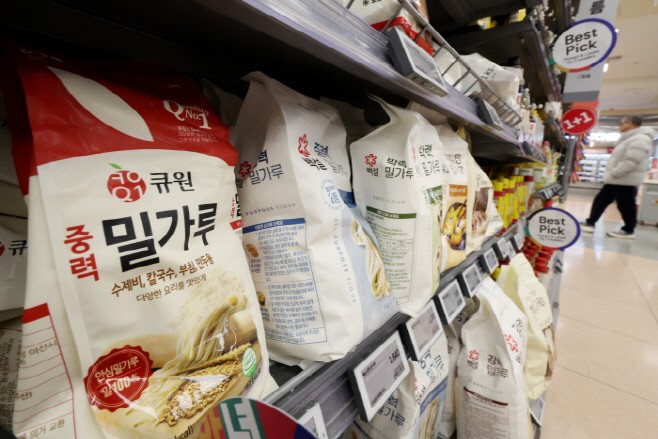 |
| Flour products are displayed on a shelf at a major supermarket in Seoul. / Yonhap |
The Fair Trade Commission (FTC) has issued an independent price-resetting order—the first in 20 years—and imposed a 6710 billion won fine on flour milling companies that engaged in price-fixing for nearly six years. These companies, which had already faced sanctions for past collusion, once again colluded on flour supply prices and volumes; the regulator intends to ease the financial burden passed on to households by handing down the largest fine ever levied in a collusion case.
According to the FTC on May 20, seven flour millers (Daehan Flour Mills, CJ CheilJedang, Sajo Dongawon, Samyang Corporation, Daesun Flour Mills, Samwha Flour Mills, and Hantop) colluded on flour supply prices and volumes for noodle and confectionery manufacturers from November 2019 to October 2025, a period marked by intensifying competition within the domestic industry.
As of 2024, these companies held an 87.7% share of the domestic business-to-business (B2B) flour market, leveraging this dominant position to agree on and execute price hikes and cuts, timing, supply volumes, and distribution priorities on 24 separate occasions. Executives and working-level officials held 55 meetings throughout this process.
The FTC also noted that the collusion extended to adjusting for price fluctuations in raw wheat, the primary ingredient for flour. The millers' price-fixing persisted even between June 2022 and February 2023, a window when the government was distributing price-stabilization subsidies to curb inflation.
"During the collusion period, the flour millers agreed on the scale and timing of price increases and cuts in response to shifting global wheat prices," explained Nam Dong-il, vice chairperson of the FTC. "They maximized their profits by passing cost increases onto selling prices as swiftly as possible, while delaying price reductions for as long as possible when raw material costs dropped."
Consequently, around September 2022, flour prices spiked by anywhere from 38% to 74% per miller compared to December 2019. The FTC estimates that the revenue tied to this flour collusion reached approximately 5.69 trillion won.
With the flour millers repeating the same collusive behavior seen in 2006, the FTC decided to hand down an independent price-resetting order. The 2006 case involved eight millers, which, excluding merged entities, comprise the exact same lineup as the current case. These companies must recalculate their prices within three months of receiving the FTC’s written decision and report the adjustments back to the commission.
"While the collusion officially ended last October, market competition may not have fully recovered yet," Vice Chairperson Nam added. "The price-resetting order was issued to help restore a healthy level of competition to the market."
Moving forward, the FTC plans to strengthen protections for items highly vulnerable to collusion. "Through this measure, we expect to re-establish fair competition in the flour market, claw back illicit gains from the participating businesses, and ease the financial burden on households," Nam said. "We will aggressively pursue institutional reforms for commodities prone to collusion, such as sugar and flour."
Most Read
-
1
Celltrion’s Omlyclo gains ground in major European..

-
2
Trump demands rates fall below 1% as Fed hikes for..

-
3
Trump makes $1 trillion bet ahead of midterm elect..

-
4
Iran resumes ballistic missile production, assembl..

-
5
Samsung Electronics, Mistral AI to jointly develop..

-
6
Trump warns countries not helping U.S. must pay re..

-
7
Apple launches first foldable, 1 million won prici..

PEOPLE






HEADLINE NEWS
- Trump to roll out ‘unprecedented welcome’ for Xi with B-2 bombers, F-22 fighters
- S. Korea, U.S., and Japan form united front on Taiwan and economic coercion..
- Trump administration moves to impose sweeping sanctions on International Cr..
- Xi to make state visit to U.S. Sept. 23-25, dispelling rumors over his heal..

-
Address : In-Young Bldg., 34, Uisadang-daero 1-gil, Yeongdeungpo-gu, Seoul
Copyright by ASIATODAY CO., LTD. All rights resereved