



Korean won stays above 1,500 as US yields and oil prices rise
May 19, 2026, 07:44 pm


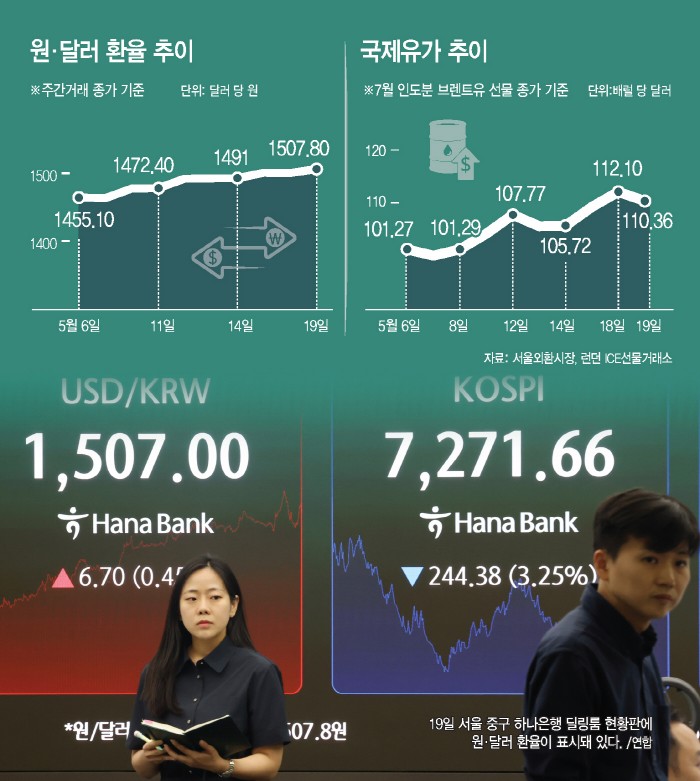 |
| A screen at a dealing room in Seoul shows the won-dollar exchange rate exceeding the 1,500-won level. /Yonhap |
The Korean won remained above the 1,500-per-dollar level for a third consecutive trading session, heightening concerns over mounting pressure on the Korean economy from soaring US Treasury yields and rising global oil prices.
According to financial market data on May 19, the won-dollar exchange rate closed daytime trading at 1,507.8 won, up 7.5 won from the previous session. After surging to 1,500.8 won on May 15, the exchange rate stayed above the 1,500-won threshold for three straight sessions, following 1,500.3 won the previous day. The latest closing level marked the highest since April 2, when the rate reached 1,519.7 won.
Market analysts said rising global bond yields, particularly in the United States, have intensified volatility in the foreign exchange market. Park Sang-hyun, an analyst at iM Securities, said instability in the UK and Japanese bond markets, combined with uncertainty surrounding monetary policy after Kevin Warsh’s congressional approval process as the next Federal Reserve chair nominee, fueled a sharp rise in Treasury yields and strengthened the dollar significantly.
He added that the possibility of intervention by Korean foreign exchange authorities could increase as the exchange rate remains above the 1,500-won level.
US Treasury yields have been a key driver behind the recent spike in the exchange rate. On May 18, the yield on the benchmark 10-year US Treasury note rose above 4.62%, the highest level since February last year. The 30-year Treasury yield also climbed near 5.15%, reaching its highest point since July 2007.
Geopolitical tensions in the Middle East and the resulting surge in international oil prices also added downward pressure on the Korean won. As of 3:30 p.m., Brent crude traded at $110.36 per barrel, while West Texas Intermediate (WTI) stood at $103.56. Although both prices eased slightly from the previous session, they remained nearly $10 higher than levels seen earlier this month.
Analysts noted that rising oil prices tend to push investors toward safe-haven assets such as the US dollar, while weakening emerging-market currencies including the won.
Foreign investors’ heavy selling in the Korean stock market further pressured the local currency. Between May 11 and May 18, foreign investors sold a net 23.2 trillion won worth of Korean stocks, averaging 3.3 trillion won per day.
Moon Da-woon, an analyst at Korea Investment & Securities, said foreign investors’ stock sales were the biggest factor behind the recent rise in the exchange rate. He explained that profit-taking and portfolio rebalancing accelerated after strong gains in Korean equities earlier this year.
Economists warned that the simultaneous rise in oil prices and the exchange rate could weigh heavily on Korea’s economy, which relies heavily on imports of crude oil, gas and raw materials. A weaker won raises import prices, potentially increasing production costs for businesses and consumer inflation.
They also cautioned that higher living costs could delay a recovery in domestic consumption, particularly as employment weakness persists in sectors such as retail, lodging and restaurants.
Park Jin, a professor at the Korea Development Institute (KDI) School of Public Policy and Management, said the won-dollar exchange rate could continue to rise gradually over the long term depending on oil prices and geopolitical developments.
He stressed that improving Korea’s investment attractiveness would be essential to reversing capital outflows.
“To attract foreign capital and reduce overseas outflows of domestic funds, Korea ultimately needs to strengthen its economic competitiveness,” Park said. “Deregulation and labor market reform are necessary to improve the business environment and make Korea a more attractive place for investment and residence.”
#Korean won #won-dollar exchange rate #US Treasury yields #oil prices #Middle East risks
Copyright by Asiatoday
Most Read
-
1
Celltrion’s Omlyclo gains ground in major European..

-
2
Trump demands rates fall below 1% as Fed hikes for..

-
3
Trump makes $1 trillion bet ahead of midterm elect..

-
4
Iran resumes ballistic missile production, assembl..

-
5
Samsung Electronics, Mistral AI to jointly develop..

-
6
Trump warns countries not helping U.S. must pay re..

-
7
Apple launches first foldable, 1 million won prici..

PEOPLE






HEADLINE NEWS
- Trump to roll out ‘unprecedented welcome’ for Xi with B-2 bombers, F-22 fighters
- S. Korea, U.S., and Japan form united front on Taiwan and economic coercion..
- Trump administration moves to impose sweeping sanctions on International Cr..
- Xi to make state visit to U.S. Sept. 23-25, dispelling rumors over his heal..

-
Address : In-Young Bldg., 34, Uisadang-daero 1-gil, Yeongdeungpo-gu, Seoul
Copyright by ASIATODAY CO., LTD. All rights resereved