



Japan eyes S. Korean petroleum products as safety valve, weighs emergency jet fuel supply
May 19, 2026, 10:48 am


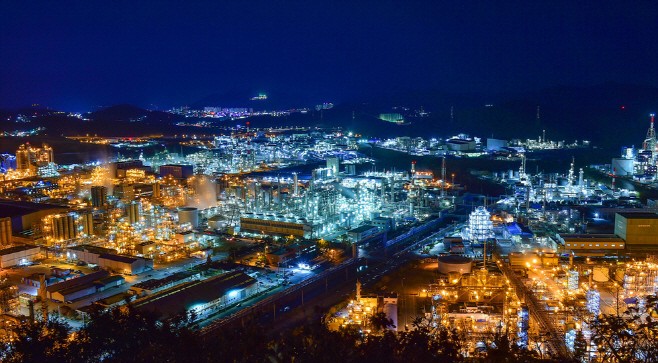 |
| The petrochemical industrial complex in Yeosu, South Korea. Amid prolonged supply instability of crude oil, naphtha, and petroleum products due to deteriorating conditions in the Middle East, Japan increasingly views South Korea's refining and petrochemical capabilities as a "safety valve" for its own supply chain. / Photo captured from the Yeosu City Hall website |
The Japanese government is seeking to push forward energy security cooperation with South Korea on the occasion of the bilateral summit held in Andong, South Korea, on May 19. Amid prolonged supply instability of crude oil, naphtha, and petroleum products due to deteriorating conditions in the Middle East, Japan increasingly views South Korea's refining and petrochemical capabilities as a "safety valve" for its own supply chain. The Yomiuri Shimbun reported on the same day that the two governments have entered final adjustments to release a joint document on energy security cooperation alongside the summit.
The core of the initiative is the mutual supply of petroleum products during emergencies. The draft joint document reportedly includes plans to launch a public-private dialogue to review cooperation in mutually swapping crude oil and petroleum products between South Korea and Japan. Jet fuel and other products are being considered as the primary petroleum products to be supplied during a supply crisis. Cooperation in crude oil procurement and transportation, as well as the restraint of export restrictions on petroleum products, are also on the agenda.
Japan's emphasis on this matter is clear. While Japan relies heavily on the Middle East for most of its crude oil, it has faced difficulties securing alternative procurement sources and transport stability since the escalation of Middle East tensions. Conversely, South Korea maintains robust competitiveness in the refining and petrochemical sectors and is already linked to the supply chain of certain petroleum products that Japan requires. According to the Yomiuri, South Korea supplies approximately 10% of its exported fuel oil to Japan. A Japanese government official remarked, "It is crucial not to impose unnecessary export restrictions even under a crisis."
◇ Energy supply chain emerges as new pillar of Korea-Japan cooperation
From the Japanese perspective, this summit serves less as a mere display of goodwill and more as a supply chain insurance policy against a prolonged energy crisis. Japan has recently attempted to diversify its procurement sources with U.S. crude, Russian Sakhalin crude, and Azerbaijani crude. However, merely importing crude oil is insufficient. A stable supply of jet fuel and various petroleum products immediately required by aviation, logistics, and industrial sites remains vital. This explains why Japan is focusing on "product-level swaps" with South Korea.
Cooperation on LNG is also included. Japan ranks as the world's second-largest importer of liquefied natural gas, while South Korea ranks third; utilizing their purchasing power and storage and transport infrastructure leaves room for joint responses during crises. The draft joint document reportedly includes measures to enhance supply chain resilience and strengthen LNG mutual swap cooperation. It also covers reviewing potential cooperation between the two nations on "Power Asia," a financial support initiative led by Japan for energy procurement in Southeast Asia.
To institutionalize these efforts, the two nations are pushing to establish a new "Industrial and Trade Policy Dialogue." This framework will involve high-ranking officials from Japan's Ministry of Economy, Trade and Industry and South Korea's Ministry of Trade, Industry and Energy to discuss petroleum product swaps, the restraint of export restrictions, crude oil procurement, and LNG cooperation. Even if an agreement is reached at the summit, participation from private enterprises—such as refiners, trading companies, and logistics firms—is essential for it to function effectively during an actual crisis.
The move holds significant meaning for South Korea as well. Japan's approach signifies that it views South Korea not merely as a diplomatic counterpart, but as an energy supply chain partner capable of weathering Middle East risks together. However, the issue of supplying petroleum products to Japan during a crisis is directly tied to domestic supply and demand, price stability, and export restriction decisions. The South Korean government must verify specific conditions to ensure that while securing the practical benefits of Korea-Japan cooperation, it does not translate into a burden for domestic consumers and industries.
What Japan anticipates from this Korea-Japan summit is less a symbol of improved relations and more a working-level mechanism for crisis response. With supply anxieties stemming from the Middle East expanding to trash bags, packaging materials, naphtha, and jet fuel, Japan views South Korea's refining capacity and petroleum product supply chain as a realistic alternative. This is why energy security is emerging as a new pillar of cooperation between South Korea and Japan.
Most Read
-
1
Celltrion’s Omlyclo gains ground in major European..

-
2
Trump demands rates fall below 1% as Fed hikes for..

-
3
Trump makes $1 trillion bet ahead of midterm elect..

-
4
Iran resumes ballistic missile production, assembl..

-
5
Samsung Electronics, Mistral AI to jointly develop..

-
6
Trump warns countries not helping U.S. must pay re..

-
7
Apple launches first foldable, 1 million won prici..

PEOPLE






HEADLINE NEWS
- Trump to roll out ‘unprecedented welcome’ for Xi with B-2 bombers, F-22 fighters
- S. Korea, U.S., and Japan form united front on Taiwan and economic coercion..
- Trump administration moves to impose sweeping sanctions on International Cr..
- Xi to make state visit to U.S. Sept. 23-25, dispelling rumors over his heal..

-
Address : In-Young Bldg., 34, Uisadang-daero 1-gil, Yeongdeungpo-gu, Seoul
Copyright by ASIATODAY CO., LTD. All rights resereved